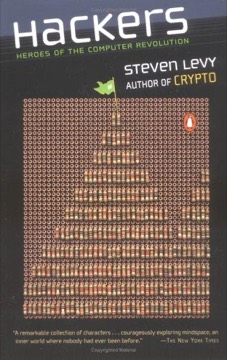
Hackers
Heroes of the Computer Revolution
Steven Levy's history of the programmers who defined computing culture — from the MIT model railroad club through the homebrew hardware scene to the early games industry — and of the ethic they developed and then lost.
- First published
- 1984
- Publisher
- Anchor Press/Doubleday
- Pages
- 456
- Shelf
- Technology
- Level
- Entry
- ISBN-13
- 9780613922081
Record checked against
Two sources agreed on 1984; a third reported differently (openlibrary 1984, wikidata 1996, wikipedia 1984).
Catalogue note
- Reads as
- TechnicalAssumes and builds craft knowledge.
- Level
- Accessible / FoundationalNo prior reading assumed.
- Approach
- Applied
- Written for
- Engineers, Newcomers to the subject
Saved in this browser only — no account, nothing sent anywhere. My library
Read this if
- You build software and want the ideas under the tools.
- You want to know how we got here.
- You want to understand what makes people willing to follow a decision.
- You work in this area and want depth rather than an overview.
- You are starting from scratch here and want a way in that assumes no prior reading.
The three generations
Levy structures the book as three waves. The MIT artificial intelligence lab hackers of the late fifties and sixties. The hardware hackers of the Bay Area in the seventies, including the Homebrew Computer Club. The game hackers of the early eighties.
The structure carries the argument: each generation inherited the ethic and encountered a version of the same conflict with commerce, and each resolved it differently.
Three generations, one recurring conflict: an ethic built on sharing meeting a business built on ownership.
Devmark’s reading — not a quotation from the book
The Hacker Ethic
Levy's articulation of the shared principles: access to computers should be unlimited, all information should be free, authority should be mistrusted, hackers should be judged by their hacking rather than by credentials, you can create art and beauty on a computer, and computers can change your life for the better.
This formulation was itself influential — it named something that had been practised rather than stated, and the naming shaped what followed.
The MIT generation
His account of the Tech Model Railroad Club and the AI lab establishes the culture: obsessive, nocturnal, indifferent to credentials and to locked doors, and organised around the machine rather than around a curriculum.
His treatment of the norm against locks — that a locked cabinet containing something needed was an obstacle to be removed rather than respected — is the clearest illustration of an ethic that was coherent internally and unintelligible from outside.
The hardware generation
The Bay Area chapters cover the Homebrew Computer Club, the Altair, and the moment when personal computers became buildable by individuals.
The most consequential episode is Bill Gates's open letter accusing hobbyists of theft for copying software — the point at which the free- information ethic met a business model that required the opposite, stated publicly for the first time.
The game generation
His final section covers the early games industry, where hackers became employees and their work became product.
This is where the ethic dissolves. Trade secrets, copy protection, marketing departments and the transformation of a craft into an industry all arrive at once, and Levy's account of individual programmers navigating that is the most melancholy part of the book.
The ethic does not get defeated in an argument. It dissolves into employment contracts and copy protection.
Devmark’s reading — not a quotation from the book
Where the account is partial
The book is overwhelmingly about young American men at a small number of institutions, and Levy's framing treats that population as the whole history.
Women in computing, work happening outside the United States, and the commercial and institutional computing that employed vastly more people are almost absent. This is a real limitation, not merely a period artefact.
The romanticism
Levy is sympathetic to his subjects and the book is a celebration as much as a history. Behaviour that was obsessive, socially destructive or straightforwardly contemptuous of others is frequently presented as admirable eccentricity.
A contemporary reader should notice that the culture being celebrated also established exclusions that the field has spent decades trying to undo.
Its influence
The book did not merely describe a culture; it supplied the culture with its self-image. The Hacker Ethic as Levy formulated it became something people consciously adopted, and it runs directly into the free software movement, open source, and a good deal of subsequent technology self-mythology.
Understanding the industry's current beliefs about itself substantially requires this book.
How it reads
Very well. Levy is a strong narrative journalist and the book moves quickly, with an eye for the specific detail that makes a person memorable.
The twenty-fifth anniversary edition adds afterword material and interviews that connect the original account to what followed, which is worth having.
What to take from it
The recurring conflict is the durable content: an ethic organised around sharing information repeatedly meeting an industry organised around owning it, with the same arguments recurring in each generation.
That conflict has not been resolved. It is still being had, in open source, in model weights, and in the argument about what training data is.
What to take away
- 01Levy named something already practisedThe Hacker Ethic was a formulation of existing behaviour, and the formulation then shaped what came next.
- 02The same conflict recurs each generationAn ethic built on sharing information meeting a business built on owning it, argued again each time.
- 03It dissolves rather than losesEmployment contracts, trade secrets and copy protection displaced the ethic without ever defeating it.
- 04The account is narrowYoung American men at a few institutions, treated as the whole history, with large absences.
- 05The book supplied a self-imageIt did not only describe the culture; the industry adopted Levy's version of itself.