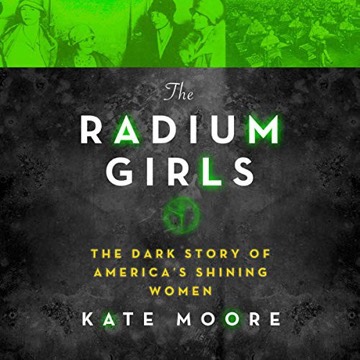
The Radium Girls
Kate Moore's history of the young women who painted watch dials with radium in the 1910s and 1920s, were told it was harmless, and whose lawsuits established that employers are liable for occupational disease.
- First published
- 2016
- Publisher
- Simon & Schuster Ltd
- Pages
- 480
- Shelf
- History
- Level
- Entry
- ISBN-13
- 9781471153877
Record checked against
Catalogue note
- Reads as
- ReflectiveChanges how you see rather than what you do.
- Level
- Accessible / FoundationalNo prior reading assumed.
- Approach
- Theoretical
- Written for
- Readers of history, Newcomers to the subject
Saved in this browser only — no account, nothing sent anywhere. My library
Read this if
- You want to know how we got here.
- You want to think harder about what is actually right.
- You want to think about how gender shapes a life, including your own.
- You want a book that changes how you see things rather than what you do tomorrow.
- You are starting from scratch here and want a way in that assumes no prior reading.
What happened
Dial-painting studios in New Jersey, Connecticut and Illinois employed young women to hand-paint luminous numbers, instructing them to point the brush with their lips. Radium was marketed as a health product, and the work was well paid and desirable.
Within years the women developed necrosis of the jaw, anaemia, sarcomas and fractures. The companies denied the connection, ran their own compromised studies, and blamed syphilis.
They were instructed to put the brushes in their mouths, and told the paint was good for them.
Devmark’s reading — not a quotation from the book
The legal consequence
The lawsuits, pursued by women who were dying and often visibly so, ran against companies with far greater resources and a statute of limitations designed for injuries rather than latent disease.
Their eventual success established employer liability for occupational illness in the United States and fed directly into later workplace safety law, including the standards that protected Manhattan Project workers.
The safety standards that protected atomic workers exist because dying dial-painters sued first.
Devmark’s reading — not a quotation from the book
How it is told
Moore names the women and follows them individually rather than treating them as a category, drawing on court records, medical files and family papers.
The medical detail is unsparing, and deliberately so: the book's argument depends on the reader understanding exactly what was being denied.
What to know
It is distressing in specific, physical ways and does not soften the material.
It is also a case study in how corporate denial operates — funded research, delay, personal attacks on claimants — that reads as entirely contemporary.
Moore also wrote it after directing a play about the women, and that origin shows in the structure: the book is organised around individual voices in a way most industrial histories are not.
Lip-pointing
The technique at the centre of the case was lip, dip, paint: the workers shaped their brushes with their mouths between strokes, ingesting small quantities of radium hundreds of times a day. They were told the paint was harmless, some used it on their nails and teeth for fun, and the studio foremen who had been warned did not pass the warning on.
What it did
The clinical material is specific and hard to read: bone deterioration beginning in the jaw, teeth that came out with pieces of bone attached, spontaneous fractures, sarcomas, and anaemia. Because radium behaves chemically like calcium the body files it in the skeleton, where it continues irradiating from inside for the rest of a life.
The two-year rule
The legal obstacle was not proving harm but time. Occupational illness claims had to be filed within a short window of exposure, and radium poisoning took years to become visible — so by the time a woman could demonstrate she was dying, her right to sue had expired. Much of the litigation was an attempt to break that specific trap.
By the time the disease was visible, the deadline for claiming had already passed.
Devmark’s reading — not a quotation from the book
The company's doctors
The employers commissioned medical examinations, reassured the workers, and withheld or reframed findings; diagnoses were attributed to syphilis in ways that damaged the women socially as well as medically. Moore documents this as deliberate rather than negligent, which is what turns the book from a tragedy into an indictment.
The second case
The Illinois litigation, pursued years after the New Jersey cases, is where the book's argument about corporate knowledge lands hardest. The same lip-pointing practice continued at a second company long after the dangers had been established and publicised, with the women employed there receiving the same reassurances that had already been demonstrated to be false in another state. It is the sequence that makes the word negligence inadequate.
What it changed
The cases contributed to the reform of occupational disease law and industrial safety standards, and the survivors were studied for decades afterwards — the data from their bodies informing the radiation exposure limits later used across nuclear industries and medicine. It is a bleak form of legacy and the book states it plainly.
What to take from it
Moore names the women and follows them individually, which is the book's method and its ethics: the harm is not aggregated into a statistic. It is distressing in physical detail and does not soften it. Read it as a case study in how long an institution can deny what it already knows, and what it costs the people waiting.
What to take away
- 01Lip-pointingThe instructed technique that delivered the dose.
- 02Radium as a health productMarketed as beneficial, which is why the work was sought after.
- 03Denial machineryCompany-funded studies, delay, and attacks on claimants' character.
- 04Liability establishedThe cases created employer responsibility for latent occupational disease.
- 05Named individualsFollowed personally rather than as a category.