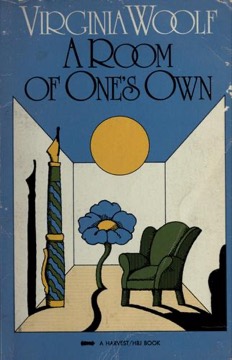
A Room of One's Own
Virginia Woolf's 1929 essay, developed from lectures at two women's colleges, arguing that a woman needs money and a room with a lock if she is to write fiction. The founding text of feminist literary criticism.
- First published
- 1929
- Publisher
- Gyldendal
- Pages
- 143
- Shelf
- History
- Level
- Core
- ISBN-13
- 9798780440239
Record checked against
Catalogue note
- Reads as
- ReflectiveChanges how you see rather than what you do.
- Level
- Core / BuildingAssumes general familiarity with the subject.
- Approach
- Theoretical
- Written for
- Readers of history, Readers with some grounding
Saved in this browser only — no account, nothing sent anywhere. My library
Read this if
- You make things, and want to understand the work rather than wait for inspiration.
- You want to think about how gender shapes a life, including your own.
- You want a book that changes how you see things rather than what you do tomorrow.
- You know roughly how the subject works and want the fuller account.
The argument
Woolf's thesis is deliberately material rather than spiritual: five hundred a year and a room of one's own. Genius, she argues, is not what has been missing; the conditions for exercising it have been.
She demonstrates rather than asserts. A narrator is turned away from a library, fed badly at the women's college and well at the men's, and follows the money backwards to explain the difference.
Money and a lockable door, stated as the precondition rather than as a metaphor.
Devmark’s reading — not a quotation from the book
Judith Shakespeare
The essay's most famous move is an invention: Shakespeare's equally gifted sister Judith, who has no schooling, is betrothed young, runs away to the theatre, is laughed at, and dies unknown.
It is a thought experiment designed to show that the absence of women from literary history is evidence about opportunity rather than about ability — an argument constructed in 1929 that historians have since substantiated.
Its limits
Woolf writes from inside a class that could contemplate five hundred a year, and the essay's assumptions about who its reader is are narrow. Later critics — Alice Walker's "In Search of Our Mothers' Gardens" is the best-known response — pointed out that Black women's creativity had been constrained by conditions Woolf does not consider.
Reading the essay alongside that response is the fuller version of it.
Two meals
The essay's argument is made most effectively through food. A luncheon at a men's college, with wine and sauces and an atmosphere in which good talk happens easily, is set against dinner at a women's college: plain soup, beef, prunes and custard. Woolf's point is not comfort but consequence — the second meal produces a different quality of thought, and the endowment behind the first is the reason.
One college had wine and partridge. The other had prunes. She is arguing that this shows up in the prose.
Devmark’s reading — not a quotation from the book
The British Museum
Sent to research women and fiction, the narrator finds shelves of books about women written almost entirely by men — on their physiology, morality, souls and inferiority — and almost nothing by women about themselves. The comic scene carries a serious observation: the archive itself was produced by the people with the leisure and the access to produce it.
Anger in the prose
One of Woolf's sharpest and most contested passages argues that writing deformed by grievance is weakened by it — that you can see, in a sentence, where an author stopped attending to the work and started answering an insult. She applies this to specific nineteenth-century novelists, and the judgement has been argued with ever since by readers who think the anger was earned and the criticism unfair.
Chloe liked Olivia
Reading an invented contemporary novel, the narrator is struck by a sentence describing two women who share a laboratory and a friendship. Her point is that literature had almost always shown women in relation to men, so an entire range of ordinary human material — women's work, rivalry and affection for each other — was simply missing from the record.
The androgynous mind
The essay closes on the claim that the best writing comes from a mind that is not consciously arguing its own sex — neither man-womanly nor woman-manly in a programmatic way, but unimpeded by the need to represent. Later feminist critics have read this as an evasion arriving exactly when the argument became uncomfortable, and that objection is worth carrying into the last chapter.
The narrator is a device
Woolf explicitly tells the reader that the "I" is a convenience and that the name attached to it does not matter. The move lets her demonstrate rather than assert: the reader follows a woman being turned off a lawn and refused a library, and the material argument arrives as experience rather than as statistics.
What to take from it
It is short, funny, and structurally stranger than its reputation suggests — closer to a performance than an essay. The durable claim is the material one: that creative work requires money, time and privacy, that these were systematically unavailable, and that the resulting absence in the record was then used as evidence of incapacity.
What to take away
- 01Material conditionsMoney and privacy, not inspiration, are the essay's subject.
- 02Judith ShakespeareAn invented sister used to show that absence is evidence about opportunity.
- 03Demonstrated, not assertedWoolf dramatises the argument through a narrator being turned away.
- 04Androgyny of mindHer closing claim that the best writing is not consciously gendered remains contested.
- 05Class blind spotsAlice Walker's response supplies what Woolf's vantage could not see.