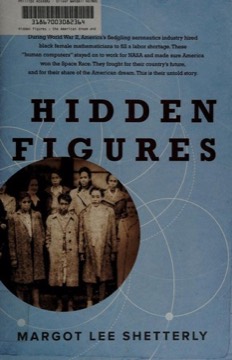
Hidden Figures
Margot Lee Shetterly's history of the Black women mathematicians who worked as human computers at NACA and NASA from the 1940s, and whose calculations underpinned American aeronautics and spaceflight.
- First published
- 2016
- Publisher
- HarperCollins Publishers Limited
- Pages
- 314
- Shelf
- History
- Level
- Entry
- ISBN-13
- 9781432843274
Record checked against
Catalogue note
- Reads as
- ReflectiveChanges how you see rather than what you do.
- Level
- Accessible / FoundationalNo prior reading assumed.
- Approach
- Theoretical
- Written for
- Readers of history, Newcomers to the subject
Saved in this browser only — no account, nothing sent anywhere. My library
Read this if
- You want to know how we got here.
- You want to know how we know things, and how that goes wrong.
- You want to think about how gender shapes a life, including your own.
- You want a book that changes how you see things rather than what you do tomorrow.
- You are starting from scratch here and want a way in that assumes no prior reading.
What it recovers
Langley Memorial Aeronautical Laboratory in Virginia hired women as "computers" to do calculation by hand. Wartime labour shortages opened the work to Black women, who were segregated into a West Area Computing unit.
Shetterly follows several — among them Dorothy Vaughan, Mary Jackson and Katherine Johnson — across decades in which the work went from wind tunnels to orbital trajectories, and segregation was slowly and incompletely dismantled around them.
They were called computers because that was the job title before it was a machine.
Devmark’s reading — not a quotation from the book
How it is told
Shetterly grew up in Hampton, where her father was a NASA scientist, and the book is built on archival research plus interviews with women who were still alive.
It is a workplace history as much as a civil rights one: promotion procedures, segregated dining rooms, which engineer put whose name on a report, and the specific route by which a computer became an engineer.
Most of the discrimination in the book is procedural, and so is most of the progress against it.
Devmark’s reading — not a quotation from the book
What to know
The 2016 film compressed timelines and invented scenes, including the most famous one. The book is the more accurate account and is more interesting for being less tidy.
It is also careful that these women were not anomalies but a workforce — which is the historical point the title makes.
How the computing pools worked
Before electronic computers, the calculation was done by people — mostly women — organised into pools and handed sheets of data to process by hand. Shetterly's recovery is of a specific segregated unit within that system, whose members did the mathematics that engineering decisions rested on while working in a separate building with separate facilities.
Why the jobs opened
The opening was wartime and administrative rather than moral: a severe labour shortage in aeronautical research, combined with a federal order prohibiting discrimination in defence industries, created positions that would otherwise not have existed. Shetterly is clear-eyed that the door opened because the work needed doing.
From computer to programmer
One of the book's most pointed arcs follows a supervisor who recognised that the electronic machines arriving would eliminate her unit, taught herself the programming language they used, and taught it to her staff — converting a group about to be made redundant into the people who ran the replacement. It is the clearest case of the technical judgement the book is recovering.
She saw the machines coming, learned to program them, and taught her whole section before they arrived.
Devmark’s reading — not a quotation from the book
The court order
To qualify as an engineer, one of the women needed classes held at a segregated white high school and had to petition a court for permission to attend. The detail captures the book's recurring point: the obstacles were administrative and specific rather than atmospheric, and overcoming them required individual legal effort on top of the work itself.
The astronaut's request
The moment most readers arrive for is real: before an orbital flight, the astronaut asked that the electronic computer's trajectory figures be verified by hand by a particular mathematician, and declined to fly until she had confirmed them. Shetterly places it carefully within a long career rather than treating it as the point of the story.
What the film changed
The 2016 adaptation compressed decades into months, merged characters, and invented its most memorable scene — a supervisor destroying a segregated bathroom sign — which did not happen. One of the women has said she simply used the nearest facilities. The film is a good film and a poor citation.
What to take from it
It is institutional history rather than biography, and the density of aeronautical and organisational detail is the point: these women were not adjacent to the technical work, they were doing it. Read it for the mechanics of how a segregated workplace actually functioned day to day, which no dramatisation has managed to convey.
What to take away
- 01Computer as a job titleHuman calculation was skilled labour before the machines took the name.
- 02A workforce, not exceptionsThe book insists these were many women, not a few prodigies.
- 03Procedural barriersSegregation operated through promotion rules and dining rooms.
- 04Archive plus interviewShetterly grew up in Hampton and spoke to surviving participants.
- 05Better than the filmThe 2016 adaptation invented its most quoted scene; the book is less tidy and more accurate.