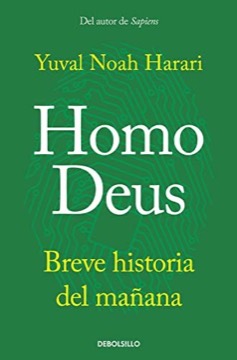
Homo Deus
Yuval Noah Harari's sequel to Sapiens — an argument that having largely contained famine, plague and war, humanity will turn to the pursuit of immortality, happiness and divinity, and may dismantle the humanist framework in the process.
- First published
- 2015
- Publisher
- Harvill Secker
- Pages
- 496
- Shelf
- History
- Level
- Core
- ISBN-13
- 9788466362689
Record checked against
Two sources agreed on 2015; a third reported differently (openlibrary 2022, wikidata 2015, wikipedia 2015).
Catalogue note
- Reads as
- ReflectiveChanges how you see rather than what you do.
- Level
- Core / BuildingAssumes general familiarity with the subject.
- Approach
- Theoretical
- Written for
- Readers of history, Readers with some grounding
Saved in this browser only — no account, nothing sent anywhere. My library
Read this if
- You want to think seriously about what these systems can and cannot do.
- You want to know how we got here.
- You want to understand what technology is doing to how we live.
- You want a book that changes how you see things rather than what you do tomorrow.
- You know roughly how the subject works and want the fuller account.
The opening premise
Harari begins with the claim that the three problems that dominated human history — famine, epidemic and war — have been reduced to manageable proportions, and that this is genuinely new.
The claim is heavily qualified in the text and heavily criticised outside it. It was also written before a global pandemic and before several major wars, and a reader should treat the opening as the weakest part of the argument rather than as its foundation.
The opening claim about contained plague and war has aged worst, and the argument does not actually need it.
Devmark’s reading — not a quotation from the book
The new agenda
His proposed next projects: engineered longevity, biochemically managed happiness, and the upgrading of human capacities to a degree he calls divine.
His argument is that these are the natural continuation of the same project, and that they will be pursued by markets and individuals regardless of whether anyone decides they should be.
Humanism as a religion
His central analytical move, and the book's most useful section. He treats liberal humanism as a belief system with doctrines: that the individual has an inner authentic self, that its feelings are the source of meaning and authority, and that free choice is therefore the highest value.
His point is that voting, free markets, romantic love and consumer choice all rest on this framework, and that it is a historically specific construction rather than an obvious truth.
The attack on free will
His argument that the sciences have not found the unified self that humanism assumes: the brain is a set of competing processes, decisions can be predicted before conscious awareness, and the narrating self constructs a story after the fact.
His use of split-brain research and of the experiencing-versus-remembering distinction is the strongest evidence he marshals, though he presents the conclusions more confidently than the literature supports.
Dataism
His term for the emerging worldview he thinks may replace humanism: that the universe consists of data flows, that value lies in contribution to information processing, and that algorithms may know individuals better than they know themselves.
His argument is that once systems make better decisions than people about health, partners and careers, the humanist grounding of authority in individual feeling collapses — not through any defeat but through obsolescence.
Humanism does not lose an argument in his account. It becomes obsolete when the algorithms decide better.
Devmark’s reading — not a quotation from the book
The useless class
His most alarming projection: that automation may produce not unemployment in the usual sense but a large population with no economic function, which is a different and harder political problem.
He is careful to present this as a possibility rather than a forecast, and the economics is the least developed part of the book.
The treatment of animals
His extended and unexpected section arguing that the human relationship to domesticated animals is the best available model for how a superior intelligence might treat humans.
It is the book's most morally serious material and the part least remarked upon. His account of industrial animal agriculture is uncompromising and is presented as evidence about what we do when we hold total power.
The method and its critics
Harari writes with confidence across biology, history, economics, psychology and computer science, and specialists in each have objected to the compression and to specific errors.
The more general charge is that the sweeping style produces claims that sound like findings and are actually speculation, and that the book's structure does not distinguish between them.
What it is actually doing
He states in the closing pages that the predictions are intended as possibilities to be avoided or chosen rather than forecasts, and that the purpose is to widen the range of what readers consider.
Read that way — as a provocation about where current trends point rather than a claim about where they lead — it is considerably more defensible than its most-quoted passages suggest.
Reading it after Sapiens
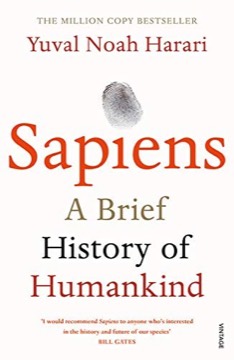
*Sapiens* is the stronger book because it is about the past and can be checked. This one is about the future and cannot.
Its durable contribution is the analysis of humanism as a contingent belief system, which is history rather than prophecy and stands independently of whether any of the predictions arrive.
What to take away
- 01Humanism is a belief systemThe inner authentic self as the source of authority is a specific historical construction, not an obvious truth.
- 02Obsolescence, not defeatIf algorithms decide better, the humanist grounding of authority collapses without losing an argument.
- 03Our animals are the modelHis most serious material: what we do with total power over other minds is already documented.
- 04A useless class is not unemploymentA population with no economic function is a different and harder political problem than joblessness.
- 05Read it as provocationHe says the predictions are possibilities to widen the range considered, not forecasts to be scored.