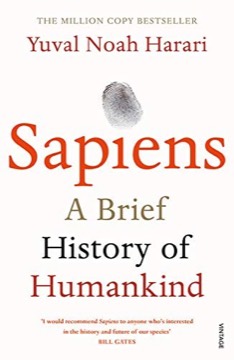
Sapiens
Yuval Noah Harari's account of how one unremarkable species of ape came to dominate the planet, organised around a single claim: that Homo sapiens' decisive advantage was the ability to cooperate flexibly in very large numbers by believing in things that do not physically exist.
- First published
- 2011
- Publisher
- Dvir Publishing House Ltd. (Israel)Random HouseHarper
- Pages
- 456
- Shelf
- History
- Level
- Core
- ISBN-13
- 9781494556907
Record checked against
Catalogue note
- Reads as
- ReflectiveChanges how you see rather than what you do.
- Level
- Core / BuildingAssumes general familiarity with the subject.
- Approach
- Theoretical
- Written for
- Readers of history, Readers with some grounding
- Ideas
Saved in this browser only — no account, nothing sent anywhere. My library
Read this if
- You want to know how we got here.
- You want a book that changes how you see things rather than what you do tomorrow.
- You know roughly how the subject works and want the fuller account.
The core claim
Harari's argument is that what separates sapiens from other human species is not intelligence, strength or tool use but the capacity for shared fiction. Money, nations, laws, corporations and human rights have no existence outside collective belief, and it is precisely that which lets millions of strangers coordinate.
Everything in the book descends from this. History becomes the study of which imagined orders took hold, how they were maintained, and what they cost.
Large-scale cooperation runs on things that exist only because enough people agree they do.
Devmark’s reading — not a quotation from the book
The Cognitive Revolution
Harari dates the decisive change to roughly 70,000 years ago, when sapiens language appears to have acquired the ability to discuss things that are not present and not real. Bands could now scale past the limits that constrain other primates.
He is careful that the cause of this change is unknown, and the honesty is worth noting, because the book is less careful elsewhere. What the evidence supports is the timing and the consequences, not the mechanism.
The Agricultural Revolution as a trap
The book's most provocative chapter argues that agriculture was, from the point of view of the individual human, a bad deal: longer hours, a narrower diet, more disease, more inequality and more vulnerability to famine than foraging.
His formulation is that wheat domesticated us. The claim is that a practice can spread because it maximises the number of people alive while making each of their lives worse — an argument about what evolutionary success actually measures.
Imagined orders
Harari's treatment of hierarchy is the book's sharpest analytical section. An imagined order is not a lie, because its believers are sincere; it is stable because it is embedded in the material world, shapes desires, and is inter-subjective — it cannot be dissolved by any individual ceasing to believe.
He applies this to caste, race and gender with a consistent method: whenever a hierarchy is justified as natural, ask whether the justification predates or postdates the arrangement.
The three unifiers
Money, empire and religion are treated as the forces that pulled scattered cultures toward a single global one. Money is presented as the most successful system of mutual trust ever devised, precisely because it requires no shared values — only shared confidence.
Empire is handled without sentiment in either direction: brutal, and also the mechanism by which most cultural inheritance was transmitted. Harari resists both the apologia and the simple condemnation, which is part of why the chapter irritates readers on both sides.
The Scientific Revolution and the admission of ignorance
Harari's account of modern science turns on a change in attitude rather than method: the willingness to say that important things are not yet known. Earlier traditions of knowledge treated the important questions as already answered.
He then links science to empire and capitalism as a mutually reinforcing system — exploration funded by investment justified by profit enabled by knowledge — which is the book's most useful structural argument.
Modern science began with an admission: that the most important questions had not yet been answered.
Devmark’s reading — not a quotation from the book
Happiness, and the uncomfortable question
The late chapters ask whether any of it made people happier, and Harari's answer is close to no. He argues that subjective wellbeing is largely governed by biochemistry and expectation, and that material progress does not move it much.
This is the least evidenced part of the book and he is reasonably open about it. It is worth reading as a provocation rather than a finding, and worth noticing that it sits awkwardly beside the historical chapters' implicit standards of better and worse.
Where historians object
The book is a work of synthesis by a scholar whose specialism is medieval military history, and specialists in most of the periods it crosses have raised objections. The complaints cluster: confident claims where the evidence is contested, compression that loses necessary qualification, and a tendency to present one interpretation as settled.
None of this makes the book worthless, but it does change how it should be read. Its value is in the framing questions it supplies, not in the reliability of any particular assertion.
Where it gets misread
The most common misreading treats it as a textbook. It is an argument — sweeping, opinionated, and deliberately provocative — and reading it as neutral background produces false confidence about a lot of contested material.
The second misreading takes the fiction argument as debunking. Harari's point is not that money or rights are worthless but that their power comes from agreement rather than from nature, which is a claim about mechanism rather than value.
What to take from it
Its durable contribution is a lens. Once you have the idea of the imagined order, a great many institutions become easier to examine, and the question "what has to be collectively believed for this to keep working?" turns out to be productive well beyond history.
Read it first, then read specialists on any period it made you curious about. Treated as an opening argument rather than a conclusion, it is one of the most useful books of its kind.
What to take away
- 01Shared fictions enable scaleFlexible cooperation among strangers requires believing in things with no physical existence.
- 02Evolutionary success is not individual welfareA practice can spread by increasing population while making each life worse.
- 03Interrogate 'natural' hierarchiesAsk whether the justification arrived before the arrangement or was supplied afterwards.
- 04Money works by requiring no agreement on valuesIt is a trust system that functions between people who share nothing else.
- 05Read it as an argumentIts value is the questions it frames, not the reliability of any single claim it makes.