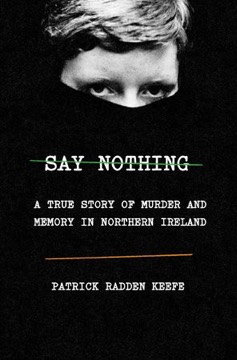
Say Nothing
Patrick Radden Keefe's account of the Troubles told through the 1972 abduction and murder of Jean McConville, a widowed mother of ten taken from her Belfast flat.
- First published
- 2018
- Publisher
- DEBOLSILLO
- Pages
- 536
- Shelf
- History
- Level
- Core
- ISBN-13
- 9781984841131
Record checked against
Catalogue note
- Reads as
- ReflectiveChanges how you see rather than what you do.
- Level
- Core / BuildingAssumes general familiarity with the subject.
- Approach
- Theoretical
- Written for
- Readers of history, Readers with some grounding
Saved in this browser only — no account, nothing sent anywhere. My library
Read this if
- You want to know how we got here.
- You want to understand how power is taken, kept and lost.
- You read for the writing as much as for the argument.
- You want a book that changes how you see things rather than what you do tomorrow.
- You know roughly how the subject works and want the fuller account.
What it is
McConville was disappeared by the IRA; her body was not found until 2003. Keefe uses the case as a spine for a history of the Provisional IRA from the early seventies to the peace process and after.
The central figures are Dolours Price, who bombed London at nineteen, and Brendan Hughes, a commander whose late disillusionment is the book's emotional core.
One disappearance, used as a way into thirty years and a peace that left questions unanswered.
Devmark’s reading — not a quotation from the book
The Belfast Project
Much of the material comes from an oral history at Boston College in which former paramilitaries gave recorded accounts on the understanding they would be sealed until death.
Subpoenas from the PSNI broke that guarantee, and the consequences — prosecutions, recriminations, the collapse of the project — are part of Keefe's story rather than an aside. The book is partly about what happens when a society tries to record what it has agreed not to discuss.
An oral history collected on a promise of secrecy, and what happened when the promise failed.
Devmark’s reading — not a quotation from the book
What it argues
Keefe's implicit case is that the Good Friday Agreement required a collective decision not to pursue the past, and that the people who carried out the violence were left holding it privately.
He names a person he believes responsible for McConville's death, based on the sources, and the naming is the book's most contested element.
How it reads
It is reported non-fiction written with the pacing of a thriller, and it is scrupulous about sourcing in a way that the speed almost conceals — the endnotes run to a substantial fraction of the book.
It does not take a constitutional position on Irish unity, and that is deliberate. Keefe's subject is what the violence cost the people who carried it out and the people it was done to, and a position on the border question would have made the book an argument rather than an account.
The disappearance
The organising crime is the abduction of a widowed mother of ten from her Belfast flat in front of her children, on suspicion of informing. She was killed and secretly buried, and for decades the organisation responsible denied involvement. Her remains were recovered from a beach in 2003. Keefe uses the case as a thread through three decades because it was never resolved and never absorbed.
The sisters
Two sisters from a republican family, one of whom became among the most recognisable IRA figures of the period, supply the book's other spine. Their bombing campaign in London, imprisonment, hunger strike and force-feeding, and what became of them afterwards, trace the arc from committed young volunteer to a person left holding what they did.
The Boston tapes
Much of the primary material comes from an oral history project in which former paramilitaries on both sides gave recorded accounts on the understanding that they would stay sealed until death. Police subpoenas eventually forced disclosure, participants were exposed, and the project collapsed — a genuine scholarly disaster that is also the reason the book could be written.
The tapes were promised to stay sealed until death. A subpoena made that promise worthless.
Devmark’s reading — not a quotation from the book
The informer problem
A late section deals with the extent of British infiltration, including allegations concerning the man who ran the IRA's own internal security — the unit responsible for interrogating and executing suspected informers. If correct, the implication is grotesque: some of those killed as informers were killed by an informer.
Who killed her
Keefe does not leave the central question open. He assembles the available evidence and names the person he believes fired the shot, with his reasoning set out. It is the book's most contested passage and he is transparent about the basis for it, which is the appropriate way to make a claim of that weight.
The amnesia the peace required
The implicit argument is that the settlement worked partly by agreeing not to account for what had been done — early releases, unresolved cases, participants becoming statesmen. Keefe does not argue the peace was wrong; he documents the specific families left holding the unpaid balance of it.
What to take from it
It reads like a thriller and is scrupulously sourced, which is an unusual combination and occasionally an uncomfortable one — the pacing can make the violence propulsive. Read it for the demonstration of how a conflict ends without ending, and of what happens to individual people inside a collective decision to move on.
What to take away
- 01One case as a spineMcConville's disappearance opens onto thirty years.
- 02The Belfast ProjectSealed oral histories, subpoenaed, and the fallout.
- 03Peace by not askingThe argument that the settlement required collective forgetting.
- 04A contested namingKeefe identifies a person responsible, from his sources.
- 05Thriller pace, scrupulous sourcingThe speed hides how carefully it is documented.