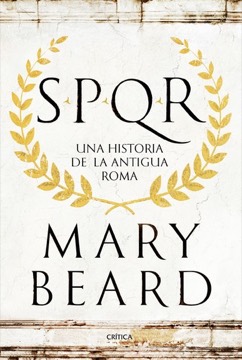
SPQR
Mary Beard's history of Rome's first millennium — from the founding legends to the extension of citizenship in 212 CE — written as an argument about how the history is known as much as about what happened.
- First published
- 2015
- Publisher
- Liveright & CompanyProfile Books
- Pages
- 644
- Shelf
- History
- Level
- Core
- ISBN-13
- 9781846683800
Record checked against
Catalogue note
- Reads as
- ReflectiveChanges how you see rather than what you do.
- Level
- Core / BuildingAssumes general familiarity with the subject.
- Approach
- Theoretical
- Written for
- Readers of history, Readers with some grounding
- Ideas
Saved in this browser only — no account, nothing sent anywhere. My library
Read this if
- You want to know how we got here.
- You want a book that changes how you see things rather than what you do tomorrow.
- You know roughly how the subject works and want the fuller account.
Where it starts
Not at the beginning. Beard opens with Cicero and Catiline in 63 BCE, a moment where the evidence is unusually rich, and works outward in both directions.
The choice is methodological. Beginning with the founding legends would require treating them as history; beginning where the sources are good establishes what kind of evidence exists before asking what can be built on it.
She begins where the evidence is good, not where the story starts. That choice is the book's method in miniature.
Devmark’s reading — not a quotation from the book
The legends, handled as legends
Her treatment of Romulus and Remus, Aeneas and the kings: not as garbled history to be decoded but as stories Romans told about themselves, which are evidence about Roman self-understanding rather than about the eighth century BCE.
Her observation that the foundation myth centres on fratricide and on the rape of the Sabine women — that Romans chose to tell a story about violence and abduction at their origin — is more interesting than any attempt to extract facts from it.
How Rome expanded
Her account of the mechanism: not primarily military superiority but an unusual willingness to extend citizenship to defeated peoples, converting enemies into a manpower reserve.
Her argument that this was the decisive difference from other ancient powers, and that it explains an expansion that military explanations alone do not, is the book's central historical claim.
The Republic's failure
Her treatment of the late Republic: the Gracchi, Marius, Sulla, the proscriptions, and the transition to one-man rule.
Her analysis locates the cause in structural mismatch — institutions designed for a city-state governing an empire, with armies loyal to commanders rather than to the state — rather than in the character of individuals, which is how the period is usually narrated.
Augustus and the fiction
Her account of the settlement: the careful preservation of republican forms, the refusal of monarchical titles, the accumulation of powers that individually had precedent and collectively did not.
Her point that everyone understood the fiction and participated in it anyway is her sharpest observation about how the transition actually worked.
Everyone understood the republican forms were a fiction and participated in them regardless. That is how it worked.
Devmark’s reading — not a quotation from the book
The emperors, deflated
Her deliberate flattening of the imperial biographies: she argues that the lurid individual differences between emperors mattered far less to the running of the empire than the sources suggest.
The administrative structure continued regardless of whether the emperor was competent or monstrous, and the stories about individual depravity tell us mostly about senatorial authors' grievances.
Ordinary people
Her recurring effort to reach the population the literary sources ignore: graffiti, tombstones, bar signs, legal documents, a Pompeian laundry, the letters of soldiers on the northern frontier.
This is where the book most differs from conventional narrative history, and her use of the Vindolanda tablets — including a birthday invitation between two women — is the sort of evidence that makes the period inhabited rather than surveyed.
Slavery
Her treatment is unsentimental and central rather than peripheral: the scale, the economic dependence, the routine violence, and the unusual Roman practice of manumission which made freed slaves and their descendants part of the citizen body.
She does not let the manumission mitigate the institution, and she is explicit that the Roman world was built on it.
Why the book ends in 212
She closes with Caracalla's extension of citizenship to virtually all free inhabitants of the empire, which she treats as the completion of the process her account of expansion began with.
It is an unusual endpoint — most histories continue to the western collapse — and it makes the book an argument about citizenship rather than a narrative of rise and fall.
Her position on relevance
She is explicit that Rome should not be treated as a source of lessons, and that the habit of reading current politics into it distorts both.
Her argument is that Rome is worth studying because Western political vocabulary, law and categories descend from it, not because its trajectory predicts anyone else's.
What to take away
- 01Citizenship was the mechanismExtending it to defeated peoples converted enemies into manpower, which military explanations cannot match.
- 02Legends are evidence about the tellersA foundation myth built on fratricide and abduction says something about Roman self-understanding.
- 03The Republic failed structurallyCity-state institutions governing an empire, with armies loyal to commanders rather than the state.
- 04The emperor's character mattered less than the stories suggestThe administration continued regardless, and the lurid accounts record senatorial grievance.
- 05Rome is not a source of lessonsIt is worth study because our categories descend from it, not because its trajectory predicts ours.