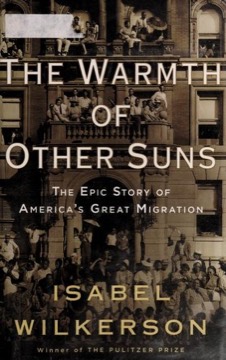
The Warmth of Other Suns
Isabel Wilkerson's history of the Great Migration — the movement of roughly six million Black Americans out of the South between 1915 and 1970 — told through three people who made the journey in different decades to different places.
- First published
- 2010
- Publisher
- Random House
- Pages
- 635
- Shelf
- History
- Level
- Deep
- ISBN-13
- 9781491545423
Record checked against
Catalogue note
- Reads as
- ReflectiveChanges how you see rather than what you do.
- Level
- Advanced / AdvancedAssumes you have read around the subject already.
- Approach
- Theoretical
- Written for
- Readers of history, Specialists and serious readers
Saved in this browser only — no account, nothing sent anywhere. My library
Read this if
- You want to know how we got here.
- You read for the writing as much as for the argument.
- You want a book that changes how you see things rather than what you do tomorrow.
- You have read around this already and want a book that assumes it.
The method
Wilkerson interviewed well over a thousand people and selected three whose lives she followed in depth: Ida Mae Gladney, who left Mississippi for Chicago in 1937; George Starling, who left Florida for Harlem in 1945; and Robert Foster, who left Louisiana for Los Angeles in 1953.
The three routes correspond to the migration's three main streams, and the three decades and three class positions let one narrative carry a movement of six million people without becoming statistical.
Three people, three decades, three routes — which is how a movement of six million stays legible as experience.
Devmark’s reading — not a quotation from the book
Reframing the migration
Her central historiographical argument: this was not a demographic drift or an economic adjustment but a leaderless, unorganised mass refusal, and it should be understood as the largest internal movement of people in American history.
Her comparison to political asylum rather than to economic migration is deliberate. People were leaving a system of legal terror, and she documents what they were leaving in enough detail to support the framing.
Ida Mae
A sharecropper's wife whose family left after a relative was beaten nearly to death over accusations about missing turkeys.
Her story is the least dramatic and the most representative: she works in Chicago, raises children, votes, watches her neighbourhood change over decades. Wilkerson follows her into old age, which is what gives the book its sense of a life rather than an episode.
George Starling
A citrus picker in Florida who organised fellow workers for better pay and left when he learned there were plans to kill him.
His subsequent career as a train attendant on the same route that carried migrants north makes him a witness to the migration itself, and his disappointment — with New York, with his marriage, with his children — gives the book its most complicated arc.
Robert Foster
A surgeon who left Louisiana because he could not practise in the hospitals near him, drove west, and could not find a motel that would take him across three states.
His account of that drive, exhausted and repeatedly refused, is the book's most cited passage. His later success in Los Angeles and his complicated relationship with what he had left is the most psychologically detailed of the three portraits.
What they were leaving
Her documentation of the system: the sharecropping settlements that could not be audited, the lynchings and their public character, the disenfranchisement, and the daily rituals of deference required to avoid violence.
Her point is that the migration is unintelligible without this, and that accounts treating it as a search for factory work omit the reason people left in the manner they did — abruptly, secretly and permanently.
What they found
Her chapters on the North and West are unsentimental: restrictive covenants, segregated neighbourhoods, hostility from existing residents, employment discrimination, and rents higher than white tenants paid for worse housing.
Her argument against the standard account is important. The problems of Northern cities are frequently attributed to the migrants themselves, and she marshals evidence that the conditions they entered were structured before they arrived.
Northern urban problems are frequently blamed on the migrants, and the conditions were structured before they arrived.
Devmark’s reading — not a quotation from the book
The scholarly argument
She engages directly with the literature holding that migrants fared worse than Northern-born Black residents, citing research indicating that migrants were on average better educated and more likely to be employed and married than the populations they joined.
This is the book's most substantive historical intervention, and she makes it with citations rather than by assertion.
The writing
It reads as narrative nonfiction rather than academic history, with scene construction, interior detail and long-form character development.
The technique has been questioned — some of the interior material must rest on what the subjects reported decades later — and Wilkerson documents her sourcing extensively in the notes. A reader should read the notes, which are substantial.
Its effect
It won the National Book Critics Circle Award and became the standard popular account of the migration, displacing a literature that had treated it as a subsidiary chapter of urban history.
Its more general contribution is the demonstration that a mass movement can be narrated through individuals without losing the scale, which a number of subsequent works have imitated.
What to take away
- 01A leaderless mass refusalNot a demographic drift: six million individual decisions to leave a system of legal terror.
- 02Three streams, three peopleThe routes were geographically distinct, and the three subjects map onto them across three decades.
- 03The conditions preceded the arrivalsCovenants and discrimination structured Northern cities before the migrants got there.
- 04They were not the least preparedThe research she cites indicates migrants were better educated and more employed than the populations they joined.
- 05Read the notesThe narrative technique rests on extensive sourcing that the main text does not display.