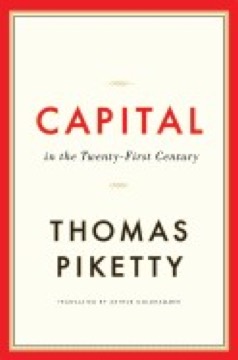
Capital in the Twenty-First Century
Thomas Piketty's long empirical study of wealth and income distribution across two centuries and twenty countries, arguing that when the return on capital exceeds the growth rate of the economy, inherited wealth concentrates — and that the twentieth century's relative equality was an exception rather than a trend.
- First published
- 2013
- Publisher
- ubl | Éditions du Seuil | Harvard University Press
- Pages
- 816
- Shelf
- Money
- Level
- Deep
- ISBN-13
- 9782021082289
Record checked against
Catalogue note
- Reads as
- ConceptualExplains how something works before what to do about it.
- Level
- Advanced / AdvancedAssumes you have read around the subject already.
- Approach
- Theoretical
- Written for
- Investors and savers, Specialists and serious readers
Saved in this browser only — no account, nothing sent anywhere. My library
Read this if
- You want to see the incentives underneath the headlines.
- You want to know how we got here.
- You want to understand how it works before deciding what to do about it.
- You have read around this already and want a book that assumes it.
The data, which is the achievement
The book's foundation is not a theory but a dataset: tax records, estate records and national accounts assembled over roughly fifteen years with collaborators, extending far further back than previous work on inequality.
Whatever one makes of the interpretation, the historical series is the contribution most economists across the political spectrum acknowledge, and it is what made the argument possible to have.
Whatever you conclude from it, the two-century dataset is the part nobody disputes.
Devmark’s reading — not a quotation from the book
r > g
His central formulation: when the average return on capital exceeds the rate of economic growth, wealth accumulated in the past grows faster than output and wages, so inherited wealth becomes more important relative to earned income.
Piketty is careful that this is a tendency rather than an iron law — wars, taxes, inflation and policy can and did interrupt it — but his historical finding is that r has exceeded g for most of recorded history.
The twentieth century as an anomaly
His most consequential historical claim. The compression of wealth and income between roughly 1914 and 1970 — which many take as the normal condition of a developed economy — was produced by extraordinary destruction: two wars, depression, inflation, and the tax regimes that followed.
On his data the pattern since has been a return toward the earlier distribution, which reframes recent decades as reversion rather than deterioration.
The two fundamental laws
His accounting identities: the capital share of income equals the return on capital times the capital-to-income ratio; and in the long run that ratio tends toward the savings rate divided by the growth rate.
These are definitional relationships rather than behavioural predictions, and much of the technical criticism concerns how much weight they can bear and whether the elasticity assumptions behind them hold.
Inheritance and the rentier
The sections on inherited wealth are the book's least-discussed and most striking. Piketty traces the share of total wealth that is inherited rather than earned, showing it falling sharply mid-century and rising again.
His use of nineteenth-century novels — where characters' prospects depend transparently on expected inheritance — is an effective device for showing what a high-inheritance society looks like from inside.
The policy proposal
His prescription is a progressive global tax on capital, coordinated internationally, alongside progressive income taxation.
He describes it himself as useful utopia — a benchmark for evaluating alternatives rather than an immediately achievable programme — and is explicit that the coordination problem is severe. Critics treat it as the book's weakest section, and Piketty does not strongly disagree.
He calls it a useful utopia himself — a benchmark for judging alternatives, not a programme.
Devmark’s reading — not a quotation from the book
The serious economic criticisms
Several deserve weight. The elasticity of substitution between capital and labour that his long-run projections require is higher than most empirical estimates support. His measure of capital includes housing, and a substantial share of the observed increase in capital-to-income ratios is housing-price appreciation rather than productive capital accumulation.
There was also a documented dispute over data handling in the wealth series, raised by the *Financial Times*; Piketty responded in detail and most subsequent assessments found the core trend intact while some specific series were disputed.
What it changed
Its measurable effect was on the agenda rather than on policy. Inequality moved from a peripheral topic in economics to a central one, and the underlying database became infrastructure that others have built on.
It also demonstrated that a long, technical, data-heavy book could reach a general audience, which was not obvious beforehand.
How to read it
It is 700 pages and genuinely long, but it is not technically difficult — Piketty writes for a general reader and keeps the mathematics light.
The introduction and conclusion carry the argument. Parts Two and Three carry the evidence. Part Four is the policy material and is the most skippable. Reading the first and last fifty pages gives an honest picture of the thesis.
What to take from it
The empirical finding is the durable part: wealth concentration is a long-run tendency, the mid-twentieth-century compression had specific violent causes, and inheritance matters more than a meritocratic self-image acknowledges.
The r > g formulation is a useful lens and a contested mechanism. Hold the data more firmly than the projection, and the projection more firmly than the policy.
What to take away
- 01The dataset is the contributionTwo centuries of tax and estate records, assembled where none existed, is what made the argument possible.
- 02Mid-century equality was produced by catastropheWars, depression and the resulting tax regimes compressed wealth; what followed is reversion.
- 03Inheritance is the quiet variableThe share of wealth that is inherited rather than earned fell sharply and has been rising again.
- 04Housing is doing a lot of the workMuch of the measured rise in capital-to-income ratios is house prices, not productive capital.
- 05Hold data, mechanism and policy differentlyThe historical series is strong, r > g is contested, and Piketty calls his own proposal a utopia.