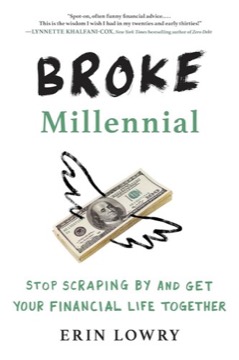
Broke Millennial
Erin Lowry's practical guide to personal finance for people starting from nothing, including the social and emotional parts most money books skip.
- First published
- 2017
- Publisher
- not established
- Pages
- 275
- Shelf
- Money
- Level
- Entry
- ISBN-13
- 9780143130406
Record checked against
Only one source carried a publication date for this work, so the year is uncorroborated.
Catalogue note
- Reads as
- PracticalWritten to be applied, not only understood.
- Level
- Accessible / FoundationalNo prior reading assumed.
- Approach
- Practical
- Written for
- Investors and savers, Newcomers to the subject
- Ideas
Saved in this browser only — no account, nothing sent anywhere. My library
Read this if
- You want to think clearly about risk before you think about returns.
- You want something to apply, not only something to think about.
- You are starting from scratch here and want a way in that assumes no prior reading.
What it covers
The mechanics are standard and well explained: budgeting, credit scores, student loan repayment options, retirement accounts, and the order in which to attack debt.
What distinguishes it is the second half, which deals with money inside relationships — splitting bills with friends who earn more, lending to family, discussing finances with a partner, and negotiating a first salary.
The awkward conversations are the part most money books leave out, and the part most people are stuck on.
Devmark’s reading — not a quotation from the book
Its approach
Lowry writes for a reader with genuine anxiety about the subject and assumes no prior knowledge without being condescending about it. Each chapter is built around a scenario rather than a principle.
She is realistic about constrained incomes in a way that a lot of the genre is not, and she does not treat debt as a moral failure.
Limits
Entirely US-specific on student loans, credit scoring and retirement vehicles, and those chapters are the bulk of the technical content.
It is an introduction and does not go deep on investing. Read it for getting organised and for the interpersonal material, then go elsewhere for portfolio construction.
Why the framing works
Lowry's assumption is that financial paralysis is emotional before it is technical. Someone avoiding a student loan balance does not need a better spreadsheet; they need to open the statement.
The book front-loads the psychological obstacles and treats the arithmetic as the easy part that follows. That ordering is why it works for readers who have bounced off more technical guides.
Money conversations
The most distinctive material covers the conversations personal finance books normally skip: telling friends you cannot afford the restaurant, splitting a bill when incomes differ wildly, lending to family, and discussing money with a partner. Lowry treats the social awkwardness as the actual obstacle rather than the arithmetic, which for her readership is correct.
The maths is not what stops people. Saying no to a group dinner is what stops people.
Devmark’s reading — not a quotation from the book
Financial baggage
She opens by asking readers to identify what they were taught about money at home — scarcity, secrecy, shame, or nothing at all — on the grounds that adult behaviour usually reproduces it unexamined. It is a short exercise, it takes ten minutes, and it is the most genuinely therapeutic thing in an otherwise thoroughly practical book about spreadsheets and interest rates.
Getting the accounts in order
The mechanical chapters are genuinely introductory: what a credit score is and how it is calculated, how to read a statement, which debt to clear first and why, how to set up automatic transfers, and what an emergency fund is actually for. Nothing here is novel; it is pitched at someone who has never been told any of it.
Student debt
A substantial section deals with American student loans specifically — repayment plans, forgiveness programmes, refinancing and the trade-offs between them. It is the most locally bound part of the book and also the reason it found its audience, since the burden it addresses is close to universal for that generation in the United States.
The register
Lowry writes informally, with jokes, worked examples and a deliberately non-judgemental tone about past mistakes. The style is a deliberate answer to the finger-wagging convention of the genre, and readers who want dense analysis will find it slight; readers who have avoided the subject out of shame are the intended audience.
Where it stops
It is an introduction and does not pretend otherwise: there is little on investing beyond the basics, nothing on tax complexity, and no guidance for anyone with irregular income, dependants or significant assets. The follow-up volumes cover investing; this one is about getting to a stable baseline.
What to take away
- 01The social side of moneySplitting bills, lending to family, and talking to a partner.
- 02No prior knowledge assumedWritten for genuine anxiety without condescension.
- 03Debt without moralisingTreated as a situation to manage rather than a character flaw.
- 04Scenario-ledChapters are built around situations rather than principles.
- 05US mechanicsStudent loans, credit scores and account types are country-specific.