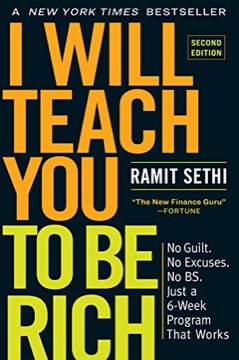
I Will Teach You to Be Rich
Ramit Sethi's six-week programme for personal finance in your twenties and thirties: automate the accounts, ignore the small economies, and spend without guilt on what you actually care about.
- First published
- 2009
- Publisher
- Workman Publishing Company
- Pages
- 352
- Shelf
- Money
- Level
- Entry
- ISBN-13
- 9781523505746
Record checked against
Sources disagree on the publication year (openlibrary 2019, wikidata 2009). The value shown is the one preferred by the most reliable source for original publication date; the disagreement is recorded rather than resolved.
Catalogue note
- Reads as
- PracticalWritten to be applied, not only understood.
- Level
- Accessible / FoundationalNo prior reading assumed.
- Approach
- Practical
- Written for
- Investors and savers, Newcomers to the subject
- Ideas
Saved in this browser only — no account, nothing sent anywhere. My library
Read this if
- You want to think clearly about risk before you think about returns.
- You want something to apply, not only something to think about.
- You are starting from scratch here and want a way in that assumes no prior reading.
The approach
Sethi's central argument is that most personal finance advice optimises the wrong variable. Cutting lattes produces trivial savings and considerable misery; negotiating a salary, choosing low-fee index funds and automating transfers produce large effects and require no ongoing willpower.
His term for the goal is a rich life, defined by the reader rather than by a number: spend extravagantly on what you love and cut mercilessly on what you do not.
Big wins over small economies: a salary negotiation is worth more than a decade of coffee guilt.
Devmark’s reading — not a quotation from the book
The system
The concrete programme is a set of linked accounts with automatic transfers scheduled around payday, so that saving and investing happen before discretionary spending is possible.
Alongside it: negotiating fees and bills by script, choosing target-date or index funds rather than picking stocks, and a conscious spending plan that allocates by category rather than tracking every purchase.
Who it is for, and its limits
It is written for someone with an income and no system, and it is very good for that reader. It is much less useful for someone whose problem is insufficient income rather than disorganisation, and Sethi's tone assumes the former.
The specifics are American — account types, tax-advantaged vehicles and credit scoring — so the mechanics need translating elsewhere even though the principles carry.
The advice assumes your problem is organisation, not income, and says so less clearly than it should.
Devmark’s reading — not a quotation from the book
The eighty-five percent solution
Sethi's governing principle is that a system you actually implement at rough accuracy beats an optimal one you never finish configuring. He is openly dismissive of spending weeks comparing funds that differ trivially, on the grounds that the delay costs more than the difference. It is the reason the book prescribes specific products rather than teaching comparison.
Big wins
His most-repeated argument is that personal finance culture fixates on small recurring economies — coffee, subscriptions — which are emotionally salient and financially trivial, while the handful of decisions that dominate lifetime outcomes get almost no attention: what you earn, what you pay in fees, what you pay for housing, and whether you invest at all.
Five decisions decide the outcome. The culture argues about the coffee.
Devmark’s reading — not a quotation from the book
The conscious spending plan
Instead of a line-item budget, he allocates income into four broad buckets — fixed costs, investing, savings goals, and spending that requires no justification — with rough target percentages. The design accepts that itemised budgets fail for most people, and it converts guilt-free spending from a leak into a planned category.
Automation
The mechanical core is a set of linked accounts with transfers scheduled to fire shortly after payday, so that saving and investing occur before discretion is involved. Sethi's position is that willpower is an unreliable component and should be designed out rather than strengthened, which is the single most transferable idea in the book.
Earning more
Later chapters cover salary negotiation and freelance pricing in unusual detail for a personal-finance book, including scripts and preparation. This follows directly from the big-wins argument: income is the largest lever most readers have and the one they are least likely to have ever deliberately worked on.
Defining the rich life
The second edition leans harder on the idea that the point of the system is to fund a life you have actually specified, and that most people have never done the specifying. He is deliberately non-prescriptive about the content — the argument is that unspecified wealth becomes accumulation for its own sake, which is a worse outcome than spending deliberately.
Where it does not travel
The account types, tax wrappers, credit mechanics and product recommendations are American and do not port. It also assumes a reader with an income and without debt-driven crisis; for someone in a genuinely constrained situation the advice on big wins is sound and the programme built on it is not available.
What to take away
- 01Big wins onlySalary, fees and asset allocation outweigh every small economy combined.
- 02Automate past willpowerTransfers scheduled around payday remove the decision entirely.
- 03Conscious spendingAllocate by category rather than tracking every transaction.
- 04Define the rich lifeThe target is reader-set rather than a universal number.
- 05American mechanicsAccount types and tax vehicles need translating outside the US.