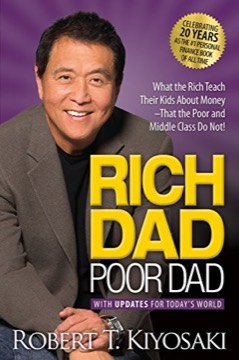
Rich Dad Poor Dad
Robert Kiyosaki's 1997 personal finance bestseller, contrasting two father figures and arguing that financial education, assets and entrepreneurship matter more than salary. Enormously influential and substantially contested.
- First published
- 1997
- Publisher
- Rich Dad on Brilliance Audio
- Pages
- 241
- Shelf
- Money
- Level
- Entry
- ISBN-13
- 9789877352115
Record checked against
Sources disagree on the publication year (openlibrary 1990, wikidata 1997, wikipedia 2000). The value shown is the one preferred by the most reliable source for original publication date; the disagreement is recorded rather than resolved.
Catalogue note
- Reads as
- PracticalWritten to be applied, not only understood.
- Level
- Accessible / FoundationalNo prior reading assumed.
- Approach
- Practical
- Written for
- Investors and savers, Newcomers to the subject
Saved in this browser only — no account, nothing sent anywhere. My library
Read this if
- You want to think clearly about risk before you think about returns.
- You have to choose what not to do, and want a way to think about it.
- You want something to apply, not only something to think about.
- You are starting from scratch here and want a way in that assumes no prior reading.
The argument
Kiyosaki contrasts his educated, salaried father — poor dad — with a friend's father, a business owner, and draws a set of lessons: that the wealthy acquire assets that generate income, that a house you live in is not an asset, and that financial literacy is not taught anywhere.
His central instruction is to have money work for you rather than working for money, which he frames as a distinction between the employee and the investor mindset.
The one durable idea is the definition: an asset puts money in your pocket, a liability takes it out.
Devmark’s reading — not a quotation from the book
Why it mattered
The book reached an enormous readership that had never encountered the distinction between earned and passive income, or the idea that a mortgage is not automatically wealth-building.
For many readers it was the first suggestion that financial arrangements are learnable rather than given, and that effect is real regardless of the book's problems.
The serious objections
The rich dad figure has never been verified and Kiyosaki has given inconsistent answers about whether he existed. The specific advice — leveraged property, minimal diversification, tax strategies described loosely — is risky and in places wrong.
He has also run paid seminars that drew consumer-protection complaints, and a linked company filed for bankruptcy in 2012. Read the book for the framing concept and take none of the tactics.
Take the definition of an asset and leave the tactics. The specific advice ranges from risky to wrong.
Devmark’s reading — not a quotation from the book
His definition of an asset
The book's one genuinely useful contribution is a cash-flow definition: an asset puts money into your pocket and a liability takes money out, regardless of how an accountant would classify it. It is not standard accounting and Kiyosaki knows that. Applied to a mortgaged home it produces the book's most provocative and most defensible claim.
Not what it is worth. Which direction the money moves each month.
Devmark’s reading — not a quotation from the book
Mind your own business
His distinction between a job and a business is that a salary builds someone else's asset column while yours stays empty, and that the remedy is not to quit but to build an asset column alongside the job. Stated plainly it is unremarkable advice to invest consistently; the framing is what made it land with readers who had never been told it.
The chapter on corporations and tax
One section argues that the wealthy use corporate structures to earn, spend and then pay tax on what remains, while employees pay first and spend after. The general observation about the ordering is real; the implication that this is broadly available is not, and the specific tactics are jurisdiction- dependent, frequently inapplicable to someone with a salary, and presented with no professional caveat at all.
Work to learn
His advice on employment is to choose roles for the skill acquired rather than the compensation, and he is specific about which skills he considers transferable — selling, negotiating, marketing and understanding accounts. This is the least contentious chapter in the book and the one most readers remember least.
Why it spread
The book arrived when personal finance writing assumed a reader who already had financial vocabulary, and it assumed none. Its narrative device — two fathers, two philosophies — made an abstract distinction memorable, and it told a large audience something nobody had told them: that this subject exists and is not taught anywhere they had been.
The business around the book
The book functions partly as an entry point to a wider commercial operation of seminars, courses and licensed products, which has attracted sustained complaints and journalistic investigation regarding high-pressure upselling. One of Kiyosaki's companies filed for bankruptcy protection after an adverse judgment. Readers should treat the book and the funnel attached to it as separate decisions.
What to take from it
Take the cash-flow test and the point that a primary residence is not the investment most people assume, and stop there. The rich dad figure has never been verified and the author has answered differently about it over the years; the speculative real-estate tactics are unsuitable for almost everyone; and there is no financial plan in this book, only a posture.
What to take away
- 01Assets versus liabilitiesThe definition by cash flow, which is the book's lasting contribution.
- 02Your house is not an assetThe claim that made the most readers re-examine their assumptions.
- 03Financial literacy is absentNobody is taught this, which was the book's opening and remains true.
- 04Unverified framingThe rich dad figure has never been established as real.
- 05Dangerous tacticsLeverage and tax advice that should not be acted on.