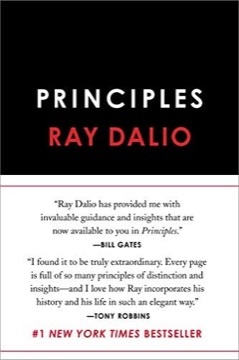
Principles
Life and Work
Ray Dalio's account of the explicit decision-making rules he developed running Bridgewater Associates — part memoir, part personal philosophy, and part unusually detailed description of an organisation designed around radical transparency.
- First published
- 2017
- Publisher
- Simon & Schuster
- Pages
- 592
- Shelf
- Money
- Level
- Core
- ISBN-13
- 9781501124051
Record checked against
Catalogue note
- Reads as
- StrategicAbout choosing between options under uncertainty.
- Level
- Core / BuildingAssumes general familiarity with the subject.
- Approach
- Applied
- Written for
- Investors and savers, Readers with some grounding
Saved in this browser only — no account, nothing sent anywhere. My library
Read this if
- You want to decide better when the information is incomplete.
- You are responsible for other people's work as well as your own.
- You want to think clearly about risk before you think about returns.
- You are weighing options and want a way to think about the trade-offs.
- You know roughly how the subject works and want the fuller account.
The premise: write the rules down
Dalio's organising practice is that every time you encounter a situation, you should decide how to handle that *class* of situation and record the principle, so that judgement compounds instead of being re-derived.
The book is the output of doing this for four decades. Whatever one makes of the specific principles, the discipline of making decision rules explicit and revisable is the transferable idea.
Decide how to handle the class of situation, write it down, and stop re-deriving judgement from scratch.
Devmark’s reading — not a quotation from the book
Radical truth and radical transparency
His two foundational commitments: say what you actually think, and make almost everything observable — meetings recorded, assessments visible, disagreements conducted in the open.
His argument is that most organisational dysfunction comes from people knowing things they do not say, and that the discomfort of transparency is a smaller cost than the accumulated distortion of politeness.
Pain plus reflection equals progress
His formula for learning, and the emotional core of the memoir half. Bad outcomes are only useful if they are examined rather than defended, and the reflex to defend is the thing to be trained out.
The account of Bridgewater's near-failure after a badly wrong public prediction is the book's most compelling section, and Dalio presents it as the origin of everything that followed.
Believability-weighted decision-making
His most distinctive mechanism: in a disagreement, weight opinions by the participants' track record in that specific domain rather than by seniority or by equal vote.
The idea is genuinely interesting — an attempt to make meritocracy arithmetic rather than rhetorical. The implementation requires continuous measurement of people's judgement quality, which is where it becomes contentious.
The machine metaphor
Dalio's framing of an organisation as a machine consisting of people and design, producing outcomes. When outcomes are bad, the diagnosis is either a design fault or a person in the wrong role.
He insists on separating the two explicitly, because organisations habitually treat design faults as people problems, and treat people problems as unfortunate rather than as design decisions that were made.
When output is wrong the cause is the design or the person in the role. Most organisations never separate the two.
Devmark’s reading — not a quotation from the book
Life principles versus work principles
The book is structurally in halves. The life principles are broadly Stoic-adjacent — embrace reality, own your outcomes, understand your own nature, weigh second and third-order consequences.
The work principles are far more specific and far more particular to Bridgewater, and the second half reads much more like an operations manual than a philosophy.
Second and third-order consequences
One of the most useful individual principles: most bad decisions optimise for the first-order consequence, which is often the opposite of the longer-order one.
His examples are deliberately ordinary — exercise, diet, difficult conversations — where the immediate consequence is unpleasant and the later one is good, and where the reverse pattern is what makes bad habits attractive.
Where it is seriously criticised
Several things deserve weight. Former employees have described the culture as harsh and the transparency practices as producing anxiety rather than candour, and journalistic accounts have disputed how meritocratically the system actually operated.
The performance claims are also difficult to evaluate independently, and critics note that attributing a fund's returns to a management philosophy is exactly the kind of causal inference the book's own principles warn against.
The form problem
It is long, repetitive and unevenly written. The memoir opening is the strongest section; the principles are presented as numbered lists that read better as reference than as prose.
Many readers report finishing the first half and abandoning the second, which is a reasonable response — the second half is genuinely a manual for a specific organisation.
What to take from it
The practice rather than the principles: keep an explicit, written, revisable record of how you have decided to handle recurring situations, and update it when a decision goes wrong.
And the second-order-consequences habit, which is cheap and immediately useful. Treat the Bridgewater operating system as one organisation's experiment rather than a template.
What to take away
- 01Write decision rules downDeciding how to handle a class of situation once beats re-deriving judgement every time.
- 02Separate design faults from people faultsOrganisations habitually treat the first as the second and never examine either properly.
- 03Weight opinions by domain track recordAn attempt to make meritocracy arithmetic rather than rhetorical — interesting, and hard to implement.
- 04Optimise past the first orderMost bad decisions take the pleasant immediate consequence and the unpleasant later one.
- 05Treat it as one experimentFormer employees dispute how the culture worked in practice, and the performance attribution is unverifiable.