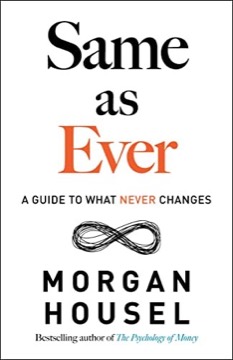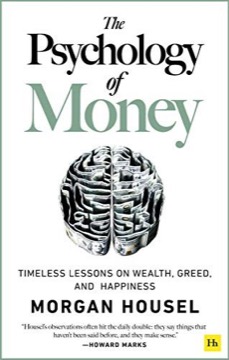
The Psychology of Money
Morgan Housel's collection of short essays argues that financial outcomes depend far less on what you know than on how you behave, and that behaviour is driven by personal history, ego and the wildly different worlds people happen to have lived through.
- First published
- 2020
- Publisher
- Harriman House
- Pages
- 289
- Shelf
- Money
- Level
- Entry
- ISBN-13
- 9781387580088
Record checked against
Catalogue note
- Reads as
- PracticalWritten to be applied, not only understood.
- Level
- Accessible / FoundationalNo prior reading assumed.
- Approach
- Practical
- Written for
- Investors and savers, Newcomers to the subject
Saved in this browser only — no account, nothing sent anywhere. My library
Read this if
- You want to change what you do repeatedly, not just what you intend.
- You want to think clearly about risk before you think about returns.
- You want something to apply, not only something to think about.
- You are starting from scratch here and want a way in that assumes no prior reading.
The core idea
Housel's premise is that finance is taught as a mathematical field and lived as a behavioural one. Spreadsheets tell you what is optimal; behaviour determines what you actually do during the years when the spreadsheet is losing money.
His conclusion is that a merely adequate strategy you can hold through a downturn beats an optimal one you abandon — and that most financial damage comes from the abandonment rather than from the strategy.
A plan you can survive holding beats a better plan you will not hold.
Devmark’s reading — not a quotation from the book
No one is crazy
The opening argument is that people's financial decisions make sense given their own experience, even when they look irrational from outside. Someone who came of age during a long bull market and someone who came of age during a crash have learned different lessons from the same world, and both lessons were taught by evidence.
The practical implication is humility in both directions: about judging other people's choices, and about trusting your own instincts, which were formed by an accident of timing.
Luck and risk
Housel treats luck and risk as the same force seen from opposite ends, and argues that both are systematically underweighted because neither is visible in the outcome.
His recommendation is to be careful whom you admire and whom you dismiss — to study broad patterns rather than individuals, because any one person's result contains an unknown quantity of chance. This is also why he avoids extracting lessons from extreme successes.
Enough
The essay on "enough" is the book's moral centre. Housel argues that the hardest financial skill is stopping the goalpost from moving, and that the worst outcomes come from risking something you have and need for something you do not have and do not need.
The observation that follows is sharp: social comparison has no finish line, because every level of wealth has a level above it whose occupants are performing contentment.
Compounding, and why it is underrated
Housel's treatment of compounding is about counter-intuition rather than arithmetic. The results are so large that intuition simply refuses them, which is why people search for higher returns instead of longer ones.
The structural lesson is that time is the variable most under an investor's control and the one most often traded away. Good investing, in his framing, is less about generating returns than about not interrupting them.
The goal is not the highest return. It is the return you can keep earning for the longest time.
Devmark’s reading — not a quotation from the book
Getting wealthy versus staying wealthy
Housel separates two skills. Getting money takes risk, optimism and putting yourself forward. Keeping it takes the opposite: humility, and a fear that what you made can be taken away.
The conclusion is survival-first: arrange finances so that you are never forced to sell at the wrong moment, and accept a lower expected return in exchange for a much higher chance of being around to collect it.
Tails drive everything
A small number of events account for most of the outcome, in portfolios and in careers. Housel's point is that this makes the frequency of being right almost irrelevant compared with the magnitude of being right when it counts.
The behavioural consequence is that a long run of unremarkable results is the normal texture of a good strategy, not evidence against it.
Room for error
Housel makes a distinctive case for margin of safety as a psychological tool rather than a purely financial one. Its function is to let a plan survive a range of futures, including ones you did not think of.
He is candid that this looks like inefficiency and that its cost is real and visible while its benefit is invisible until the day it isn't.
Where it is limited
This is a book of essays, not a method. It will not tell you what to hold, how much to save, or how to construct a portfolio, and readers looking for that will find it frustratingly unspecific.
Its evidence is also anecdotal by design. The stories illustrate rather than demonstrate, and a careful reader should treat them as ways of remembering a principle rather than as support for one.
What it is good for
It is one of the few finance books aimed squarely at the part of the problem that actually defeats people. Its real contribution is a set of handles — enough, room for error, tails, the difference between getting and keeping — that make it easier to notice yourself about to do something expensive.
Best read early, before the habits form, and re-read during a downturn, which is the only time its arguments are genuinely difficult.
What to take away
- 01Behaviour dominates knowledgeThe strategy you can hold through a bad decade beats the better one you abandon in year three.
- 02Everyone's instincts came from their own decadeFinancial intuition is formed by an accident of when you were born, including yours.
- 03Define enough in advanceA goalpost that moves guarantees that no amount will ever feel sufficient.
- 04Protect the time, not the returnCompounding rewards duration more than rate, and duration is the part you control.
- 05Survival is the strategyNever being forced to sell at the wrong moment is worth more than a higher expected return.