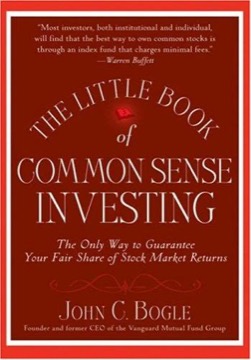
The Little Book of Common Sense Investing
John Bogle's short, insistent case for the low-cost total-market index fund — written by the person who created the first one for retail investors, and argued almost entirely from arithmetic rather than from forecasting.
- First published
- 2007
- Publisher
- John Wiley & Sons
- Pages
- 228
- Shelf
- Money
- Level
- Entry
- ISBN-13
- 9781427201454
Record checked against
Catalogue note
- Reads as
- PracticalWritten to be applied, not only understood.
- Level
- Accessible / FoundationalNo prior reading assumed.
- Approach
- Practical
- Written for
- Investors and savers, Newcomers to the subject
- Ideas
Saved in this browser only — no account, nothing sent anywhere. My library
Read this if
- You want to think clearly about risk before you think about returns.
- You want something to apply, not only something to think about.
- You are starting from scratch here and want a way in that assumes no prior reading.
The arithmetic argument
Bogle's case rests on a tautology he calls the relentless rules of humble arithmetic: investors collectively own the market, so collectively they earn the market return minus costs. Before costs, active investing is a zero-sum game against other active investors; after costs it is negative-sum.
This is not a prediction and does not depend on markets being efficient. It holds by definition, which is what makes it unusually strong for a financial argument.
This is not a forecast. Investors collectively own the market, so collectively they earn it minus costs.
Devmark’s reading — not a quotation from the book
Costs, compounded
His central practical point: a one-or-two-percentage-point annual cost sounds trivial and is not, because it compounds against the investor for decades.
His tyranny of compounding costs framing — showing what share of a lifetime's cumulative return is consumed by fees — is the book's most persuasive single exhibit, and the figures surprise almost everyone who sees them for the first time.
Why the winners do not stay
Bogle examines the persistence of fund outperformance and finds it weak: funds that lead one period are not reliably the leaders in the next, and survivorship in the published averages flatters the industry because closed funds disappear from the record.
His conclusion is that past performance is a poor selection criterion, and that selecting on it is close to the default behaviour of retail investors.
Reversion to the mean
His account of why chasing a strong performer usually disappoints: extreme results contain a large chance component, and the subsequent period tends to be less extreme.
This applies to funds, sectors, styles and whole markets, and it is the mechanism behind his advice to rebalance mechanically rather than to allocate toward whatever has recently done well.
The index fund as the conclusion
His prescription is a broad, market-capitalisation-weighted, minimum-cost index fund held indefinitely, with no attempt at timing and no selection of managers.
He is explicit that this guarantees an average result before costs and a substantially above-average one after them — which is the whole case, stated without embellishment.
On ETFs and the industry's response
Later editions engage with exchange-traded funds, and Bogle is notably sceptical of them — not of the index inside, but of the tradability, which he argues reintroduces exactly the behaviour indexing was meant to prevent.
His observation that an instrument designed for long-term holding was repackaged into one designed for trading is a sharp piece of industry criticism from someone in a position to make it.
The index was the good idea. Making it tradable by the minute reinstated the behaviour it was meant to remove.
Devmark’s reading — not a quotation from the book
Bogle's own position
He founded Vanguard and structured it so the funds own the management company, which removed the usual tension between fund investors and shareholders of the manager.
This is relevant to reading the book: he is arguing for a structure he built, and the argument is stronger for being arithmetic rather than promotional — but the interest should be noted.
Where the argument is contested
The main serious objection concerns market-capitalisation weighting, which mechanically allocates most to whatever has already risen most, and the growth of index ownership and its effects on price discovery, governance and concentration.
Bogle addresses these only briefly. They are live questions and they do not dissolve the cost argument, which remains the book's foundation.
Where it is repetitive
It is a short book that restates its point many times, with charts that make substantially the same case. That is deliberate — Bogle is arguing against a powerful commercial interest and expects resistance — but it makes for monotonous reading.
The essential content could be twenty pages, and readers frequently say so.
Why it matters
Because its central claim has held up under fifty years of adversarial scrutiny by an industry with every incentive to refute it, and because the practical advice is implementable by anyone in an afternoon.
Very little financial writing can claim either. Read it once, act on it, and do not read another book about fund selection.
What to take away
- 01The argument is arithmetic, not predictiveInvestors collectively own the market and collectively earn it minus costs. That holds by definition.
- 02Costs compound against youOne or two points a year consumes a startling share of a lifetime's cumulative return.
- 03Past performance selects poorlyLeadership does not persist reliably, and closed funds vanish from the averages that suggest it does.
- 04Extremes revertChasing whatever recently outperformed is betting that an unusually large chance component repeats.
- 05Tradability reintroduced the problemBogle's objection to ETFs is not the index; it is making a long-term instrument tradable by the minute.