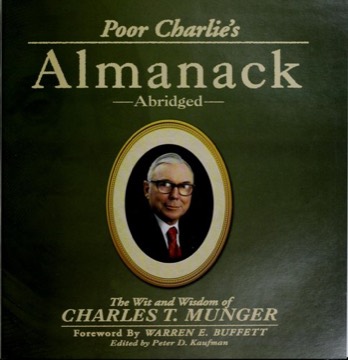
Poor Charlie's Almanack
A compiled collection of Charlie Munger's speeches, talks and writings, assembled by Peter Kaufman — most valuable for its account of multidisciplinary mental models and its catalogue of the psychological tendencies that cause misjudgement.
- First published
- 2005
- Publisher
- Donning Co. Publishers
- Pages
- 512
- Shelf
- Money
- Level
- Core
- ISBN-13
- 9781953953575
Record checked against
Catalogue note
- Reads as
- StrategicAbout choosing between options under uncertainty.
- Level
- Core / BuildingAssumes general familiarity with the subject.
- Approach
- Applied
- Written for
- Investors and savers, Readers with some grounding
Saved in this browser only — no account, nothing sent anywhere. My library
Read this if
- You want to decide better when the information is incomplete.
- You want to think clearly about risk before you think about returns.
- You are weighing options and want a way to think about the trade-offs.
- You know roughly how the subject works and want the fuller account.
What the book is
Not written by Munger as a book. It is a compilation — talks, commencement addresses, shareholder letter excerpts, and Kaufman's editorial framing — produced with Munger's cooperation and expanded across editions.
It is physically large, visually dense with marginalia and illustrations, and repetitive by construction, since the same ideas recur across talks given years apart.
A compilation of talks, not a written book. The repetition is a property of the source material.
Devmark’s reading — not a quotation from the book
The latticework of mental models
Munger's organising idea: that a person needs the major models from the major disciplines — physics, biology, psychology, mathematics, economics, engineering — held in a mental latticework so that experience can be hung on them.
His warning is the memorable half: to the man with only a hammer, every problem looks like a nail. He argues that specialists systematically misapply their own discipline's model to problems it does not fit.
The Psychology of Human Misjudgment
The single most valuable item in the collection: a long talk cataloguing around twenty-five tendencies that produce bad decisions — reward and punishment superresponse, liking and disliking distortion, doubt avoidance, inconsistency avoidance, social proof, contrast misreaction, authority misinfluence, deprival superreaction, and others.
It is an amateur's taxonomy assembled from reading and observation rather than from research, and it overlaps substantially with the academic literature while using its own vocabulary.
Lollapalooza effects
His term for what happens when several psychological tendencies point the same way at once: the result is not additive but multiplicative, producing behaviour far more extreme than any single bias would.
His examples — auctions, cults, multi-level marketing, certain sales environments — are situations engineered so that reciprocity, social proof, commitment, scarcity and authority all fire together.
Invert, always invert
Borrowed from Jacobi, and one of his most repeated instructions: to solve a hard problem, state its inverse. Instead of asking how to succeed, ask what would reliably produce failure, then avoid that.
His commencement address on how to guarantee a miserable life is the clearest demonstration, and it is genuinely funnier and more useful than the equivalent positive advice would be.
Ask what would guarantee failure, then do not do it. Easier to answer and harder to argue with.
Devmark’s reading — not a quotation from the book
Incentives, taken seriously
Munger's repeated position is that he has underestimated incentive effects his entire life despite trying not to, and that most people vastly underestimate them.
His practical rule — when you see a puzzling pattern of behaviour, look at the incentives before looking for explanations involving character — is the single most portable thing in the book.
Investment philosophy
The investment content is less systematic than the psychology and largely consistent with what became the Berkshire approach: a small number of concentrated positions in understandable businesses with durable advantages, bought at sensible prices, held for long periods.
His circle-of-competence insistence — that the boundary matters more than the size — is the framing most worth carrying away.
Where it is limited
It is a hagiography in presentation. Kaufman's framing is admiring throughout, there is no critical apparatus, and Munger's views are presented without the counter-arguments.
The psychology is also self-taught and occasionally wrong in ways a specialist would flag. It should be read as an exceptionally sharp practitioner's working theory, not as a survey of the field.
Where Munger's own views were contestable
He was forthright on subjects well outside his expertise, and some of those opinions — on particular industries, technologies and social questions — have aged variably.
A reader should separate the general method, which is robust, from the specific judgements, which were one investor's and were sometimes wrong.
How to read it
Do not read it front to back. Read the Psychology of Human Misjudgment talk, which is the core, then the inversion address, then sample the rest.
Its best use is as a reference for the misjudgement taxonomy — a list to check a decision against when something feels off and you cannot say why.
What to take away
- 01Carry models from several disciplinesA specialist reliably misapplies their own discipline's model to problems that do not fit it.
- 02Biases multiply, not addLollapalooza effects arise when several tendencies point the same way, producing behaviour no single bias explains.
- 03Invert the questionAsking what would guarantee failure is easier to answer and harder to argue with than asking how to succeed.
- 04Check incentives before characterPuzzling behaviour almost always has an incentive behind it that nobody has looked at.
- 05The boundary matters more than the sizeA small circle of competence honestly drawn beats a large one with vague edges.