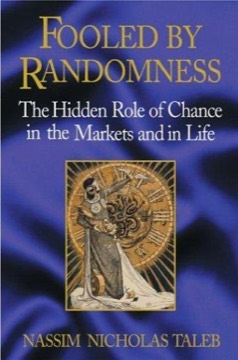
Fooled by Randomness
the hidden role of chance in life and in the markets
Taleb's first book, and the one where his argument is most contained: that we systematically mistake luck for skill, particularly in fields like markets where feedback is noisy, and that survivors' explanations for their success are unreliable.
- First published
- 2001
- Publisher
- Random House
- Pages
- 312
- Shelf
- Money
- Level
- Core
- ISBN-13
- 9781587991844
Record checked against
Catalogue note
- Reads as
- StrategicAbout choosing between options under uncertainty.
- Level
- Core / BuildingAssumes general familiarity with the subject.
- Approach
- Applied
- Written for
- Investors and savers, Readers with some grounding
Saved in this browser only — no account, nothing sent anywhere. My library
Read this if
- You want to decide better when the information is incomplete.
- You want to see the incentives underneath the headlines.
- You want to know the specific ways your own judgement misleads you.
- You are weighing options and want a way to think about the trade-offs.
- You know roughly how the subject works and want the fuller account.
The central claim
Taleb's subject is the misattribution of chance outcomes to causal skill. In domains with high randomness and slow feedback, a run of good results is weak evidence of ability, yet it is treated as strong evidence by the person who produced it and by everyone watching.
The consequence is that both the market and the individual draw confident conclusions from a sample that supports almost nothing.
In a noisy domain, a good run is weak evidence of skill — and is universally read as strong evidence.
Devmark’s reading — not a quotation from the book
Alternative histories
His central mental tool: judge a decision by the distribution of worlds it could have produced, not by the single world that happened to occur.
A decision that produced a good outcome in nine of ten possible histories is a good decision; one that produced a good outcome in the one history we observed and disaster in the other nine is not, and looks identical from the outside.
Survivorship bias
His treatment of who we hear from is the book's most practically useful section. Successful traders, entrepreneurs and fund managers are visible precisely because they succeeded, and the population of people who did the same things and failed is invisible.
His illustration — that a large enough population of random coin-flippers will reliably produce a small number with spectacular unbroken runs — is the clearest demonstration of the problem in any popular book.
Skewness and asymmetric payoffs
A key technical point often lost in summaries. Taleb argues that probability of being right matters far less than the magnitude of the outcome when right, and that many strategies are frequently right and occasionally catastrophically wrong.
Such a strategy looks like consistent skill for years. The rarity of the bad event means the track record cannot distinguish it from genuine ability until the event arrives.
The problem of induction
He takes up Hume's problem directly: no number of confirming observations establishes a general rule, and a single contrary observation refutes it.
Applied to a track record, this means the evidence that a strategy works accumulates slowly and asymmetrically, and the absence of a blow-up is not evidence that a blow-up cannot happen.
Years without the bad event is not evidence the bad event cannot happen. It is just years.
Devmark’s reading — not a quotation from the book
Noise and signal in monitoring
His observation about frequency of observation is small and genuinely useful: checking a volatile series more often increases the proportion of noise you see without increasing information.
The emotional consequence is real — frequent monitoring of a portfolio delivers a much higher ratio of unpleasant observations than infrequent monitoring, for identical underlying returns.
Character, and his own position
Taleb is unusually candid that he considers himself as susceptible as anyone, and that his response is structural rather than cognitive — arrange your affairs so your biases cannot ruin you, because you will not think your way out of them.
This is more modest than his later books and is part of why this one is often considered his best.
Where it is weak
The evidence is anecdote, thought experiment and assertion rather than data. The book makes statistical arguments without doing statistics, and a reader wanting the underlying research will not find citations here.
It is also digressive and score-settling in places, though considerably less so than his later work.
How it sits against the later books
This is the most disciplined of the series. *The Black Swan* generalises the argument and *Antifragile* turns it into a philosophy, with each step widening the scope and loosening the rigour.
Readers new to Taleb are usually better served starting here, where the claim is narrower and better supported, and where the tone has not yet become the obstacle it later does.
What to take from it
Two habits. Ask what else could have happened — evaluate the decision against its distribution rather than its single realised outcome. And ask who is missing from the sample whenever you are being shown a success.
Both are cheap, both are uncomfortable, and both apply well outside markets.
What to take away
- 01Judge the distribution, not the outcomeA decision that worked in one of ten possible worlds looks identical, from outside, to one that worked in nine.
- 02Ask who is missingSuccessful people are visible because they succeeded; the identical-strategy failures are not in the room.
- 03Frequent checking buys noiseObserving a volatile series more often raises the share of noise without raising information.
- 04Rare blow-ups hide inside good recordsA strategy that is usually right and occasionally catastrophic looks like skill until it does not.
- 05Arrange, do not resolveTaleb's own answer is structural — build so your biases cannot ruin you, since you will not out-think them.