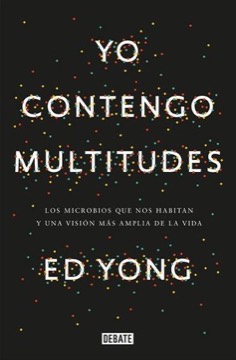
I Contain Multitudes
Ed Yong's account of the microbes that live in and on every animal, and of how much of what we think of as an organism is actually a partnership.
- First published
- 2016
- Publisher
- HarperCollins Publishers and Blackstone Audio
- Pages
- 368
- Shelf
- Science
- Level
- Core
- ISBN-13
- 9781784700171
Record checked against
Catalogue note
- Reads as
- ConceptualExplains how something works before what to do about it.
- Level
- Core / BuildingAssumes general familiarity with the subject.
- Approach
- Theoretical
- Written for
- Curious general readers, Readers with some grounding
Saved in this browser only — no account, nothing sent anywhere. My library
Read this if
- You want to understand living things by how they came to be.
- You want to know how we know things, and how that goes wrong.
- You want to understand how it works before deciding what to do about it.
- You know roughly how the subject works and want the fuller account.
The argument
Yong's case is that microbes are not primarily pathogens but partners: they build immune systems, digest what hosts cannot, supply vitamins, and in some species make entire ways of life possible.
The framing move is to treat every animal as an ecosystem rather than an individual, and to take that seriously rather than as a metaphor.
Every animal in the book is treated as an ecosystem, and the treatment is literal.
Devmark’s reading — not a quotation from the book
The examples
The squid that uses luminous bacteria as camouflage; the beetles whose symbionts let them digest coffee; the Hawaiian bobtail's daily cycling of its bacterial partners; the aphids whose bacteria confer heat tolerance; and the mice whose behaviour changes with their gut flora.
Yong reports the human microbiome work with markedly more caution than the animal material, which is the correct proportion.
Where he is careful
The book is unusually good at separating established symbiosis research from the more excitable human claims. Yong is explicit that microbiome science has a reproducibility problem and that the commercial probiotic industry outruns the evidence substantially.
That restraint is why the book has aged better than most on this subject.
Yong is explicit that the probiotic industry runs well ahead of the evidence, which is why it has aged well.
Devmark’s reading — not a quotation from the book
What follows from it
Yong's closing argument is that the partnership framing changes what intervention means. If a microbial community is part of the organism, then antibiotics are an ecological event rather than a targeted strike, and restoring a damaged community is a different problem from killing a pathogen.
He is careful not to convert that into advice. The book's position is that the science is early, the commercial claims are ahead of it, and the useful shift is in how the question is framed rather than in what to buy.
The idea that had to be won first
Yong sets his subject against the long resistance to symbiosis as a serious biological force. The proposal that mitochondria and chloroplasts were once free-living bacteria absorbed into other cells was ridiculed for years before becoming textbook material, and he uses that history deliberately: the pattern of a partnership explanation being dismissed as fringe until the evidence became unanswerable recurs through the book.
Wolbachia
The bacterium that gets the most attention is one that infects a large fraction of all insect species and manipulates their reproduction to spread itself — killing males, feminising embryos, making uninfected pairings infertile. The applied consequence is striking: deliberately seeding mosquito populations with strains that block the transmission of dengue, which turns a parasite's selfishness into a public-health instrument.
Milk that is not for the baby
One of the clearest examples of co-evolution is the set of complex sugars in human breast milk that infants cannot digest at all. They are not for the infant; they are food for particular gut bacteria, which the mother is cultivating. Yong's point is that this is not an accident or a side effect — a mother is provisioning a microbial community as deliberately as she is feeding her child.
Some of what is in milk was never meant for the baby. It is for the bacteria.
Devmark’s reading — not a quotation from the book
Animals raised without microbes
Much of the causal evidence comes from germ-free animals, reared sterile from birth. They develop abnormally: stunted immune systems, altered gut architecture, changed behaviour. This is the experimental backbone of the partnership claim, and Yong is careful about its limits — an animal raised with nothing is a blunt instrument for showing what any particular microbe does in an animal raised normally.
The transplant that works
Faecal transplantation for recurrent Clostridioides difficile infection is the one human microbiome intervention with unambiguous results, and Yong treats it as the exception that clarifies the rule: it works because it replaces a devastated community wholesale in a specific, well-defined disease. Extending the same logic to conditions with diffuse causes is where the field's claims outrun its evidence.
Where the hype is
The book is notably unimpressed by the commercial probiotic market, pointing out that most products contain a handful of strains chosen for their ability to survive manufacturing rather than for demonstrated effect, and that a healthy gut already contains hundreds. He applies the same scepticism to studies that move from a correlation in mice to a headline about human personality.
What to take from it
Its lasting contribution is a change of default: stop treating microbes as things that happen to a body and start treating a body as a habitat with a resident population that shapes it. Yong is a careful reporter, which is why the book has aged well while a lot of microbiome writing from the same years has not.
What to take away
- 01Partners, not pathogensMicrobes as the default condition of animal life.
- 02Animals as ecosystemsTaken literally rather than as a figure of speech.
- 03The bobtail squidLuminous bacterial camouflage, cycled daily — the book's signature case.
- 04Caution on humansAnimal symbiosis is solid; human microbiome claims are hedged.
- 05Aged wellRestraint about a hype-prone field is why.