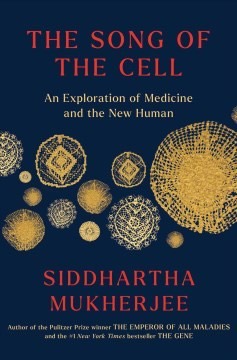
The Song of the Cell
Siddhartha Mukherjee's history of cell biology and of the medicine built on it, from the first observations through to cell therapy and its consequences.
- First published
- 2022
- Publisher
- Random House Espanol
- Pages
- 496
- Shelf
- Science
- Level
- Deep
- ISBN-13
- 9781529111781
Record checked against
Catalogue note
- Reads as
- ConceptualExplains how something works before what to do about it.
- Level
- Advanced / AdvancedAssumes you have read around the subject already.
- Approach
- Theoretical
- Written for
- Curious general readers, Specialists and serious readers
Saved in this browser only — no account, nothing sent anywhere. My library
Read this if
- You want to understand living things by how they came to be.
- You want to know how we got here.
- You want to understand how it works before deciding what to do about it.
- You have read around this already and want a book that assumes it.
The argument
Mukherjee's thesis is that modern medicine is cellular medicine: that the decisive shift was understanding disease as cellular malfunction, and that the current frontier — engineered immune cells, stem cell therapy, gene editing delivered into cells — is the same idea maturing.
The book moves from Hooke and Leeuwenhoek through Virchow's principle that every cell comes from a cell, to CAR-T therapy and the first gene-edited children.
His claim is that the story from Hooke to CAR-T is one idea getting more precise.
Devmark’s reading — not a quotation from the book
How it is written
As with his previous books, Mukherjee alternates history with clinical experience. He is an oncologist, and the patient material is drawn from his own practice.
That double vision is the method: the discovery of a mechanism is followed immediately by what it means at a bedside, which prevents the history from becoming abstract.
Where it is strongest
The immunology chapters and the account of CAR-T development are the most vivid, partly because Mukherjee has treated patients with it and reports both the remissions and the deaths.
He is also serious about the ethics of germline editing, treating He Jiankui's gene-edited births as a failure of governance rather than a curiosity.
He reports the deaths alongside the remissions, which is not the convention in this genre.
Devmark’s reading — not a quotation from the book
The unresolved part
Mukherjee is careful that cellular medicine has produced as many hard questions as treatments. Engineered cell therapies work spectacularly for some cancers and not at all for others, and nobody yet knows why in a way that predicts.
He closes on what he calls the new human — people whose bodies contain engineered cells — and treats the ethical questions as open rather than settled, which is unusual for a book by a clinician invested in the field.
The observation that started it
Mukherjee begins with the seventeenth-century microscopists who first saw that tissue was made of discrete units, and with the long gap before anyone understood what that implied. His point is that cell theory — that all living things are made of cells and that cells come only from cells — is both obvious in retrospect and among the hardest things biology had to establish.
Medicine as cellular repair
His organising thesis is that modern therapeutic medicine is, at bottom, the manipulation of cells: transfusion, organ transplantation, chemotherapy, hormone replacement, bone marrow grafting, in vitro fertilisation and now engineered immune cells. Framed that way, a scattered collection of specialities that trained separately and barely speak to each other becomes a single project with a single history, which is the claim the whole book is built to support.
The engineered immune cell
The account of taking a patient's own T cells, modifying them to recognise a cancer, and returning them is the book's most compelling clinical material — including the first paediatric patient treated and the near-fatal immune storm that followed. Mukherjee is a practising oncologist and writes the uncertainty from inside it.
The treatment nearly killed her before it worked, and nobody could be sure which was happening.
Devmark’s reading — not a quotation from the book
What cells made possible and what they cost
He is careful that cellular medicine has generated problems as well as solutions: transplant rejection and lifelong immunosuppression, the toxicity of cytotoxic therapy, leukaemias caused by treatment, and the cost structure of individually manufactured therapies. The chapter on who can afford these treatments is short and pointed.
The new cell
Later sections move to engineered and synthetic biology — gene editing in embryos, chimeric organisms, cells built to specification — and to the governance questions attached. Mukherjee discusses the case of edited human embryos directly and treats the episode as a failure of regulation rather than of technique.
The transplant problem
A recurring thread concerns what happens when cells from one body are placed into another: the immune recognition that makes transfusion and grafting possible only under specific conditions, the discovery of tissue matching, and the permanent trade-off of suppressing a patient's own defences in order to keep a donated organ alive. It is the clearest case of a cellular therapy whose cost is structural rather than incidental.
What to take from it
It is the best single account of why the cell is the unit that organises modern medicine, written by someone who both treats patients and can explain the science. Read it after his cancer book if you are choosing; this one assumes slightly more and rewards it.
What to take away
- 01Cellular medicineDisease as cellular malfunction, and the frontier as the same idea refined.
- 02Omnis cellula e cellulaVirchow's principle as the historical turning point.
- 03History plus bedsideEach mechanism followed immediately by its clinical meaning.
- 04CAR-T, honestlyRemissions and deaths reported together.
- 05Germline ethicsHe Jiankui treated as a governance failure, not an anecdote.