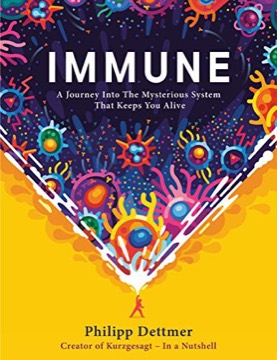
Immune
Philipp Dettmer's illustrated guide to the immune system, from the Kurzgesagt channel: an attempt to explain the most complex system in the body without simplifying it into uselessness.
- First published
- 2021
- Publisher
- Hodder & Stoughton
- Pages
- 368
- Shelf
- Science
- Level
- Entry
- ISBN-13
- 9780593241332
Record checked against
Only one source carried a publication date for this work, so the year is uncorroborated.
Catalogue note
- Reads as
- ConceptualExplains how something works before what to do about it.
- Level
- Accessible / FoundationalNo prior reading assumed.
- Approach
- Theoretical
- Written for
- Curious general readers, Newcomers to the subject
- Ideas
Saved in this browser only — no account, nothing sent anywhere. My library
Read this if
- You want to understand living things by how they came to be.
- You want to understand how it works before deciding what to do about it.
- You are starting from scratch here and want a way in that assumes no prior reading.
The approach
Dettmer's method is to follow an infection through the whole response, in order, building the cast as it appears: macrophages, neutrophils, dendritic cells, T cells, B cells, antibodies, the complement system.
The book is heavily illustrated and written in a deliberately informal register, with the immune cells given something close to personalities so the interactions can be followed.
It follows one splinter in one finger through the entire response, which is why the complexity stays navigable.
Devmark’s reading — not a quotation from the book
What it covers
Innate and adaptive immunity, the mechanics of antigen presentation, why fever exists, how vaccines work, allergy and autoimmunity as the system misfiring, and a substantial section on cancer as an immune failure.
The chapter on why the system needs to distinguish self from non-self, and the elaborate machinery for training that distinction, is the book's core.
Its achievement and its limit
Immunology is genuinely difficult and general accounts tend either to flatten it or lose the reader. Dettmer holds an unusual middle: the reader finishes with a working mental model rather than a set of facts.
The informality is divisive, and the anthropomorphism that makes it followable also makes it occasionally imprecise. Dettmer flags where he is simplifying, which mitigates this.
The anthropomorphism is what makes it followable and what makes it approximate; he says so.
Devmark’s reading — not a quotation from the book
Timing
Written largely before the pandemic and published in 2021, with a section on coronaviruses added. It is not a Covid book and is better for it.
A good first book on the subject and a reasonable foundation for reading anything more technical afterwards.
The illustrations are integral rather than decorative, and the book loses a great deal in audio: this is one to read in print or on a screen where the diagrams are visible alongside the text.
The cast
Dettmer's structure depends on introducing cells as characters with jobs: the patrolling scavengers that arrive first, the short-lived infantry that die in enormous numbers, the messengers that carry fragments of the enemy back to headquarters, the specialists that take days to arrive but arrive targeted. Naming them before explaining the chemistry is what makes the rest legible.
Buying time
The central architecture is a relay. The innate system responds in minutes, cannot learn, and is mostly there to hold a line; the adaptive system takes days to organise and is exquisitely specific. Nearly everything a person experiences as being ill — fever, swelling, exhaustion — is the first system fighting and signalling while the second is still getting ready.
Most of what illness feels like is the fast system holding on until the slow one is ready.
Devmark’s reading — not a quotation from the book
Specificity out of randomness
The book's most counter-intuitive passage explains how the body can recognise pathogens it has never met and could not have anticipated: receptor genes are shuffled essentially at random during development, producing an enormous library of specificities, and the ones that would attack the body are destroyed before release. Recognition is therefore not designed in advance. It is generated blindly and then edited.
Where the cells meet
Lymph nodes get a chapter of their own because the immune response has a logistics problem: the few cells that happen to match a given invader must find the messengers carrying its fragments. The nodes solve it by concentrating both populations in one place and forcing them through it, which is also why they swell when you are ill.
When it turns on you
Autoimmunity and allergy are treated as the same machinery misdirected rather than as separate malfunctions: a system built to distinguish self from non-self, with catastrophic consequences when the distinction slips, and a system built for parasites reacting to pollen. Dettmer is careful to present the hygiene-hypothesis explanation as a leading idea rather than a settled one.
What the illustrations are for
The diagrams do argumentative work rather than decoration. Immunology's difficulty is largely that it involves many interacting agents at once, which prose handles badly and pictures handle well. The cost is precision: Dettmer is explicit in his notes that the visual metaphors simplify, and readers going on to real immunology will need to unlearn some of them.
What to take from it
It is the best available first model of the immune system for someone with no biology, and it is honest that a first model is what it is. Read it for the shape of the response, not for the detail, and treat the footnotes as part of the book rather than as optional.
What to take away
- 01One infection, followed throughThe cast is introduced as it becomes relevant.
- 02Innate and adaptiveTwo systems with different speeds and different jobs.
- 03Self versus non-selfThe training machinery for that distinction is the book's core.
- 04MisfiresAllergy and autoimmunity as the same system going wrong.
- 05A working modelYou finish with a mental model rather than a list of facts.