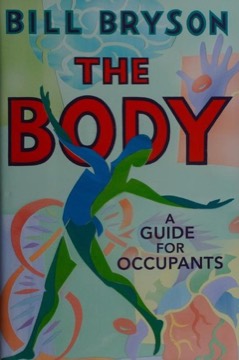
The Body
Bill Bryson's guided tour of human anatomy and physiology, organ by organ and system by system, with the same biographical curiosity he brought to the sciences.
- First published
- 2019
- Publisher
- Transworld Publishers Limited
- Pages
- 465
- Shelf
- Science
- Level
- Entry
- ISBN-13
- 9781473508156
Record checked against
Catalogue note
- Reads as
- ConceptualExplains how something works before what to do about it.
- Level
- Accessible / FoundationalNo prior reading assumed.
- Approach
- Theoretical
- Written for
- Curious general readers, Newcomers to the subject
Saved in this browser only — no account, nothing sent anywhere. My library
Read this if
- You want to understand living things by how they came to be.
- You want to know how we know things, and how that goes wrong.
- You want to understand how it works before deciding what to do about it.
- You are starting from scratch here and want a way in that assumes no prior reading.
What it covers
Skin, hair, microbes, the brain, the head, the mouth and throat, the heart and blood, the skeleton, sleep, disease, medicine and death — roughly a chapter per system, with the history of how each was understood.
The framing question is how a body made of common elements, costing very little in raw material, manages to be a person.
The organising question is how something assembled from cheap common elements ends up being someone.
Devmark’s reading — not a quotation from the book
What it does well
The medical history is the strongest material: the surgeons who experimented on themselves, the resistance to handwashing, the accidental discoveries, and the recurring pattern of correct ideas rejected for a generation.
Bryson is also good on how much remains unknown — why we sleep, why we age, what most of the immune system is doing — and does not paper over it.
Limits
Published in 2019 and already dated in the microbiome and immunology sections, which are among the fastest-moving areas he covers.
As with his other science books, it is a well-sourced popular survey rather than a medical text, and reads best as an introduction that makes the specialist literature approachable.
He is consistently clear about what medicine still does not know, which is rarer than it should be.
Devmark’s reading — not a quotation from the book
The recurring point
Bryson keeps returning to how much of the body's functioning is self-managing and invisible: the count of cells replaced daily, the immune decisions made without any signal reaching consciousness, the quantity of maintenance that proceeds regardless.
The other repeated observation is how much medical progress came from accident, stubbornness or outright error, and how recently the basics were settled — anaesthesia, sterile technique and the germ theory are all more recent than most readers assume.
The doctors who used themselves
Bryson's favourite material is the self-experimenters: the physician who threaded a catheter into his own heart to prove it could be done and was disciplined for it, the researchers who swallowed cultures to establish causation, the anaesthetists who tested their compounds on themselves. He uses them to make a point about how knowledge was actually obtained, which is messier and more personal than a textbook implies.
How long it took to accept handwashing
The recurring theme of medical resistance gets its clearest case in the history of puerperal fever, where a physician's demonstration that handwashing collapsed maternal deaths was rejected by colleagues for decades and he died discredited. Bryson's interest is less in the villainy than in the mechanism — evidence that insults the competence of the people who must act on it is absorbed very slowly.
The evidence was not weak. It was insulting to the people who would have had to act on it.
Devmark’s reading — not a quotation from the book
The vitamin story
The chapters on nutrition trace how long it took to establish that some diseases are caused by an absence rather than a presence: scurvy solved empirically, then forgotten, then re-solved; deficiency conditions misattributed to infection for years. It is Bryson's best illustration of how counter-intuitive the idea of a disease of absence was.
What the brain costs
Among the physiological material he returns to most is the energy budget: an organ that is a small fraction of body mass consuming a disproportionate share of the body's fuel, running continuously, generating everything a person experiences from electrochemical activity it has no direct access to the world through. He does not theorise about consciousness; he lets the numbers carry the strangeness.
Sleep and what is still unexplained
The sleep chapter is deliberately inconclusive. Bryson lays out the consequences of deprivation, the consolidation findings and the clearance hypotheses, and then declines to resolve why the state exists, on the grounds that the field has not. It is characteristic: the book is at its most reliable where it reports uncertainty rather than closing it.
Where it is dated
Published in 2019, and the fastest-moving chapters have moved: microbiome research, immunology and cancer genetics have all changed materially since, and the pandemic that followed is obviously absent. The anatomy and the medical history, which is most of the book, have not dated at all.
What to take from it
Read it for the history and the accumulation of specifics rather than for a systematic understanding — it is a tour, and tours are structured by what is interesting rather than by what is fundamental. Its durable effect is a kind of attention: the recurring reminder that an enormous amount is going on that you neither direct nor perceive.
What to take away
- 01System by systemRoughly a chapter per organ or process, with its history attached.
- 02Medicine's resistanceCorrect ideas rejected for a generation, repeatedly.
- 03Self-experimenting doctorsA recurring and frequently alarming motif.
- 04What is still unknownSleep, ageing and much of immunity, stated plainly.
- 05Dated in fast areasMicrobiome and immunology have moved since 2019.