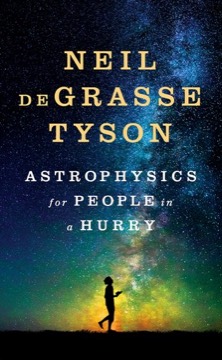
Astrophysics for People in a Hurry
Neil deGrasse Tyson's compressed tour of modern astrophysics — twelve short chapters covering the origin of the universe, its contents, its forces and its likely fate, written for readers with limited time.
- First published
- 2017
- Publisher
- W. W. Norton & Company
- Pages
- 209
- Shelf
- Science
- Level
- Entry
- ISBN-13
- 9788449333934
Record checked against
Catalogue note
- Reads as
- ConceptualExplains how something works before what to do about it.
- Level
- Accessible / FoundationalNo prior reading assumed.
- Approach
- Theoretical
- Written for
- Curious general readers, Newcomers to the subject
- Ideas
Saved in this browser only — no account, nothing sent anywhere. My library
Read this if
- You want to know how the universe is put together.
- You want to understand how it works before deciding what to do about it.
- You are starting from scratch here and want a way in that assumes no prior reading.
The premise and the constraint
Tyson's stated audience is someone who wants to know what is going on in the universe but has no time to take a course. The chapters are short, each covering one topic, and the whole can be read in a few sittings.
The constraint shapes everything. There are no equations, few diagrams, and the explanations are compressed to the point where a reader gains familiarity with concepts rather than an ability to reason with them.
You come away able to recognise the concepts rather than able to reason with them. That is the trade it makes.
Devmark’s reading — not a quotation from the book
The first three minutes
His opening chapter on the earliest moments: the separation of the fundamental forces, the formation of particles, the brief window of nucleosynthesis in which the light elements were made.
His treatment of how much is known with confidence and how much remains speculative — particularly before the first fraction of a second — is appropriately careful, and he marks the boundary rather than blurring it.
Dark matter
His account of the evidence: galaxies rotating faster than their visible mass allows, clusters held together by more gravity than their contents explain, and gravitational lensing revealing mass where nothing is visible.
His insistence that the name is a confession of ignorance rather than a description is the right emphasis. We know there is gravitational influence and we do not know what produces it.
Dark energy
His chapter on the discovery that the expansion of the universe is accelerating, and on the vacuum energy that would account for it.
His framing of the cosmological constant's history — introduced, discarded as a blunder, resurrected by observation — is a useful illustration of how theory and evidence interact over decades, and it is one of the better passages in the book.
Light, spectra and what telescopes see
His chapters on the electromagnetic spectrum, on why observing in different wavelengths reveals different universes, and on what spectroscopy tells us about composition and motion.
This is the most practically illuminating material for a general reader, because it explains the mechanism by which distant facts are known, which is the question most people actually have about astronomy.
The periodic table among the stars
His account of where the elements came from: hydrogen and helium from the early universe, most of the rest from stellar fusion and from the deaths of massive stars.
His conclusion that the atoms in a human body were assembled inside stars is the book's version of a line he has made famous in other contexts, and the chemistry behind it is laid out properly rather than asserted.
Exoplanets and the search
His treatment of planet detection methods and of what has been found, which is the fastest-moving field the book covers and therefore the most vulnerable to dating.
His caution about what can and cannot be inferred about habitability from current observations is well judged, and it is a useful corrective to headlines announcing Earth-like worlds on the basis of a radius and an orbital distance, which between them establish very little about whether anything could live there.
The cosmic perspective
His closing chapter, and the most quoted. His argument is that understanding the scale of the universe should change how one regards human conflicts, national boundaries and self-importance.
It is a moral argument rather than a scientific one and he presents it as such. Readers find it either the point of the book or an unearned sermon.
The closing chapter is a moral argument, not a scientific one, and he does not pretend otherwise.
Devmark’s reading — not a quotation from the book
Where it is limited
The brevity is the main cost. Complex topics receive a few pages, analogies substitute for mechanisms, and a reader who wants to understand rather than be informed will need something longer.
The tone is also more performative than Sagan's, with a recurring jokiness that some readers find warm and others find distracting from the material.
What it is good for
Orientation. It gives a reader the vocabulary and the shape of the field so that subsequent reading has somewhere to attach.
For someone who has never read popular physics, it is a reasonable first book. For someone who has, it will mostly restate what they know in less space.
What to take away
- 01Dark matter names an ignoranceWe know there is gravitational influence and we do not know what produces it.
- 02Different wavelengths, different universesSpectroscopy is the mechanism by which distant facts are known, which is the question most readers have.
- 03The elements were made in starsThe chemistry behind the familiar line is laid out properly rather than asserted.
- 04The constant was discarded and resurrectedA clean illustration of how theory and observation correct each other across decades.
- 05It orients rather than explainsGood as a first book in the field; largely redundant if you have read others.