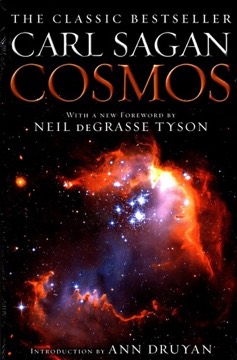
Cosmos
Carl Sagan's account of the universe and of humanity's attempt to understand it — written alongside the television series, moving between astronomy, the history of science, evolution and the question of what kind of civilisation we intend to be.
- First published
- 1980
- Publisher
- Random House
- Pages
- 354
- Shelf
- Science
- Level
- Entry
- ISBN-13
- 9780351314216
Record checked against
Catalogue note
- Reads as
- ConceptualExplains how something works before what to do about it.
- Level
- Accessible / FoundationalNo prior reading assumed.
- Approach
- Theoretical
- Written for
- Curious general readers, Newcomers to the subject
Saved in this browser only — no account, nothing sent anywhere. My library
Read this if
- You want to know how the universe is put together.
- You want to know how we know things, and how that goes wrong.
- You want to understand how it works before deciding what to do about it.
- You are starting from scratch here and want a way in that assumes no prior reading.
What it is doing
It is not a textbook and not a popularisation of a single field. It is an argument that the scientific understanding of the universe is a cultural achievement belonging to everyone, and that the history of how we came to it is as important as the content.
Its thirteen chapters move between cosmology, biology, planetary science, the history of ideas and political argument, held together by a consistent voice rather than by a discipline.
The argument is that scientific understanding is a cultural inheritance, not the property of specialists.
Devmark’s reading — not a quotation from the book
The cosmic calendar
His device for making deep time comprehensible: compress the history of the universe into a single year. The Big Bang on 1 January, the Milky Way in May, the solar system in September, life shortly after.
All of recorded human history occupies the final seconds of 31 December. The device is arithmetic rather than argument, and it does more to convey scale than any amount of exponent notation.
The library of Alexandria
His recurring historical thread and his most emotionally loaded material: the accumulation of ancient learning, the work of Eratosthenes measuring the Earth's circumference with shadows and reasoning, and the destruction of what had been gathered.
His account of Hypatia's murder and the library's loss functions as the book's warning: knowledge is not self-preserving, and a civilisation can discard what it took centuries to build.
Eratosthenes and the method
His favourite illustration of how science works. A man in Egypt notices that a stick casts no shadow at noon in one city and does cast one in another, and from that difference calculates the size of the planet with striking accuracy.
The point is methodological. No new technology was required, only careful observation, a willingness to ask why, and the assumption that the world is intelligible.
Evolution and the Heike crab
His treatment of natural selection through a specific case: Japanese crabs whose shells resemble a samurai face, and the suggestion that fishermen returning such crabs to the sea produced artificial selection over generations.
The example is contested by biologists and is probably not the best illustration he could have chosen. The underlying exposition of selection and of the relatedness of all terrestrial life is sound.
Other worlds and the search
His chapters on planetary exploration, on Venus as a warning about runaway greenhouse warming, on Mars and the Viking landers, and on the search for intelligence elsewhere.
His treatment of the Drake equation is honest about how little is known about most of its terms, which distinguishes it from a great deal of subsequent writing on the subject.
The political argument
The book was written during the Cold War and its closing chapters are explicit: nuclear weapons represent a plausible route to the extinction of a species that took four billion years to arrive.
His argument that the same intelligence that produced science produced the means of self-destruction, and that no outside authority will resolve it, is not incidental to the book. It is where the whole argument was heading.
The same intelligence produced both the science and the means of ending it. That is where the book was heading.
Devmark’s reading — not a quotation from the book
The prose
It is deliberately lyrical, and the criticism that it is overwrought has been made since publication. Sagan's cadences, his repetitions and his willingness to be moved are either the book's great strength or its weakness depending on the reader.
What is not in dispute is that the register was a choice. He believed that wonder was a legitimate response to accurate information and that stripping it out was itself a distortion.
What has dated
The astronomy, inevitably. Exoplanets were unknown, the expansion's acceleration undiscovered, Pluto was a planet, and the Viking results are described without what followed.
The history, the method and the argument have not dated. A reader should expect the specific science to require updating and the framework to hold.
Its effect
It reached an extraordinarily large audience for a work about science, and a substantial number of working scientists have described it as the reason they entered the field.
Its more durable contribution may be the posture it models: that scepticism and wonder are not opposites, and that demanding evidence and finding the universe astonishing are the same activity conducted properly.
What to take away
- 01The cosmic calendarCompressing everything into one year puts all recorded history in the final seconds of December.
- 02Eratosthenes needed only shadowsCareful observation and the assumption that the world is intelligible were sufficient to measure a planet.
- 03Knowledge is not self-preservingAlexandria is the book's standing warning that a civilisation can discard what took centuries to build.
- 04Scepticism and wonder are the same postureDemanding evidence and finding the universe astonishing are not in tension.
- 05The science dates, the framework does notExpect to update the astronomy; the method and the argument hold.