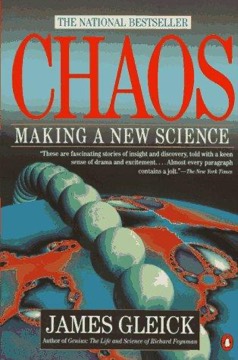
Chaos
making a new science
James Gleick's history of how a set of scattered findings across several disciplines converged into the study of nonlinear dynamics — deterministic systems whose behaviour cannot be predicted in practice.
- First published
- 1987
- Publisher
- Viking Books
- Pages
- 364
- Shelf
- Science
- Level
- Core
- ISBN-13
- 9789518840124
Record checked against
Catalogue note
- Reads as
- TechnicalAssumes and builds craft knowledge.
- Level
- Core / BuildingAssumes general familiarity with the subject.
- Approach
- Applied
- Written for
- Curious general readers, Readers with some grounding
Saved in this browser only — no account, nothing sent anywhere. My library
Read this if
- You keep fixing symptoms and want to see the structure producing them.
- You want to know how the universe is put together.
- You want to know how we got here.
- You work in this area and want depth rather than an overview.
- You know roughly how the subject works and want the fuller account.
The central finding
The discovery the book documents is that simple deterministic rules can produce behaviour that is entirely unpredictable over time, without any randomness anywhere in the system.
This broke an assumption that had operated since Newton: that determinism and predictability were the same thing, and that unpredictability indicated either randomness or incomplete knowledge of the rules.
Determinism and predictability turned out to be different things. That assumption had held since Newton.
Devmark’s reading — not a quotation from the book
Lorenz and the weather model
His founding story: a meteorologist running a simplified weather simulation, restarting it from printed values rounded to three decimal places instead of six, and finding that the two runs diverged completely.
The rounding was a thousandth of a per cent and the forecasts became unrelated. The system was deterministic and its long-term behaviour was inaccessible, which is the whole discovery in a single accident.
Sensitive dependence and the butterfly
The technical property: arbitrarily small differences in initial conditions grow exponentially, so any finite measurement precision buys only a finite prediction horizon.
The butterfly image came from the title of a Lorenz talk and has been misused ever since as a claim that small causes have large effects generally. The actual claim is narrower and more precise: in certain systems, the error in your knowledge doubles at a characteristic rate.
Attractors and phase space
His exposition of the geometric approach: plotting a system's state as a point in an abstract space and watching what shape its trajectory settles onto.
Fixed points and cycles were understood. The Lorenz attractor — a bounded shape the trajectory never leaves and never repeats — was the new object, and its structure is what gives chaotic systems their combination of stability and unpredictability.
Feigenbaum and universality
The book's most surprising result. Studying how simple iterated equations transition to chaos through period doubling, Feigenbaum found that the ratio at which the doublings accelerate is a specific constant, the same across entirely different equations.
Universality is what made chaos a field rather than a collection of curiosities. A number that appears in dripping taps, fluid convection and population models is evidence that something structural is being described rather than a set of coincidences.
Mandelbrot and fractals
His chapters on self-similarity across scales, on the coastline measurement problem, and on fractional dimension as a way of characterising roughness.
The connection to chaos runs through the geometry of strange attractors, which are fractal objects. His account of how Mandelbrot's work was received — as insufficiently rigorous, by a mathematics establishment uncomfortable with pictures — is one of the book's better sociological passages.
The people and the resistance
A recurring theme: these results were found by people working at the edges of their disciplines, frequently on equipment they were not supposed to be using, and were often dismissed by colleagues.
His account of why is instructive. The findings did not fit the existing categories of any single field, and a result that belongs to no department is nobody's responsibility to take seriously.
A result that belongs to no department is nobody's responsibility to take seriously.
Devmark’s reading — not a quotation from the book
Applications and overreach
His later chapters cover applications to physiology, ecology, economics and turbulence.
This is where the book is weakest and where the field subsequently disappointed. Chaos theory explained why certain predictions are impossible, which is valuable, but it produced fewer usable predictive tools than the enthusiasm of the period suggested.
How it has aged
The history is excellent and remains the standard popular account. The science is established and has been absorbed into ordinary practice in several fields.
The revolutionary framing has dated. Chaos is now a normal part of applied mathematics rather than a paradigm shift in progress, and the wider claims made for it in the eighties did not materialise.
What to take from it
The distinction between deterministic and predictable, which is the conceptual gain and which changes how one reads any long-range forecast.
And universality, which is the strongest evidence that the field found something real: the same constant governing the route to chaos in systems that have nothing else in common.
What to take away
- 01Deterministic is not predictableSimple rules with no randomness can produce behaviour inaccessible beyond a finite horizon.
- 02Precision buys time, not certaintyErrors double at a characteristic rate, so more accurate measurement extends the horizon linearly at best.
- 03Universality made it a fieldThe same constant governing period doubling across unrelated equations is what ruled out coincidence.
- 04Strange attractors are bounded and never repeatWhich is how a system can be stable in shape and unpredictable in detail at once.
- 05The applications underdeliveredIt explained why some predictions are impossible more successfully than it produced new predictive tools.