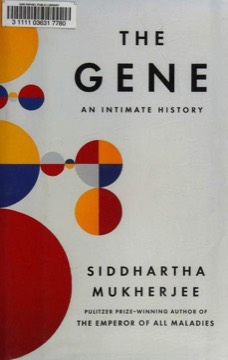
The Gene
Siddhartha Mukherjee's history of heredity — from Mendel's peas to gene editing — structured around the scientific question of what a gene is and the moral question of what we should do once we can change one.
- First published
- 2016
- Publisher
- Scribner
- Pages
- 605
- Shelf
- Science
- Level
- Deep
- ISBN-13
- 9781501150128
Record checked against
Catalogue note
- Reads as
- ConceptualExplains how something works before what to do about it.
- Level
- Advanced / AdvancedAssumes you have read around the subject already.
- Approach
- Theoretical
- Written for
- Curious general readers, Specialists and serious readers
Saved in this browser only — no account, nothing sent anywhere. My library
Read this if
- You want to understand living things by how they came to be.
- You want to know how we got here.
- You want to understand how it works before deciding what to do about it.
- You have read around this already and want a book that assumes it.
The personal frame
Mukherjee opens with his own family: two uncles and a cousin with severe mental illness, and the question of what has been transmitted through his family and what it means for his children.
The frame is not decoration. It establishes the book's governing tension between the gene as an abstraction studied in laboratories and the gene as something that determines particular lives, and he returns to it at each major turn.
The family question is the book's spine: the gene as laboratory abstraction and as a verdict on particular lives.
Devmark’s reading — not a quotation from the book
Mendel and the forty years of silence
His account of the monastery garden, the careful counting, and the paper that was published and then almost entirely ignored until it was rediscovered at the turn of the century.
His interest is in why it was ignored: the result was correct, the method was sound, and the scientific community had no framework into which it fitted. It is his standing example of how discovery depends on a receptive context.
Darwin without heredity
His treatment of the central gap in the original theory of evolution: Darwin had a mechanism of selection and no account of how variation was produced or transmitted, and his own proposal was wrong.
The reunification of selection with Mendelian inheritance in the modern synthesis is one of the book's clearest expositions, and it explains why evolution's explanatory power arrived decades after the theory.
Eugenics
His most important historical section, and he refuses to treat it as an aberration. Eugenics was mainstream science, advocated by prominent biologists and statisticians, enacted through sterilisation laws in the United States and elsewhere before being carried to its conclusion in Germany.
His point is that it followed from a genuine scientific enthusiasm applied without a moral framework, and that the scientists involved were not cranks. This is the book's central warning and it governs how he treats everything that follows.
Identifying the molecule
His account of the experimental chain: Griffith's transforming principle, Avery's identification of DNA, Hershey and Chase, and the structure itself.
His treatment of Rosalind Franklin is careful — he describes the use of her data without her knowledge and assesses the credit question without reducing it to a simple morality tale, which is the responsible way to handle a genuinely contested history.
Regulation, and the gene as verb
His coverage of what came after the structure: the genetic code, gene regulation, the discovery that genes are switched on and off in patterns that account for how one genome produces many cell types.
His emphasis is that the gene is not a static instruction but something expressed conditionally, which is the finding that most undermines simple genetic determinism.
The genome project and what it found
His account of the public and private sequencing efforts, their rivalry, and the surprising result: far fewer genes than expected, and vast stretches whose function was unclear.
His observation that the number came in closer to a worm's than to expectations is the book's best illustration of how complexity arises from regulation and combination rather than from the count of parts.
Behaviour, identity and what genes do not determine
His most careful chapters, on the genetics of intelligence, sexuality, temperament and mental illness.
His treatment of heritability is the part most worth reading closely. He explains why a high heritability estimate within a population says nothing about the causes of differences between populations, which is the single most consequential misunderstanding in public discussion of genetics.
High heritability within a population says nothing about differences between populations. That error is the costly one.
Devmark’s reading — not a quotation from the book
Editing
His final section on CRISPR and on the arrival of precise, cheap genome editing, written as the technology was becoming real.
His framing question — not can we but should we, and who decides — returns directly to the eugenics chapters. His three criteria for when intervention might be justified are offered tentatively rather than as a settled position.
Where it is limited
It is long and the narrative technique — a historical figure introduced with biographical colour, then the finding — becomes repetitive across six hundred pages.
Specialists have also noted that the treatment of some contemporary genetics is simplified, and that the book's moral framing occasionally shapes which scientific disputes get airtime. Its history is stronger than its account of the current state of the field.
What to take away
- 01Eugenics was mainstream scienceNot an aberration by cranks, which is why the warning applies to enthusiasm rather than to villains.
- 02Mendel was ignored because nothing fitted himCorrect results published into a context with no framework to receive them.
- 03Regulation, not count, produces complexityThe gene number came in far lower than expected, which relocated the explanation to expression.
- 04Heritability is within-population onlyExtending an estimate across populations is the single most consequential error in public genetics discussion.
- 05The editing question returns to eugenicsNot whether we can, but who decides and on what criteria, which is where the history was always pointing.