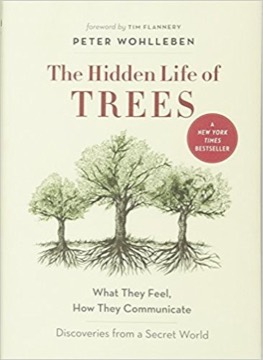
The Hidden Life of Trees
Peter Wohlleben's account of forests as communicating, cooperating systems — written from decades as a working forester, and arguing that trees should be understood as social organisms rather than as standing timber.
- First published
- 2015
- Publisher
- French and European Publications Inc
- Pages
- 264
- Shelf
- Science
- Level
- Entry
- ISBN-13
- 9780008327422
Record checked against
Only one source carried a publication date for this work, so the year is uncorroborated.
Catalogue note
- Reads as
- ReflectiveChanges how you see rather than what you do.
- Level
- Accessible / FoundationalNo prior reading assumed.
- Approach
- Theoretical
- Written for
- Curious general readers, Newcomers to the subject
Saved in this browser only — no account, nothing sent anywhere. My library
Read this if
- You want to understand living things by how they came to be.
- You want to understand a place, or what we are doing to one.
- You want a book that changes how you see things rather than what you do tomorrow.
- You are starting from scratch here and want a way in that assumes no prior reading.
Where it comes from
Wohlleben managed a municipal forest in Germany for decades and wrote this after shifting his own practice from commercial forestry toward conservation.
The book is a practitioner's account informed by research rather than a work of science, and its authority comes from long observation of specific woodland. That is both its strength and the source of most criticism of it.
A practitioner's account informed by research, not a work of science. That distinction explains both its strengths and its critics.
Devmark’s reading — not a quotation from the book
The wood wide web
His central subject: the mycorrhizal networks connecting tree roots through fungal filaments, through which water, carbon and chemical signals can pass.
The underlying science is real and associated with Suzanne Simard's research on carbon transfer between trees. Wohlleben's presentation of it as a deliberate support system is where interpretation exceeds what the evidence establishes.
Mother trees and their offspring
His account of large old trees connected to seedlings of the same species, apparently supplying them with sugars while they grow in shade.
The observed phenomenon of carbon movement is documented. Whether it constitutes nurture, or is better explained as fungal networks moving resources for their own reasons, is actively disputed among ecologists and the book does not present the dispute.
Chemical signalling
His stronger material: trees releasing volatile compounds when attacked, neighbouring trees detecting them and increasing their own chemical defences, and specific compounds attracting predators of the attacking insect.
This is well established experimentally, including the frequently cited acacia and giraffe observations, and it is the clearest example of trees responding to information from other trees.
Time at a different scale
His most persuasive contribution: the argument that trees appear inert because they operate on a timescale we cannot perceive, and that a beech seedling may spend decades waiting in shade for an opening.
This reframing does more work than any of the contested claims. A great deal of what looks like passivity in a forest is activity observed at the wrong frame rate.
Forest as a system
His argument that a forest is not a collection of trees but a regulated environment — humidity, temperature, wind, soil biology — that individual trees depend on and collectively maintain.
His practical case follows: clear-felling and plantation forestry destroy the conditions the trees require, which is why planted monocultures need management that established woodland does not.
The anthropomorphism problem
It is the main scientific objection and it is substantial. Wohlleben writes of trees as friends, as mothers, as suffering, as screaming, and he defends this as making the biology accessible.
The cost is that a reader cannot easily distinguish documented finding from interpretive framing. Several plant scientists have publicly criticised the book on exactly this ground, and a reader should hold the vocabulary lightly while taking the underlying phenomena seriously.
The vocabulary and the findings are hard to separate, which is the substance of the scientific objection.
Devmark’s reading — not a quotation from the book
What is solid and what is not
Solid: mycorrhizal networks, chemical signalling between plants, root grafting between trees of the same species, the microclimate effects of intact forest.
Contested: the degree of deliberate resource-sharing, the interpretation of networks as cooperative rather than as fungal self-interest, and anything implying intention or feeling. Recent reviews have argued that some network claims were overstated in the popular literature generally.
Its effect
It reached an extremely large readership and changed public conversation about forestry in Germany and elsewhere, and it contributed to interest in continuous-cover and mixed-species management.
Whether one accepts its framing, it moved a technical argument about forest management into general discussion, which few works of natural history manage.
How to read it
As a forester's observations and enthusiasms, valuable for what it makes you notice in actual woodland, and not as a summary of plant science.
Read alongside a more sceptical treatment of plant communication, a reader gets both the phenomena and the appropriate uncertainty, which is better than either source alone.
What to take away
- 01Forests are regulated environmentsHumidity, temperature and soil biology are maintained collectively, which is why plantations need management.
- 02Chemical signalling is well establishedVolatile compounds released under attack, detected by neighbours, is the solid core of the book.
- 03Wrong frame rate, not passivityA seedling waiting decades in shade looks inert only because we observe at human speed.
- 04The nurture reading is contestedCarbon moves between trees; whether that constitutes support or fungal self-interest is genuinely disputed.
- 05Hold the vocabulary lightlyThe anthropomorphism makes it readable and makes finding and interpretation hard to separate.