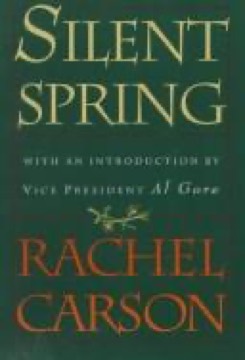
Silent Spring
Rachel Carson's account of what synthetic pesticides were doing to living systems — the book that is generally credited with starting the modern environmental movement, and with establishing that chemical use is a public question.
- First published
- 1962
- Publisher
- Fawcett World Library
- Pages
- 336
- Shelf
- Science
- Level
- Core
- ISBN-13
- 9788498920918
Record checked against
Catalogue note
- Reads as
- ConceptualExplains how something works before what to do about it.
- Level
- Core / BuildingAssumes general familiarity with the subject.
- Approach
- Theoretical
- Written for
- Curious general readers, Readers with some grounding
- Ideas
Saved in this browser only — no account, nothing sent anywhere. My library
Read this if
- You want to understand a place, or what we are doing to one.
- You want to understand how it works before deciding what to do about it.
- You know roughly how the subject works and want the fuller account.
The opening fable
It begins with a short imagined account of an American town where the birds have gone silent, the vegetation is browned, and people are falling ill — then states that no such town exists, but that every one of the described events has happened somewhere.
The device is rhetorical and it is honest about being so. It gives the reader an image to hold before the evidence arrives, which is why the book reached people that a technical report would not have.
No such town exists, she writes, but every event described has happened somewhere. The device is honest about itself.
Devmark’s reading — not a quotation from the book
The central mechanism
Her scientific core: persistent synthetic chemicals, particularly the chlorinated hydrocarbons, do not break down quickly, accumulate in fatty tissue, and concentrate as they move up food chains.
Biomagnification is the key process. A concentration harmless in water becomes lethal in a predator several steps up, which is why effects appear in species far from where the chemical was applied.
DDT and the birds
Her best-documented case: raptor and fish-eating bird populations declining sharply, with reproductive failure rather than direct poisoning as the mechanism.
The eggshell-thinning link was established more firmly after publication than she could state at the time, and it subsequently became one of the clearest demonstrations of the effect she described.
Resistance and the treadmill
Her argument that heavy pesticide use selects for resistant insects, requiring more chemical or stronger chemicals, while simultaneously killing the predators that had been controlling the pest.
This is the part of the book that was least disputed even by her opponents and that has been most thoroughly confirmed. It is also an argument about evolution operating on agricultural timescales, which was not widely understood at the time.
Human health
Her chapters on carcinogenesis and on chronic low-dose exposure, which are the most cautious in the book and were the most attacked.
Her position was that effects might take decades to appear and that absence of immediate harm was not evidence of safety. Some specific claims were beyond the evidence then available; the general principle became standard in toxicology.
What she actually proposed
Not a ban on all pesticides. Her recommendations were for restraint, targeted application, biological controls, and above all for testing before widespread use and for public disclosure.
This matters because she was attacked then, and is attacked now, for a position she did not take. She wrote explicitly that she was not arguing chemical insecticides should never be used.
She wrote explicitly that she was not arguing insecticides should never be used. She is still criticised for it.
Devmark’s reading — not a quotation from the book
The attack on her
The chemical industry mounted a substantial campaign before and after publication, questioning her competence, her motives and — repeatedly and explicitly — her suitability as an unmarried woman without a doctorate to comment on the subject.
She was dying of cancer while defending the book, a fact she kept private because it would have been used to characterise her as emotionally involved.
Its consequences
It led to a presidential advisory committee review that substantially supported her, to the eventual United States ban on agricultural DDT, and to the creation of the Environmental Protection Agency.
Its more general consequence was establishing that the effects of industrial chemicals on shared ecosystems are a matter for public decision rather than for producers alone.
The malaria criticism
The persistent modern charge is that restricting DDT cost lives by hampering malaria control. It requires a careful answer.
The agricultural bans did not prohibit public-health use, and mosquito resistance driven by heavy agricultural application was already reducing effectiveness — which is the mechanism Carson herself described. The history is genuinely contested in its details, and the simple version of the charge does not survive examination.
Reading it now
The specific chemistry is dated and some claims have been refined or corrected. Its argument about persistence, accumulation and unintended consequence has been repeatedly vindicated with other compounds.
It is also, unusually for a book with this much political effect, written with real literary care. Carson was a working marine biologist and a successful nature writer before this, and the prose is why it was read.
What to take away
- 01Biomagnification is the mechanismA harmless concentration in water becomes lethal several steps up a food chain.
- 02Pesticides select for resistanceAnd kill the predators that were controlling the pest, which is the treadmill nobody disputed.
- 03Absence of immediate harm is not safetyHer principle about delayed effects became standard toxicology after being attacked as alarmism.
- 04She did not call for a banHer recommendations were restraint, targeted use, testing before deployment and public disclosure.
- 05The malaria charge is weaker than it soundsPublic-health use was not prohibited, and agricultural overuse was already driving the resistance.