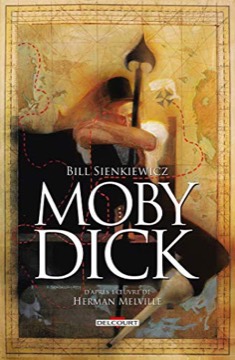
Moby-Dick
Herman Melville's novel of a whaling voyage commanded by a captain pursuing one particular whale — part adventure, part encyclopaedia of an industry, part metaphysical argument, and formally stranger than its reputation suggests.
- First published
- 1851
- Publisher
- Bobbs-Merrill
- Pages
- 452
- Shelf
- Fiction
- Level
- Deep
- ISBN-13
- 9783491960398
Record checked against
Catalogue note
- Reads as
- ReflectiveChanges how you see rather than what you do.
- Level
- Advanced / AdvancedAssumes you have read around the subject already.
- Approach
- Theoretical
- Written for
- Readers of literature, Specialists and serious readers
Saved in this browser only — no account, nothing sent anywhere. My library
Read this if
- You read for the writing as much as for the argument.
- You want to understand a place, or what we are doing to one.
- You want a book that changes how you see things rather than what you do tomorrow.
- You have read around this already and want a book that assumes it.
What kind of book it is
It is not primarily an adventure novel. Roughly half of it is exposition: cetology, the economics of whaling, the practical mechanics of the trade, taxonomies of whales, the history of whaling in art and literature.
These chapters are not padding and they are not a mistake. They are the book's method — an attempt to know a thing completely from every available angle, which is also what Ahab is attempting and which the novel suggests is impossible.
The encyclopaedic chapters are the method, not padding: an attempt to know a thing completely from every angle.
Devmark’s reading — not a quotation from the book
Ishmael
The narrator, who introduces himself and then largely dissolves into the book, sometimes reporting scenes he could not have witnessed and sometimes disappearing for long stretches.
His unreliability is not a puzzle to solve. Melville is using a voice rather than maintaining a consistent point of view, and the inconsistency is part of the formal looseness that makes the novel feel modern.
Ahab
The captain, who lost a leg to the white whale and has converted a commercial voyage into a private pursuit, binding a crew to it through a combination of charisma, ritual and payment.
His monomania is the novel's engine and its subject. Melville presents him as genuinely great — capable, commanding, articulate — and as destroying everyone around him, and declines to resolve which reading governs.
Queequeg and the crew
The harpooner from the South Pacific with whom Ishmael shares a bed in the opening chapters, and whose friendship is described with a warmth unusual for its period.
The crew is deliberately international — Pacific islanders, Africans, Americans, a Parsee — and the ship functions as a compressed model of a world in which people of every origin labour together under one man's obsession.
The whale
Whether Moby Dick means anything is the novel's standing question, and it refuses to answer.
The chapter on the whale's whiteness is the clearest statement of the problem: whiteness signifies purity, terror, blankness and absence simultaneously, and the accumulation of meanings produces no meaning at all. The whale may be evil, may be indifferent, may be nothing, and the book will not say.
The whale may be malevolent, indifferent or nothing at all. The novel systematically declines to resolve it.
Devmark’s reading — not a quotation from the book
The form
Chapters vary wildly: first-person narration, stage directions and soliloquies borrowed from drama, essays, catalogues, a sermon delivered whole.
Melville was writing before the novel's conventions had hardened, and the result is a book that uses whatever form each chapter requires. This is the main reason it reads as experimental to modern readers and read as incompetent to its contemporaries.
The industry
The whaling material is accurate and detailed. Melville had served on a whaler, and the descriptions of the hunt, the processing, the rendering of oil and the economics of the voyage are documentary.
The book is therefore also a primary source on an industry that was central to the nineteenth-century economy and that has since disappeared entirely.
Its failure and recovery
It sold poorly, was reviewed badly, and Melville died in obscurity working as a customs inspector. The book was essentially forgotten for seventy years.
Its revival in the 1920s, and its subsequent installation as a central American novel, is one of the most complete reversals of reputation in literary history, and it happened because modernist readers recognised techniques that its own century had no category for.
Reading it
Most readers who abandon it do so in the cetology chapters. The common advice is to read them rather than skip them, but to read them at a different pace — as essays rather than as narrative.
The narrative chapters are fast, funny and frequently thrilling. The alternation is the experience, and a reader who fights it has a worse time than one who accepts that this book changes mode every few pages.
Why it survives
Because it asks whether the world means anything and constructs an entire apparatus for investigating the question without arriving at an answer.
And because Ahab is a permanently available figure: the person whose capability and conviction are the same thing as their destructiveness, which every generation finds new applications for.
What to take away
- 01The digressions are the argumentKnowing a thing from every angle is what the book attempts and what it suggests cannot be done.
- 02Ahab is great and ruinous at onceMelville refuses to settle which reading governs, and the refusal is the point.
- 03Whiteness accumulates meanings into noneThe chapter on it is the clearest statement of the novel's resistance to interpretation.
- 04It uses whatever form the chapter needsDrama, essay, catalogue and sermon, written before the novel's conventions had hardened.
- 05Forgotten for seventy yearsModernist readers recognised techniques that its own century had no category for.