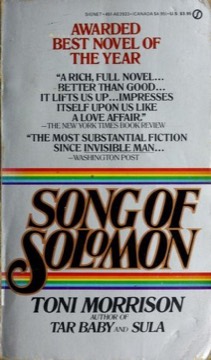
Song of Solomon
Toni Morrison's third novel, following a man called Milkman Dead from Michigan to Virginia in search of family gold and finding something else. The book that won her the National Book Critics Circle Award and led toward the Nobel.
- First published
- 1977
- Publisher
- Knopf Doubleday Publishing Group
- Pages
- 341
- Shelf
- Fiction
- Level
- Deep
- ISBN-13
- 9782267043372
Record checked against
Catalogue note
- Reads as
- ReflectiveChanges how you see rather than what you do.
- Level
- Advanced / AdvancedAssumes you have read around the subject already.
- Approach
- Theoretical
- Written for
- Readers of literature, Specialists and serious readers
Saved in this browser only — no account, nothing sent anywhere. My library
Read this if
- You read for the writing as much as for the argument.
- You want a book that changes how you see things rather than what you do tomorrow.
- You have read around this already and want a book that assumes it.
The premise
Macon Dead III, called Milkman, grows up wealthy, insulated and incurious in a Black Michigan community. His father is a landlord who despises the poor; his aunt Pilate lives outside every convention the family observes.
In his thirties Milkman travels south after a rumoured cache of gold. What he finds instead is his family's history, which is not what he was told, and which is preserved in a children's song.
He goes looking for gold and finds a genealogy, encoded in a song children sing without knowing what it is.
Devmark’s reading — not a quotation from the book
How it is built
This was Morrison's first novel with a male protagonist and her first with a wide geographic sweep. The structure is a quest inverted: the object of the search turns out to be worthless and the journey turns out to be the inheritance.
Myth is woven in without apology — the opening scene involves a man who intends to fly, and flight recurs as both metaphor and literal folk claim, drawn from the African-American legend of enslaved people who flew home.
Morrison treats the flying African legend as true within the novel, and does not explain the decision.
Devmark’s reading — not a quotation from the book
Themes
Names carry the book. The Dead surname comes from a clerical error; Pilate carries hers in an earring; streets are called one thing officially and another by the people who live there. Morrison is writing about who gets to name whom.
Against that is the question of what a man owes the women who made him possible. Milkman's education comes almost entirely from women he has spent his life failing to see properly.
Why it matters
It is the novel where Morrison's mature style arrived fully — the compression, the folk material treated as fact, the refusal to explain Black communities to an implied white reader.
Morrison said she wrote the books she wanted to read and that were not being written. This is the one where that position became a body of work rather than a stance.
The flight
The novel opens with a man stepping off a hospital roof wearing blue silk wings, and closes on a related image. Flight is the book's controlling metaphor and its plot: Milkman's journey is literally a search for whether an ancestor could fly, and figuratively a question about what leaving costs the people left behind.
The men in this book fly. The women are the ones who stay and pay for it.
Devmark’s reading — not a quotation from the book
Names
Almost every character carries a name that was imposed, misrecorded or chosen in defiance: a surname from a drunk clerk's error, a woman named from a Bible opened at random, a nickname earned by humiliation. Morrison makes the recovery of a true name the object of the quest.
Pilate
Milkman's aunt Pilate — born without a navel, carrying her written name folded inside a brass earring, brewing and selling wine, and refusing every convention of respectability her brother has organised his life around — is widely considered Morrison's finest single creation. She is simultaneously the novel's moral centre and the only remaining source of the family history everyone else has worked to bury.
South, and backwards
The second half sends Milkman south from Michigan to Pennsylvania and then Virginia in search of a bag of gold, and what he finds instead is a genealogy, a song and a name. The journey deliberately reverses the direction of the Great Migration, and the novel's argument is that the inheritance he actually needs is precisely the one his father spent an entire life escaping and denying.
Guitar
Guitar, the friend who joins a secret organisation killing white people in numerical retaliation for Black deaths, is given a coherent, sustained and genuinely disturbing argument that the novel declines to dismiss or to caricature. Morrison lets him make his case at length and in his own terms, and her refusal to reduce him to a cautionary figure is among the hardest choices in the book.
Her first male protagonist
Morrison had written two novels centred on women before this, and has described the shift as a deliberate attempt to write a man's journey outward rather than a woman's endurance in place. The Nobel citation singled this novel out, and it is usually the recommended entry point to her work.
What to take away
- 01A quest that invertsThe gold is nothing; the journey delivers a genealogy instead.
- 02Names as powerThe surname is a clerical error, and nearly every name in the book has two versions.
- 03FlightThe legend of enslaved people who flew home is treated as fact inside the novel.
- 04Women as the curriculumMilkman learns everything from women he had not been looking at.
- 05Morrison's arrivalThe novel where the compression and the refusal to explain became fully hers.