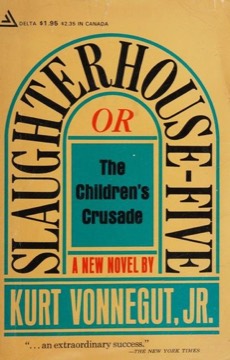
Slaughterhouse-Five
Kurt Vonnegut's novel about Billy Pilgrim, who becomes unstuck in time, and about the firebombing of Dresden, which Vonnegut survived in a meat locker as a prisoner of war.
- First published
- 1969
- Publisher
- Anagrama
- Pages
- 203
- Shelf
- Fiction
- Level
- Core
- ISBN-13
- 9783499115240
Record checked against
Two sources agreed on 1969; a third reported differently (openlibrary 1956, wikidata 1969, wikipedia 1969).
Catalogue note
- Reads as
- ReflectiveChanges how you see rather than what you do.
- Level
- Core / BuildingAssumes general familiarity with the subject.
- Approach
- Theoretical
- Written for
- Readers of literature, Readers with some grounding
Saved in this browser only — no account, nothing sent anywhere. My library
Read this if
- You read for the writing as much as for the argument.
- You want to understand how power is taken, kept and lost.
- You want a book that changes how you see things rather than what you do tomorrow.
- You know roughly how the subject works and want the fuller account.
The premise
Billy Pilgrim experiences his life out of order: his optometry practice, his capture in the Ardennes, the destruction of Dresden, his abduction by aliens from Tralfamadore, his death, all available at once and none in sequence.
The first chapter is Vonnegut in his own voice, explaining that he has been trying to write this book for twenty years and that there is nothing intelligent to say about a massacre.
The first chapter is the author admitting he cannot write the book, and then writing it anyway.
Devmark’s reading — not a quotation from the book
The form as the argument
The time-scrambling is not a device for cleverness. Vonnegut's stated problem was that a conventional war narrative supplies causation and meaning, and Dresden had neither.
The Tralfamadorian view — that all moments always exist and that death is therefore not final — is offered and simultaneously undercut. Billy's fatalism is a survival strategy, and the novel does not endorse it.
The aliens' philosophy is a coping mechanism the book presents and refuses to recommend.
Devmark’s reading — not a quotation from the book
So it goes
The phrase appears after every death, more than a hundred times, and its effect changes across the book: first a tic, then a drumbeat, finally unbearable.
It is the clearest example of Vonnegut's method — a flat refusal of rhetoric that produces more feeling than rhetoric would.
What it is not
It is not an anti-war novel in the sense of arguing a position; Vonnegut says explicitly that writing one is like writing an anti-glacier book.
It is short, funny, and structurally strange, and the comedy is inseparable from the horror rather than relief from it.
The first chapter is the author
Vonnegut opens in his own voice, describing twenty years of failing to write this book, a visit to an old army friend whose wife accuses him of planning a war story that will make war look good, and his promise to call it The Children's Crusade. Everything after it is written under that promise, and the novel cannot be read properly without it.
He promises a friend's wife that he will not make it look good. The rest of the book keeps that promise.
Devmark’s reading — not a quotation from the book
Dresden
Vonnegut was a prisoner of war held in a meat locker beneath a slaughterhouse when the city was firebombed, and emerged to help recover bodies. The novel approaches the raid obliquely for two hundred pages and then describes it in a few flat sentences, because his stated position is that there is nothing intelligent to say about a massacre.
The Tralfamadorians
The aliens who abduct Billy see all moments simultaneously and regard death as merely an unpleasant moment that continues to exist elsewhere in time. Their philosophy is consoling and the novel is ambivalent about it: it is either genuine wisdom about mortality or an elaborate description of what trauma does to a mind that cannot proceed chronologically.
Unstuck in time
Billy moves without warning between his optometry practice, the war, the zoo and his death. The structure is the argument: a man who cannot keep events in order, for whom the past is not past. Presented as science fiction, it describes something clinicians would now recognise immediately.
Billy is not a hero
The protagonist is passive, ridiculous, physically unimpressive and largely without agency, and Vonnegut refuses to give him a single moment of courage. This is a deliberate refusal of the war novel's central figure, and it is the main way the book keeps the promise made in chapter one.
Banned repeatedly
It has been among the most frequently challenged books in American schools for fifty years — for obscenity, for irreligion, and in at least one documented case burned in a school furnace. Vonnegut's response to that particular incident is worth seeking out; the bans are now part of the book's history.
What to take away
- 01Unstuck in timeBilly's life available all at once, in no order.
- 02Form follows the problemConventional narrative supplies meaning; Dresden had none.
- 03So it goesA hundred repetitions that change in effect as the book proceeds.
- 04Fatalism, unendorsedThe Tralfamadorian view is Billy's coping, not the novel's position.
- 05Anti-glacierVonnegut's own line about the futility of the anti-war novel.