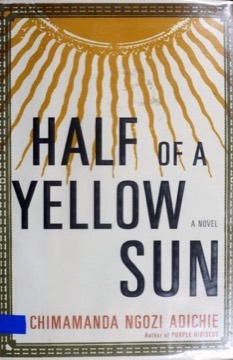
Half of a Yellow Sun
Chimamanda Ngozi Adichie's novel about the Nigeria-Biafra war (1967-70), told through three people whose lives are reorganised by a secession that began in optimism and ended in famine.
- First published
- 2006
- Publisher
- HarperCollins Publishers
- Pages
- 500
- Shelf
- Fiction
- Level
- Core
- ISBN-13
- 9780007272372
Record checked against
Catalogue note
- Reads as
- ReflectiveChanges how you see rather than what you do.
- Level
- Core / BuildingAssumes general familiarity with the subject.
- Approach
- Theoretical
- Written for
- Readers of literature, Readers with some grounding
Saved in this browser only — no account, nothing sent anywhere. My library
Read this if
- You read for the writing as much as for the argument.
- You want to understand how power is taken, kept and lost.
- You want a book that changes how you see things rather than what you do tomorrow.
- You know roughly how the subject works and want the fuller account.
The premise
Ugwu is a village boy who becomes houseboy to Odenigbo, a radical university lecturer in Nsukka. Olanna is Odenigbo's partner, from a wealthy Igbo family, educated in England. Richard is a British writer in love with Olanna's twin sister Kainene and trying to write about Igbo art.
The novel opens in the early sixties, during the confident years after independence, then moves into the war in which the Igbo southeast seceded as Biafra and was starved into surrender.
The book insists on the years before, so that what is lost is something you have seen.
Devmark’s reading — not a quotation from the book
How it is built
Adichie splits the novel into four parts that move between the early sixties and the late sixties rather than running straight, so the reader holds the peace and the war simultaneously.
The three viewpoints are chosen for their distance from power: a servant, a woman, a foreigner. None of them is a general. The war arrives to them as rumour, then queues, then hunger.
The title is the Biafran flag. Half a sun, on a flag for a country that lasted three years.
Devmark’s reading — not a quotation from the book
Why it matters
Biafra is barely taught outside Nigeria, and the famine was one of the first humanitarian catastrophes televised to Western audiences. Adichie, whose grandfathers both died in the war, wrote the novel to hold the events in a form that outlasts the news photographs.
It is also a book about who gets to narrate. Richard intends to write the definitive account; the novel has a quiet and pointed view about that.
Three points of view
The war reaches the reader through a houseboy from a poor village, an English expatriate writer, and one of two wealthy twin sisters. The selection is deliberate: class, nationality and gender determine what each can see, and none of the three has access to the whole.
Nobody in the book can see the whole war. The structure is built out of that limitation.
Devmark’s reading — not a quotation from the book
Ugwu
The houseboy who arrives at thirteen and is taught to read is the novel's moral centre, and Adichie takes a considerable risk with him in the later sections that complicates any reading of him as innocent. The decision about who ends up holding the pen is the book's final and best move.
The structure
The novel moves from the early sixties to the late sixties and back again, and the reordering is not a stylistic flourish: it withholds a central event until the reader has spent time with its consequences, which is how Adichie avoids writing a countdown to an atrocity.
Biafra
The secession, the blockade, the starvation and the photographs that reached the world are the book's subject, and it is written from inside the seceding state rather than about it. Adichie's grandfathers both died in the conflict, and she interviewed survivors extensively; the domestic detail of shortage is the most convincing thing in it.
The book within the book
Short passages from a history titled The World Was Silent When We Died appear between chapters, and the question of who is writing them is left open until late. It is how the novel raises the problem of who gets to narrate a catastrophe without stopping to discuss it.
The expatriate
Richard, the English writer who wants badly to belong and never can, is the book's most uncomfortable figure: sympathetic, genuinely well-intentioned, in love with the place and its art, and repeatedly shown to have no standing whatever to speak for anyone in it. Adichie uses him to examine the position of the foreign observer and the foreign correspondent without ever reducing him to a villain, which makes the point land harder.
The love stories
The domestic plots — infidelity, estrangement, a broken relationship between sisters — are not relief from the war material but the means of measuring it. The novel's argument is that a catastrophe is experienced as a series of private ruptures, and it keeps the marriages in the foreground accordingly.
What to take away
- 01The years beforeThe novel spends its first act on ordinary intellectual life, so the loss registers.
- 02Three distancesA houseboy, a woman and an expatriate — nobody with command of events.
- 03Braided chronologyMoving between early and late sixties keeps peace and war in the same frame.
- 04Who writes it downRichard's ambition to author the account is the book's most pointed thread.
- 05A televised famineBiafra shaped Western humanitarian imagery and is still barely taught.