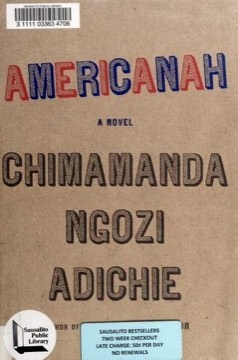
Americanah
Chimamanda Ngozi Adichie's novel about a Nigerian woman who goes to America for university, becomes a blogger about race, and eventually goes home. About discovering you are Black by emigrating, and about what return costs.
- First published
- 2013
- Publisher
- fanbooks
- Pages
- 592
- Shelf
- Fiction
- Level
- Core
- ISBN-13
- 9780606367219
Record checked against
Two sources agreed on 2013; a third reported differently (openlibrary 1969, wikidata 2013, wikipedia 2013).
Catalogue note
- Reads as
- ReflectiveChanges how you see rather than what you do.
- Level
- Core / BuildingAssumes general familiarity with the subject.
- Approach
- Theoretical
- Written for
- Readers of literature, Readers with some grounding
Saved in this browser only — no account, nothing sent anywhere. My library
Read this if
- You read for the writing as much as for the argument.
- You want to know how we got here.
- You want a book that changes how you see things rather than what you do tomorrow.
- You know roughly how the subject works and want the fuller account.
The premise
Ifemelu leaves Lagos for an American university, leaving behind Obinze, who had expected to follow and instead ends up living undocumented in London. Years later Ifemelu is a successful blogger and academic in Princeton, and decides to move back to Nigeria.
The novel is structured around a hair appointment in a Trenton braiding salon, from which Ifemelu remembers everything that brought her there.
Ifemelu's line is that she did not think of herself as Black until she came to America.
Devmark’s reading — not a quotation from the book
How it is built
Adichie embeds Ifemelu's blog posts in the text, which lets the novel make direct arguments about American race without putting essays in characters' mouths. The posts are funny and deliberately unhedged in a way the narrative around them is not.
The braiding salon frame is doing quiet work too: a space of African immigrant women, with its own hierarchies, where Ifemelu is both at home and conspicuously the one with the degree.
Themes
The novel's sharpest observation is that race is a local system rather than a universal one, and that an African immigrant acquires an American racial identity on arrival, with rules nobody explains.
The other half is return. Nigeria has moved on without Ifemelu, and the novel is unsentimental about the returnee — the "Americanah" of the title — who expects the country to have waited.
Neither leaving nor coming back is treated as the honest choice; both cost something specific.
Devmark’s reading — not a quotation from the book
The blog
Ifemelu's posts about American race are embedded in the text, and they let the novel make direct, unhedged arguments that the narrative around them deliberately complicates. The device solves a real problem: it puts polemic in the book without putting speeches in anybody's mouth, and the posts are funnier and blunter than the prose.
Becoming Black in America
The observation the novel is built on is that Ifemelu did not think of herself as Black until she arrived, because in Lagos she was simply a person. Race is presented as a local system with unwritten rules that an immigrant must learn without instruction, and the book distinguishes carefully between American Blacks and non-American Blacks throughout.
She did not become Black by being born. She became Black by landing at an airport.
Devmark’s reading — not a quotation from the book
The braiding salon
The frame is a long appointment in a Trenton braiding salon, and the setting does a great deal of quiet work. It is a space of African immigrant women with its own internal hierarchies of country, language and length of residence, in which Ifemelu is simultaneously at home and conspicuously the one with the Princeton fellowship. The class distance between her and the woman braiding her hair is as carefully observed as any racial boundary in the book.
Obinze's London
The parallel narrative follows the man she left behind into undocumented work in Britain — cleaning, a borrowed National Insurance number, an arranged marriage that fails, deportation. Setting it against her credentialed American experience is the novel's sharpest structural decision about what migration actually is.
Hair
The extended attention to hair — relaxers and the chemical burns they leave, the decision to go natural, the online forums, what a hiring manager considers professional — is not a motif but a subject in its own right. It is the place where the abstract argument about assimilation becomes a concrete weekly expenditure of money, hours and physical pain, paid by one group of people and invisible to everyone else.
Coming back
The final section is unsentimental about return. Nigeria has moved on without her, the returnee is mocked as an Americanah for her acquired accent and her new fastidiousness, and Ifemelu discovers that she is now a foreigner in the second place as well as the first. Adichie refuses to let either country resolve into home, and the novel ends with a decision rather than an arrival.
Where it is arguable
The novel's judgements are delivered with great confidence, and its characters are frequently vehicles for a position — the liberal academics, the Nigerian expatriates, the boyfriends are each doing argumentative work. Some readers find this bracing and others find it closer to essay with dialogue.
What to take away
- 01Race as localIfemelu becomes Black in America, under rules she was never taught.
- 02Blog posts as argumentEmbedding the blog lets the book state things the narrative would soften.
- 03Hair as politicsThe salon frame makes an ordinary appointment carry the novel's subject.
- 04The cost of returnNigeria did not stand still, and the returnee is quietly mocked.
- 05Two migrationsObinze's undocumented London is set against Ifemelu's credentialed America.