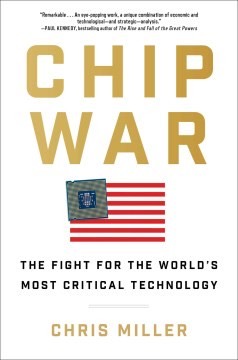
Chip War
Chris Miller's history of the semiconductor industry as geopolitics: how a handful of companies and one Taiwanese foundry came to hold the chokepoint of the world economy.
- First published
- 2022
- Publisher
- Simon & Schuster Audio and Blackstone Publishing
- Pages
- 464
- Shelf
- Business
- Level
- Core
- ISBN-13
- 9781982172015
Record checked against
Catalogue note
- Reads as
- StrategicAbout choosing between options under uncertainty.
- Level
- Core / BuildingAssumes general familiarity with the subject.
- Approach
- Applied
- Written for
- Founders and operators, Readers with some grounding
Saved in this browser only — no account, nothing sent anywhere. My library
Read this if
- You want to understand what technology is doing to how we live.
- You want to know how we got here.
- You have to choose what not to do, and want a way to think about it.
- You are weighing options and want a way to think about the trade-offs.
- You know roughly how the subject works and want the fuller account.
The argument
Miller, an economic historian, traces computing power from the transistor to the present as a story about state strategy rather than about engineering alone: American defence spending, Japanese industrial policy, Korean conglomerates, and China's attempt to catch up.
His central observation is concentration. Advanced logic chips are made essentially by one company, TSMC, in one place, using lithography machines made by one company, ASML, in the Netherlands.
The most valuable manufacturing chokepoint in the world is a single company on a single island.
Devmark’s reading — not a quotation from the book
The technical spine
The book explains why this concentration happened: the cost of each generation of fabrication rises so steeply that the number of firms able to stay at the leading edge has fallen with every node.
Extreme ultraviolet lithography, developed over decades at a cost no single firm could have borne alone, is treated as the pivotal technology and the narrowest chokepoint of all.
The strategic conclusion
Miller's implicit argument is that Taiwan's position in chip manufacturing is now a security question rather than an economic one, and that export controls have become the primary instrument of great-power competition.
Published in 2022, before the most recent rounds of controls and subsidy programmes, so the specifics have moved while the framework has held.
Written in 2022, and the framework has survived several rounds of policy that came after it.
Devmark’s reading — not a quotation from the book
How it reads
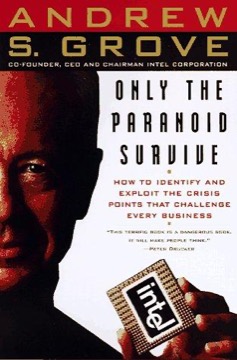
Narrative history with real technical content, built around individuals — Noyce, Moore, Morris Chang, Andy Grove — so the industrial policy has people attached.
The best available single-volume account of why semiconductors are the subject of foreign policy.
Miller is also careful to keep the engineering legible without dumbing it down, so a reader with no technical background finishes understanding why a nanometre matters commercially and strategically.
Why the cost curve concentrated everything
The book's mechanism is economic before it is political. Each generation of fabrication plant costs far more than the last, so the number of firms able to stay at the leading edge falls with every step, until advanced logic manufacturing is effectively a single company on a single island. Nobody planned that concentration; the capital requirements produced it.
The lithography bottleneck
The most extraordinary industrial story here concerns the machines that print the circuits: a decades-long development effort, a supply chain spanning several countries, and a final assembly performed by one Dutch firm. Without those machines the leading edge cannot be reproduced anywhere, which makes a single vendor a genuine strategic chokepoint.
One company in one country makes the machine. Without it, nobody makes the newest chips at all.
Devmark’s reading — not a quotation from the book
Offshoring as policy
Miller traces how manufacturing moved to East Asia through deliberate American decisions — cost pressure, Cold War industrial policy intended to bind allies economically, and the fabless model that separated design from fabrication. The dependency now treated as a crisis was an outcome of choices that looked sensible at each step.
The Soviet failure
A valuable comparative thread covers the Soviet semiconductor programme, which relied substantially on acquiring and copying Western designs and consequently remained a generation behind for its entire existence. The lesson Miller draws is precise and transferable: reverse-engineering can reproduce a product, but it cannot reproduce the accumulated process knowledge required to manufacture that product reliably and at volume, and that knowledge is where the real barrier sits.
Export controls
The final sections cover the use of chip and equipment restrictions as instruments of statecraft, and the difficulty of the strategy: it constrains a rival's access in the short run while supplying a powerful incentive to build a domestic alternative. Miller is even-handed about whether this will work.
Taiwan
The strategic conclusion is uncomfortable and stated plainly: a single island under active territorial dispute manufactures the majority of advanced logic, and no substitute could be stood up quickly. Miller declines to predict, and sets out why every party's incentives around this are more complicated than the headlines suggest.
What to take from it
It is narrative history with real technical content, organised around individuals, and it is the best available explanation of why a component most people never think about determines industrial and military capacity. Read it for the mechanism rather than the forecasts, which are already being overtaken.
What to take away
- 01Concentration by costEach generation's expense removed competitors until few remained.
- 02TSMC and ASMLTwo chokepoints, one in Taiwan and one in the Netherlands.
- 03EUV lithographyDecades of development no single firm could have funded.
- 04Chips as foreign policyExport controls as the main instrument of competition.
- 05People attachedNoyce, Moore, Chang and Grove carry the industrial history.