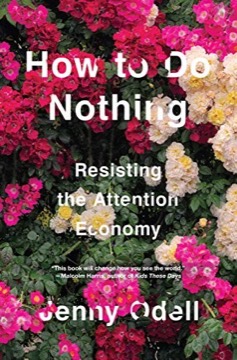
How to Do Nothing
Resisting the Attention Economy
Jenny Odell's argument that resisting the attention economy is not about productivity or digital detox but about reclaiming attention for place, for other people and for things that cannot be optimised.
- First published
- 2019
- Publisher
- HighBridge Audio
- Pages
- 256
- Shelf
- Habits
- Level
- Core
- ISBN-13
- 9781612197494
Record checked against
Only one source carried a publication date for this work, so the year is uncorroborated.
Catalogue note
- Reads as
- PracticalWritten to be applied, not only understood.
- Level
- Core / BuildingAssumes general familiarity with the subject.
- Approach
- Practical
- Written for
- Anyone changing how they work, Readers with some grounding
Saved in this browser only — no account, nothing sent anywhere. My library
Read this if
- You are losing your attention to things you did not choose.
- You want to understand how power is taken, kept and lost.
- You want something to apply, not only something to think about.
- You know roughly how the subject works and want the fuller account.
The argument
Odell, an artist and teacher, rejects the framing in which attention is managed to produce more output. Her nothing is not rest in service of work; it is a refusal of the terms on which the question is usually asked.
Her model is what she calls standing apart — remaining present and engaged rather than withdrawing, and directing attention at what is physically near rather than at what is algorithmically delivered.
Her nothing is not rest so that you can work better. It is a refusal of the exchange rate.
Devmark’s reading — not a quotation from the book
How it is built
The book moves through Diogenes and the Greek refusers; the failure of the 1960s communes, which she treats seriously as an argument against withdrawal; bioregionalism; and her own practice of birdwatching in an Oakland rose garden.
The birds are not decoration. Odell uses learning to identify local species as a worked example of attention that cannot be monetised and that changes what a place looks like.
Learning the local birds is her worked example of an attention nobody can sell.
Devmark’s reading — not a quotation from the book
What it is not
It is not a productivity book and is actively hostile to being read as one, which has not stopped it being shelved that way.
It is also not a call to leave the internet. Odell's position is that withdrawal concedes the ground, and that the useful move is to change what attention is for while staying present.
What nothing means here
Odell's title is a provocation and her subject is not idleness. The nothing in question is attention that produces no output, generates no content and cannot be accounted for — looking at something long enough to see it, with no intention of using it. Her claim is that this has become the genuinely transgressive activity, because it is the one thing the attention economy cannot capture.
Refusal in place
Rather than escape, she argues for staying and withholding — a refusal conducted inside the situation rather than by leaving it. Her literary anchor is the clerk who responds to every instruction with a preference not to, neither resisting nor complying, and whose passivity is more destabilising to the office than an argument would have been.
Not leaving, and not complying either. The third option is the one that unsettles people.
Devmark’s reading — not a quotation from the book
Why the communes failed
A substantial section examines the 1960s attempts to withdraw and build elsewhere, and concludes they failed for structural reasons rather than personal ones: they depended on the society they had exited, reproduced its hierarchies, and had no mechanism for handling disagreement. She uses this as the argument against the contemporary equivalent, the retreat and the detox.
Attention as a trainable capacity
The book's most concrete thread is her own practice of birdwatching, which she presents not as a hobby but as evidence that perception is trainable: after enough attention, a previously undifferentiated background resolves into distinct species with distinct calls. Her argument is that the same sharpening is available for anything given sustained attention, and is foreclosed by an interface designed around novelty.
The rose garden
The public garden she keeps returning to does structural work. It is maintained, free, purposeless, physically fixed, and belongs to no one — a counter-example to the attention economy on every axis at once. Her defence of such places is also a political argument about what public space is for and why it is disappearing.
Where it is a difficult read
It is a work of art criticism and philosophy that arrives shelved beside productivity books, which produces a lot of disappointed readers. It is discursive, resists summary, offers no method, and ends without a programme. The refusal to supply one is deliberate and consistent with the argument, and it is still a reason many people do not finish it.
What to take from it
Its usable residue is a reframe rather than a technique: the question is not how to reclaim attention in order to be more productive, but what attention is for when it is not being converted into anything. That question survives the book, and it is a different one from the one most digital-wellbeing writing asks.
What to take away
- 01Not a detoxWithdrawal concedes the ground; the argument is for staying and redirecting.
- 02Standing apartPresent and engaged, but refusing the terms of the exchange.
- 03BioregionalismAttention to the specific place you are physically in.
- 04The rose gardenBirdwatching as attention that cannot be monetised.
- 05The communes failedShe takes the 1960s withdrawal seriously and shows why it did not work.