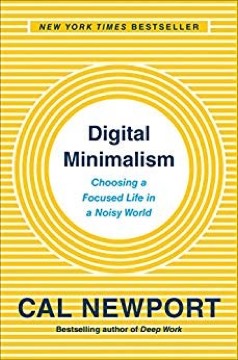
Digital Minimalism
Cal Newport's argument that the problem with personal technology is not any individual app but the absence of a philosophy for using it — and his proposal for one, built around deliberately chosen tools serving explicitly named values.
- First published
- 2019
- Publisher
- Portfolio (Hc)
- Pages
- 295
- Shelf
- Habits
- Level
- Entry
- ISBN-13
- 9780241453575
Record checked against
Only one source carried a publication date for this work, so the year is uncorroborated.
Catalogue note
- Reads as
- PracticalWritten to be applied, not only understood.
- Level
- Accessible / FoundationalNo prior reading assumed.
- Approach
- Practical
- Written for
- Anyone changing how they work, Newcomers to the subject
Saved in this browser only — no account, nothing sent anywhere. My library
Read this if
- You are losing your attention to things you did not choose.
- You want to understand what technology is doing to how we live.
- You want something to apply, not only something to think about.
- You are starting from scratch here and want a way in that assumes no prior reading.
The philosophy, stated
Newport's definition: digital minimalism is a philosophy of technology use in which you focus online time on a small number of carefully selected activities that strongly support things you value, and happily miss out on everything else.
The two halves matter equally. The selection is deliberate and value-driven, and the acceptance of missing things is explicit rather than reluctant, because the anxiety about missing out is what defeats most attempts.
Choose a few tools that serve something you actually value, and accept missing everything else on purpose.
Devmark’s reading — not a quotation from the book
Why willpower approaches fail
His diagnosis is that these tools are engineered by large teams to be compelling, using intermittent variable reward and social approval — the two most reliable mechanisms available.
An individual applying willpower against a professionally optimised attention system is not in a fair contest, which is why tips-and-tricks approaches produce temporary improvement and then revert.
The digital declutter
His central intervention, and the book's practical core: remove all optional technologies for thirty days, use the time to rediscover activities you find satisfying, then reintroduce tools one at a time with an explicit case for each.
The reintroduction test is strict. A tool must serve something you deeply value, must be the best way to serve it, and must come with rules about when and how it is used. Most fail the second condition.
Solitude deprivation
His most original concept: solitude is not physical isolation but freedom from input from other minds, and the constant availability of entertainment has made it nearly extinct.
He argues the consequences — difficulty with reflection, reduced capacity to process emotion, and a diminished sense of one's own positions — are real and under-noticed, because the deprivation is comfortable rather than painful.
Conversation and connection
His distinction, drawing on Sherry Turkle: conversation is bandwidth-rich and synchronous; connection is low-bandwidth and asynchronous. His claim is that the second has substituted for the first rather than supplementing it.
His practical prescriptions are unfashionable and concrete — do not click like, hold conversation office hours, and treat text as logistics rather than as relationship maintenance.
Likes and messages substituted for conversation rather than adding to it, which is the part that cost something.
Devmark’s reading — not a quotation from the book
Reclaiming leisure
His argument that an attention vacuum is why declutters fail: removing distraction without replacing it leaves boredom, which the old tools reliably fill.
He advocates demanding leisure over passive consumption, particularly activities involving physical skill and structured social interaction, on the grounds that these produce satisfaction that passive consumption does not.
The attention resistance
His practical toolkit: delete social media from the phone while retaining desktop access, use apps for specific purposes rather than browsing, embrace slow media, and dumb down the smartphone deliberately.
These are the most-quoted parts of the book and the least interesting. They work as tactics only inside the philosophy — applied alone they are the tips-and-tricks approach he argues against.
Where it is limited
The book is written for people with substantial control over their communication. For work that requires responsiveness, for freelancers whose clients arrive through these platforms, and for people whose communities exist primarily online, the prescriptions are much harder to apply.
Newport acknowledges this only lightly, and his own position as a tenured academic shapes the assumptions more than he examines.
The evidence base
Thinner than the confident tone implies. The research on social media and wellbeing is genuinely contested, with effect sizes in large studies generally small and causal direction disputed.
The argument stands better as a philosophical position about how one wants to spend attention than as a claim about documented harm, and readers should notice where the book slides between the two.
What to take from it
The thirty-day declutter is the part worth actually doing, because it generates personal evidence rather than accepting the book's. Most people who complete it reinstate fewer tools than they expected.
And the reintroduction test — does this serve something I value, is it the best way, and what are my rules — which is the durable content and works independently of any claim about harm.
What to take away
- 01A philosophy beats tacticsTips fail because they fight an optimised system without a rule for deciding what belongs.
- 02Willpower is the wrong instrumentAn individual against a professionally engineered attention system is not in a fair contest.
- 03Reintroduce with a testServes something you value, is the best available way, and comes with explicit rules. Most tools fail the second.
- 04Solitude means freedom from other mindsNot isolation — and its disappearance is comfortable, which is why nobody notices the loss.
- 05Replace, do not just removeRemoving distraction leaves a vacuum, and the old tools reliably fill it.