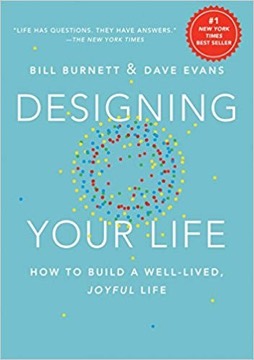
Designing Your Life
Bill Burnett and Dave Evans's application of design thinking to career and life decisions, from the Stanford course they teach: prototype, test, iterate, rather than plan.
- First published
- 2016
- Publisher
- Rocco
- Pages
- 256
- Shelf
- Habits
- Level
- Entry
- ISBN-13
- 9781473522312
Record checked against
Two sources agreed on 2016; a third reported differently (openlibrary 2013, wikidata 2016, wikipedia 2016).
Catalogue note
- Reads as
- PracticalWritten to be applied, not only understood.
- Level
- Accessible / FoundationalNo prior reading assumed.
- Approach
- Practical
- Written for
- Anyone changing how they work, Newcomers to the subject
- Ideas
Saved in this browser only — no account, nothing sent anywhere. My library
Read this if
- You are asking what you should be doing with your working life.
- You care why some things are obvious to use and others are not.
- You want something to apply, not only something to think about.
- You are starting from scratch here and want a way in that assumes no prior reading.
The approach
The authors, both Stanford design professors with Silicon Valley backgrounds, argue that people approach life choices as problems to be solved analytically when they are design problems: ill-defined, without a single correct answer, and only resolvable by building something and seeing.
The consequence is a process rather than an answer: generate many options, prototype cheaply, gather data from reality rather than from introspection.
You cannot think your way to the answer, because it is a design problem rather than an analytical one.
Devmark’s reading — not a quotation from the book
The tools
Odyssey plans: write three different five-year versions of your life, all plausible, one of which assumes your current path is impossible. The point is to break the assumption that there is one right life.
Prototype conversations and experiences: talk to someone doing the thing, spend a week shadowing, build the smallest test that produces real information. Also the good-time journal, tracking engagement and energy rather than satisfaction in retrospect.
The reframes
Their useful move is naming dysfunctional beliefs and replacing them: that you should know your passion before acting, that it is too late, that success means not settling.
The passion one is the most valuable. The research they cite indicates most people develop passion through competence rather than discovering it first, which inverts the standard advice.
Passion usually follows competence rather than preceding it, which reverses the usual instruction.
Devmark’s reading — not a quotation from the book
Limits
The book assumes mobility, education and some financial slack, and its examples are drawn heavily from a particular professional class.
It is a workbook: the exercises are the content, and reading without doing them produces little. That is stated but easy to ignore.
It is also strongest for people at a transition point and weakest for anyone whose constraint is immediate financial pressure, where the leisurely prototyping the method depends on is not available.
Gravity problems
Their most useful filter separates problems from circumstances. A gravity problem is a condition you cannot change — the pay scale of your profession, the fact that you started late — and the authors' point is that it is not actionable and therefore not a problem in the design sense. Time spent resenting it is time not spent on the part that is adjustable.
If it cannot be acted on, it is not a problem. It is a situation, and the design starts after it.
Devmark’s reading — not a quotation from the book
The Good Time Journal
Before any planning, they ask for data: a log of daily activities annotated for engagement and for energy, kept long enough to show patterns. The point is that people are unreliable narrators of what they enjoy, and that the specific components worth keeping usually cut across job titles rather than corresponding to them.
Workview and Lifeview
Two short written statements — what work is for, and what a life is for — followed by an examination of where they contradict each other. The exercise is deceptively difficult and it is the one that gives the rest of the book its criteria, since a design problem cannot be solved without knowing what counts as a good outcome.
Prototyping instead of deciding
Their central methodological import is that you do not think your way into a career, you build small tests of it: conversations with people doing the work, short experiences, low-cost trials. The prototype's purpose is explicitly to generate information rather than to succeed, which removes most of the fear attached to trying something.
Choosing, and then letting go
The final tool addresses what happens after a decision: gather options, narrow, choose, and then stop reconsidering. They cite the well-documented finding that reversible choices are held onto more anxiously and enjoyed less than irreversible ones, and argue that the agonising afterwards is a separate problem from the choosing.
The beliefs they attack
A running thread names the assumptions that make the problem harder: that there is one right career, that you should know what it is by now, that passion precedes work rather than following competence, and that arriving somewhere finishes the process. The passion reframe is the most substantively supported.
Where it assumes privilege
The method presupposes options: the ability to take a lower-paid step, time for exploratory conversations, a network that answers, and a social position in which curiosity reads as initiative. The authors acknowledge this only briefly, and readers without that slack will find the tools sound and the worked examples remote.
What to take away
- 01A design problemIll-defined, no single answer, resolvable only by building.
- 02Three odyssey plansIncluding one where your current path is unavailable.
- 03Prototype conversationsCheap tests that produce real data instead of speculation.
- 04Passion follows competenceInverts the standard instruction to find it first.
- 05A workbookThe exercises are the content; reading alone does nothing.