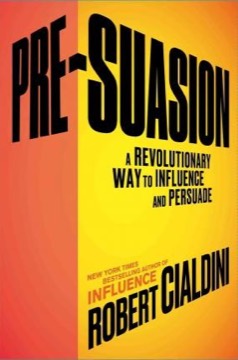
Pre-Suasion
Robert Cialdini's follow-up to Influence, on the moment before the message — the argument that what an audience attends to immediately beforehand changes how receptive they are to what comes next.
- First published
- 2016
- Publisher
- Simon & Schuster Audio
- Pages
- 432
- Shelf
- Communication
- Level
- Core
- ISBN-13
- 9781501109812
Record checked against
Only one source carried a publication date for this work, so the year is uncorroborated.
Catalogue note
- Reads as
- PracticalWritten to be applied, not only understood.
- Level
- Core / BuildingAssumes general familiarity with the subject.
- Approach
- Practical
- Written for
- Writers and speakers, Readers with some grounding
Saved in this browser only — no account, nothing sent anywhere. My library
Read this if
- You want to be understood the first time.
- You are losing your attention to things you did not choose.
- You want evidence about why people behave as they do, not folklore.
- You want something to apply, not only something to think about.
- You know roughly how the subject works and want the fuller account.
The central claim
Cialdini's thesis is that the effectiveness of a message depends heavily on the recipient's state in the seconds before it arrives, and that skilled communicators create that state deliberately rather than relying on the message alone.
His term for this is pre-suasion: arranging for an audience to be receptive before they encounter what you want them to accept. The claim is distinct from his earlier work, which concerned the content of persuasive appeals rather than their setting.
The argument is about the seconds before the message, not the message itself.
Devmark’s reading — not a quotation from the book
Privileged moments and attention
His mechanism: whatever a person is attending to at a given moment is temporarily granted disproportionate importance, simply because it is occupying attention.
His examples run from survey question ordering to the placement of background imagery on websites. The underlying finding — that attention confers perceived importance — is well established; the size of the practical effects varies a great deal by context.
Association and priming
His treatment of how concepts activated in advance shape subsequent judgement: words, images, physical sensations and environmental cues that make related ideas more accessible.
This is where the book is most exposed, because a substantial part of the social priming literature it draws on failed to replicate in the years around and after publication. The general principle that context affects judgement is secure; several specific studies he cites are not.
Attractors and magnetisers
His catalogue of what reliably captures attention — the sexual, the threatening, the different — and what holds it: the self-relevant, the unfinished, the mysterious.
His treatment of unfinished tasks and open loops is the most useful section, and it rests on a more robust research base than the priming material. The mechanism explains why a question posed before an argument outperforms the same argument delivered as a statement.
Geographies of influence
His practical chapters on arranging physical and digital environments: what is visible, what is adjacent, what a person passes through before arriving at a decision.
His observation that people rarely attribute their judgements to the environment that shaped them is the ethically significant part, since it is precisely what makes the techniques effective and what makes their use difficult to detect.
The seventh principle: unity
His addition to the six principles from *Influence*. Unity is shared identity — the sense of being of the same group, family, place or category — and he argues it is more powerful than liking because it operates on who someone is rather than how they feel.
The distinction is genuine and the supporting evidence on in-group behaviour is strong. It is the most durable new contribution in the book.
Ethics and the long game
His closing chapters argue that dishonest pre-suasion is not merely wrong but commercially unwise, since detection destroys trust and the costs accumulate through employee attrition and reputational damage.
He is more serious about this than most authors in the genre, and his argument is consequentialist rather than moral, which makes it more likely to be heard by the practitioners who need it and less satisfying as ethics.
His ethical argument is consequentialist: deception is unwise because it is detected and the costs compound.
Devmark’s reading — not a quotation from the book
The replication problem
It has to be addressed directly. The book was published as the replication crisis was reshaping social psychology, and several priming effects of the kind it relies on have since failed to reproduce or have shrunk substantially.
Cialdini has engaged with this more responsibly than many, but a reader should treat the specific studies with caution and the general framework — attention confers importance, context shapes judgement — as the part that survives.
How it differs from Influence
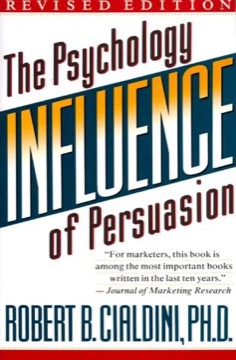
*Influence* is the stronger book: its six principles rest on decades of robust findings and on Cialdini's own field observation. This one is more speculative, more dependent on contested laboratory results, and more loosely organised.
A reader choosing one should read *Influence*. This is worth reading afterwards for the unity principle and for the attention framing, held at lower confidence.
What to take from it
That the setting is part of the message, which is a practical instruction: consider what an audience encounters immediately before your case, because you can frequently control it.
And unity as a seventh principle, which explains the persuasive force of shared identity more accurately than liking or authority do, and which has the best evidence of anything new in the book.
What to take away
- 01The moment before mattersReceptivity is established by what the audience attended to just beforehand, which is often controllable.
- 02Attention confers importanceWhatever occupies attention is temporarily treated as more significant than it is.
- 03Unity beats likingShared identity operates on who someone is rather than how they feel, and the in-group evidence is strong.
- 04Open loops hold attentionA question before an argument outperforms the same argument stated, and this rests on solid ground.
- 05Hold the priming studies looselyMuch of that literature did not replicate; the general framework survives, the specific effects often do not.