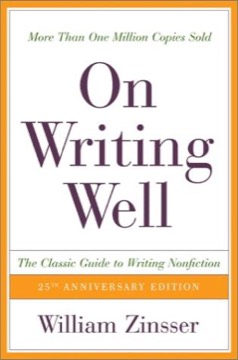
On Writing Well
An Informal Guide to Writing Nonfiction
William Zinsser's guide to writing nonfiction — a case for simplicity, clarity and humanity, built from decades of teaching and from the conviction that clutter is the disease of American prose.
- First published
- 1976
- Publisher
- St. Martins
- Pages
- 288
- Shelf
- Communication
- Level
- Core
- ISBN-13
- 9780060552725
Record checked against
Catalogue note
- Reads as
- FoundationThe standard first book on its subject.
- Level
- Core / BuildingAssumes general familiarity with the subject.
- Approach
- Balanced
- Written for
- Writers and speakers, Readers with some grounding
Saved in this browser only — no account, nothing sent anywhere. My library
Read this if
- You want to be understood the first time.
- You make things, and want to understand the work rather than wait for inspiration.
- You want the book people are sent to first on this subject.
- You know roughly how the subject works and want the fuller account.
The central diagnosis
Zinsser's opening chapters identify the enemy as clutter: the unnecessary word, the circular construction, the pompous frill, the adverb carrying meaning the verb already contains.
His claim is that clutter is not a stylistic flaw but a failure of thinking, because a writer who has not decided what they mean produces qualifications and padding in place of the decision. The remedy is therefore not to write more elegantly but to know more precisely what is being said, which is why the book is more about thought than about sentences.
Clutter is not a style problem. It is the residue of a decision the writer has not yet made.
Devmark’s reading — not a quotation from the book
Simplicity and the stripping method
His practical instruction: examine every sentence for what can be removed without loss, and remove it. He demonstrates on his own manuscript pages, reproduced with his cuts visible.
Those facsimile pages are the most effective teaching device in the book, because they show a professional writer removing roughly a third of his own draft and improving it. The demonstration is far more persuasive than the instruction, and it establishes that heavy cutting is normal practice rather than evidence of a weak first attempt.
Audience and voice
His two positions that appear to conflict and do not. Write for yourself, because you cannot know the reader's taste and trying to guess it produces hedged prose. But respect the reader's intelligence, time and attention, because they will leave the moment you stop earning them.
His reconciliation is that you please yourself on matters of taste and serve the reader on matters of craft — clarity, structure, pace — which is a clean distinction and one most writing advice muddles.
Words, usage and style
His chapters on vocabulary: prefer the concrete to the abstract, the short word to the long, the active to the passive, and the specific noun to the qualified general one.
His warning against style as something applied afterwards — a layer of personality added to clear prose — is the most important of these. His position is that style is what remains when the clutter has gone, and that attempting to add it produces the opposite of what the writer wants.
Unity, the lead and the ending
His structural chapters. Unity of tense, of person, of attitude, decided before writing. A lead that compels the next sentence and the next. An ending that arrives rather than trails off, ideally sooner than the reader expects.
His advice that the perfect ending frequently occurs one paragraph before the writer stopped is specific, testable against any draft, and correct often enough to be worth applying as a routine check.
The forms
The middle section covers particular kinds of nonfiction: interviews, travel writing, memoir, science and technology, business writing, sports, criticism, humour.
The science and business chapters are the most useful for readers outside journalism. His principle for explaining technical material — lead the reader by one step at a time, and never assume the step just taken has been absorbed — is a better account of technical writing than most books devoted to it.
Memoir and the problem of self
His chapters on writing about one's own life, added and expanded in later editions, and clearly the subject that mattered most to him in his final years.
His guidance is to narrow rather than broaden — write about one strand of a life rather than its whole — and to be a reliable narrator about oneself, which means including the material that does not flatter.
The writer's attitude
His closing arguments concern the disposition the work requires: confidence, enjoyment, the willingness to be yourself on the page, and the discipline to keep working when the sentences will not come.
His insistence that writing is a craft learned by doing rather than a gift is consistent throughout and is the reason the book functions as encouragement as well as instruction.
Where it has dated
Its examples are drawn largely from mid-century American magazine journalism and its cultural references assume a reader of that period. It has nothing to say about writing for screens, for search, for collaborative documents, or for readers who will not read past a paragraph.
Its conception of the writer is also individual and literary, and it does not address the documents most people actually write, which are produced by several people for a specific institutional purpose.
What to take from it
The stripping method, applied as a separate pass: write to find out what you mean, then cut to make it readable, and never attempt both at once.
And the ending check, which costs one minute and improves a surprising proportion of drafts by removing the paragraph in which the writer explains what has already been shown.
What to take away
- 01Clutter is unfinished thinkingPadding and qualification appear where a decision about meaning has not yet been made.
- 02Cut a third and it improvesHis own marked-up manuscript pages prove that heavy cutting is normal professional practice.
- 03Please yourself on taste, serve the reader on craftThe distinction resolves the apparent contradiction between writing for yourself and respecting the reader.
- 04Style is what remains after the clutterIt cannot be applied as a layer, and attempting to produces the opposite of what was wanted.
- 05The ending is often one paragraph earlierA one-minute check that improves a large proportion of drafts.