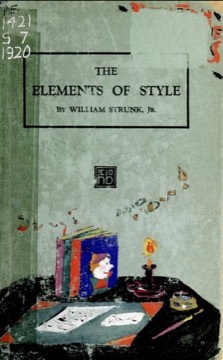
The Elements of Style
Strunk and White's short book of usage rules and composition principles — the most influential and most argued-about writing manual in English, valuable as a discipline and unreliable as a description of grammar.
- First published
- 1920
- Publisher
- Franklin Classics
- Pages
- 76
- Shelf
- Communication
- Level
- Entry
- ISBN-13
- 9798547907852
Record checked against
Catalogue note
- Reads as
- FoundationThe standard first book on its subject.
- Level
- Accessible / FoundationalNo prior reading assumed.
- Approach
- Balanced
- Written for
- Writers and speakers, Newcomers to the subject
- Ideas
Saved in this browser only — no account, nothing sent anywhere. My library
Read this if
- You want to be understood the first time.
- You want the book people are sent to first on this subject.
- You are starting from scratch here and want a way in that assumes no prior reading.
Its origin and shape
Strunk wrote it as a compressed manual for his own Cornell students. E. B. White, who had been one of them, revised and expanded it decades later and added the chapter that carries his voice.
The book is therefore two things joined: a terse list of usage rules from one author, and a more discursive essay on style from another. Its brevity is deliberate and is a large part of why it survived when longer and more accurate manuals did not.
Two books joined: Strunk's terse rules and White's essay. Its brevity is why it outlived better manuals.
Devmark’s reading — not a quotation from the book
Omit needless words
The single most famous instruction in English writing advice, and the one that has done the most good. Strunk's surrounding passage — that a sentence should contain no unnecessary words for the same reason a drawing should have no unnecessary lines — is the argument in miniature.
Its value is as a habit rather than a rule. A writer who applies it to every draft improves; a writer who applies it to every sentence in isolation produces prose that is terse without being clear.
The elementary rules of usage
Strunk's opening section covers possessives, series commas, parenthetic expressions, participial phrases and the joining of independent clauses.
These are the most defensible parts of the book. They are conventions rather than laws, but they are widely shared conventions, and a writer who follows them consistently will not be misread on mechanical grounds. The serial comma recommendation in particular resolves a genuine ambiguity.
Principles of composition
The section with the most enduring influence: use the active voice, put statements in positive form, use definite and specific language, keep related words together, and place the emphatic words at the end of the sentence.
The end-emphasis principle is the least known and the most useful of these, because it addresses something most writers never consider — that the final position in a sentence carries weight, and that putting the important idea there is nearly free.
White's chapter on style
His twenty-one reminders, written in a different register from Strunk's: place yourself in the background, write in a way that comes naturally, revise and rewrite, do not overwrite, avoid qualifiers, do not explain too much, prefer the standard to the offbeat.
This chapter is where the book becomes literature rather than instruction, and its closing passages on the relationship between a writer and their own character are the reason people reread it.
The grammatical criticism
It is serious and it comes from professional linguists. The book misidentifies the passive voice in several of its own examples, prescribes usage rules with no basis in how English is or has been written, and presents the authors' preferences as grammatical fact.
Geoffrey Pullum's critique is the most cited and is substantially correct on the specifics. A reader should not treat this book as a description of English grammar, because on several points it is simply wrong.
On several points it is simply wrong about English grammar. It should not be used as a reference on that.
Devmark’s reading — not a quotation from the book
The stylistic criticism
A separate objection: that its prescriptions, applied uniformly, produce a narrow, clipped, mid-century American register and discourage complexity, subordination and long sentences that skilled writers use deliberately.
The charge has force against literal application. Strunk's own note that these rules may be broken by writers who know what they are doing is the book's answer, and it is easy to miss.
Why it survived anyway
Because it is forty pages, because it can be read in an hour, and because its central disposition — that writing is improved by removing things and by taking responsibility for every word — is correct even where its specific rules are not.
It also arrived when most alternatives were long, dull and consulted by nobody. Availability and brevity did as much for it as accuracy would have.
How to use it now
As a set of defaults for a writer who has none, and as a discipline to outgrow. It is most valuable to someone whose prose is loose and least valuable to someone whose prose is already spare.
Pair it with a real grammar reference for questions of fact, and with Zinsser or a modern usage guide for the situations it does not cover.
What to take from it
Omit needless words, held as a habit of revision rather than a rule of composition, which is how it was intended and how it does the most good.
And the end-emphasis principle, which is nearly unknown outside this book and improves sentences at no cost once you start noticing where the weight is landing.
What to take away
- 01Omit needless wordsA discipline of revision rather than a rule of composition, and the best thing in the book.
- 02Put the emphatic word lastThe least known and most useful of its principles, and free to apply.
- 03It is wrong about grammarIt misidentifies the passive voice in its own examples and presents preference as law.
- 04The rules produce one registerApplied uniformly they discourage the complexity that skilled writers use deliberately.
- 05Outgrow it deliberatelyMost valuable to a writer with no defaults, least valuable to one whose prose is already spare.