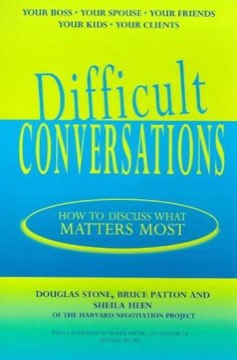
Difficult Conversations
Stone, Patton and Heen's analysis from the Harvard Negotiation Project of what makes certain conversations hard — the finding that every difficult conversation is actually three conversations happening at once, each with its own failure mode.
- First published
- 1999
- Publisher
- Michael Joseph
- Pages
- 250
- Shelf
- Communication
- Level
- Core
- ISBN-13
- 9780553525687
Record checked against
Only one source carried a publication date for this work, so the year is uncorroborated.
Catalogue note
- Reads as
- PracticalWritten to be applied, not only understood.
- Level
- Core / BuildingAssumes general familiarity with the subject.
- Approach
- Practical
- Written for
- Writers and speakers, Readers with some grounding
Saved in this browser only — no account, nothing sent anywhere. My library
Read this if
- You want to get to an agreement without treating the other side as an obstacle.
- You want to be understood the first time.
- You want something to apply, not only something to think about.
- You know roughly how the subject works and want the fuller account.
The three conversations
Their central structure. Beneath every difficult exchange are three simultaneous conversations: the What Happened conversation, about facts and blame; the Feelings conversation, about emotions usually unacknowledged; and the Identity conversation, about what this situation says about who each person is.
The framework's power is diagnostic. Conversations that seem to be about a deadline or a decision stall because the real disagreement is in one of the other two layers, and arguing harder in the wrong layer is how these exchanges become intractable.
Arguing harder in the wrong layer is how a difficult conversation becomes an intractable one.
Devmark’s reading — not a quotation from the book
Move from truth to contribution
Their reframing of the What Happened conversation. The assumption that one party is right and the other wrong produces a contest; the question of what each person contributed to the situation produces information.
Their distinction between contribution and blame is the crucial one. Blame looks backward and asks who should be punished; contribution looks at the system of actions that produced the outcome and asks what each person could do differently. The first ends conversations and the second continues them.
Intentions and impact
Their treatment of the most common error in these conversations: inferring the other person's intentions from the impact their actions had on you.
Their observation is that we judge ourselves by our intentions and others by their effects, and that this asymmetry is nearly universal. Separating the two — saying what the impact was without asserting what was intended — removes a large proportion of the defensiveness that derails these exchanges.
The feelings conversation
Their argument that emotions are not an intrusion into difficult conversations but their substance, and that unexpressed feelings leak through tone, timing and word choice regardless.
Their practical guidance is to acknowledge feelings explicitly, to distinguish feeling an emotion from acting on it, and to recognise that feelings are frequently bundled — anger concealing hurt, irritation concealing fear.
The identity conversation
Their most original contribution. The reason a small piece of feedback can be devastating is that it threatens a foundational belief about oneself: that one is competent, is a good person, is worthy.
Their solution is to complexify the self-image, moving from an all-or- nothing identity to one that can absorb information. Someone who believes they are perfectly competent is destroyed by one error; someone who believes they are generally competent and sometimes wrong is not.
The learning conversation
Their proposed alternative to the message-delivery stance: enter the conversation to understand what the other person sees rather than to deliver a verdict.
The shift is not a softening. A learning conversation still says the difficult thing, but it does so as one account among two rather than as a finding, which is what makes it possible for the other person to respond with something other than defence.
How to actually run one
Their practical sequence: open with the third story — a description of the gap between the two views that a neutral observer would give — then invite the other account, share your own, and work toward a joint problem statement.
The third-story opening is the most-used technique from the book because it solves the hardest moment, which is the first sentence. Beginning with the difference in perception rather than with your own version prevents the conversation from starting in a defence.
The third story solves the hardest moment: the first sentence, which otherwise begins in defence.
Devmark’s reading — not a quotation from the book
Listening and speaking
Their chapters on the mechanics: listening to understand rather than to reply, inquiring about the reasoning behind a position, paraphrasing to check, and acknowledging before problem-solving.
Their instruction to say what you actually mean rather than raising it obliquely is the counterweight, and it is necessary — the techniques can otherwise produce a conversation that is careful, extended and never arrives at the point.
Where it is limited
It assumes both parties have some good faith and some interest in the relationship continuing, and it says relatively little about conversations with people acting in bad faith or with a large power asymmetry.
Its advice is also demanding under pressure. The techniques require emotional regulation at exactly the moment it is least available, and the book underplays how much practice that takes.
Its standing
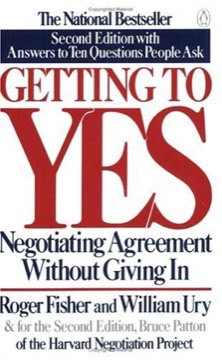
It emerged from the same Harvard programme as *Getting to Yes* and shares its underlying approach — separate the people from the problem, work from interests rather than positions.
Among books on interpersonal conflict it is the one most consistently recommended by practitioners, largely because the three-conversation diagnosis is accurate about situations people recognise immediately in their own lives.
What to take away
- 01Three conversations at onceWhat happened, feelings, and identity. Arguing in the wrong layer is why these exchanges stall.
- 02Contribution, not blameBlame asks who is punished; contribution asks what each person could do differently.
- 03Separate intent from impactWe judge ourselves by intentions and others by effects, and that asymmetry drives most defensiveness.
- 04Complexify the identityAn all-or-nothing self-image is destroyed by one error; a nuanced one can absorb information.
- 05Open with the third storyDescribe the gap between the two views as a neutral observer would, which avoids starting in a defence.