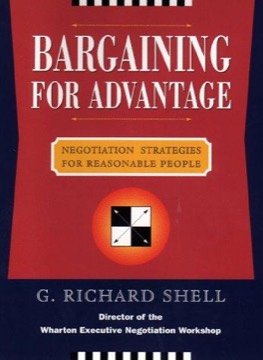
Bargaining for Advantage
G. Richard Shell's negotiation framework from the Wharton school — a six-step process grounded in the argument that effective negotiation begins with knowing your own bargaining style rather than adopting someone else's.
- First published
- 1999
- Publisher
- Penguin
- Pages
- 290
- Shelf
- Communication
- Level
- Core
- ISBN-13
- 9780140289305
Record checked against
Only one source carried a publication date for this work, so the year is uncorroborated.
Catalogue note
- Reads as
- PracticalWritten to be applied, not only understood.
- Level
- Core / BuildingAssumes general familiarity with the subject.
- Approach
- Practical
- Written for
- Writers and speakers, Readers with some grounding
Saved in this browser only — no account, nothing sent anywhere. My library
Read this if
- You want to get to an agreement without treating the other side as an obstacle.
- You have to choose what not to do, and want a way to think about it.
- You want something to apply, not only something to think about.
- You know roughly how the subject works and want the fuller account.
Start with your own style
Shell's distinguishing move. Most negotiation books prescribe a method; this one begins by having the reader assess their own disposition across the standard conflict-handling modes — competing, accommodating, avoiding, compromising, collaborating.
His argument is that a technique that contradicts your temperament will fail under pressure, because pressure returns everyone to their default. The goal is to work from your actual style and compensate for its specific weaknesses rather than to imitate a style you cannot sustain.
Under pressure everyone returns to their default, which is why an imitated style collapses exactly when it matters.
Devmark’s reading — not a quotation from the book
The six foundations
His preparatory framework: your bargaining style, your goals and expectations, authoritative standards and norms, relationships, the other party's interests, and leverage.
Treating these as foundations rather than tactics is the structural argument of the book — that almost all negotiation outcomes are determined before anyone sits down, and that the table is where preparation is revealed rather than where results are produced.
Goals versus expectations
His most research-supported distinction. A goal is what you want; an expectation is what you consider a reasonable and justifiable outcome.
The finding he builds on is that negotiators with specific, high and justifiable expectations achieve better results than those with modest ones, and that the effect runs through their behaviour at the table rather than through wishful thinking. His instruction to write the expectation down before negotiating operationalises it.
Standards and norms
His treatment of the consistency principle: people are strongly reluctant to act against standards they have publicly endorsed, and a negotiator who can frame a proposal within the other party's own stated norms has an advantage no amount of pressure supplies.
His practical version — research what the other side has said, published or committed to, and argue from it — is one of the most under-used preparations in practice.
Leverage, precisely defined
His definition is sharper than the usual one: leverage is about which party has more to lose from no deal, and it shifts during a negotiation rather than being fixed at the start.
His distinction between positive leverage (what you can give), negative leverage (what you can threaten) and normative leverage (the standards the other side is bound by) is the most useful taxonomy in the book, because it shows that the weaker party frequently has normative leverage available when it has nothing else.
The four-step process
His sequence at the table: preparation, exchanging information, opening and making concessions, and closing with commitment.
His treatment of the information-exchange stage is the most valuable, since most negotiators rush it. His argument is that rapport and the discovery of the other side's actual interests happen here or not at all, and that the concessions stage is unproductive without it.
Opening and concessions
His guidance on who should open, when anchoring helps and when it damages the relationship, and how a concession pattern signals a reservation point whether or not the negotiator intends it.
His point that the shape of your concessions communicates more than your words is specific and practical: diminishing concessions signal approaching a limit, and uniform ones invite continued pressure.
The shape of your concessions signals your limit whether or not you meant to disclose it.
Devmark’s reading — not a quotation from the book
Ethics and the three schools
His unusually direct chapter on negotiation ethics, which sets out three positions — the poker school, the idealist school, the pragmatist school — and asks the reader to locate themselves rather than prescribing one.
His treatment of what is customary, what is legally permissible and what is defensible is more honest than most books manage, and his practical rule is that a negotiator should be able to state their standard publicly.
Where it sits against Getting to Yes
*Getting to Yes* argues for principled, interest-based negotiation as a general method. Shell is more empirical, more attentive to competitive situations, and more willing to say that some negotiations are distributive and should be handled as such.
His position is that the Harvard method describes one style well and underestimates how often the other party is not playing that game. Reading both gives a fuller picture than either.
What to take from it
The goals-versus-expectations distinction, written down before every negotiation, which is the cheapest and best-supported improvement available.
And normative leverage, which is the resource most consistently overlooked by the weaker party in a negotiation and frequently the only one they have. Finding it means reading what the other side has already committed to in public, which is preparation anyone can do and almost nobody does before a difficult conversation about terms.
What to take away
- 01Work from your real stylePressure returns everyone to their default, so a borrowed technique fails at the moment it is needed.
- 02Write the expectation downSpecific, high, justifiable expectations produce better outcomes than goals, through behaviour at the table.
- 03Leverage is about who loses more from no dealAnd it moves during the negotiation rather than being fixed at the start.
- 04Normative leverage is available to the weakArguing from standards the other side has publicly endorsed works when nothing else is available.
- 05Concession shape discloses your limitDiminishing concessions signal a boundary; uniform ones invite continued pressure.