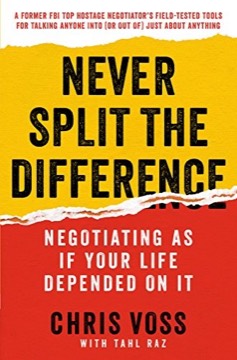
Never Split the Difference
Chris Voss, formerly the FBI's lead international kidnapping negotiator, argues that negotiation is not a rational exchange of positions but an exercise in emotional intelligence — and that the techniques developed for hostage situations transfer to ordinary ones better than most business frameworks do.
- First published
- 2016
- Publisher
- HarperCollins Publishers
- Pages
- 288
- Shelf
- Communication
- Level
- Entry
- ISBN-13
- 9781847941497
Record checked against
Only one source carried a publication date for this work, so the year is uncorroborated.
Catalogue note
- Reads as
- PracticalWritten to be applied, not only understood.
- Level
- Accessible / FoundationalNo prior reading assumed.
- Approach
- Practical
- Written for
- Writers and speakers, Newcomers to the subject
Saved in this browser only — no account, nothing sent anywhere. My library
Read this if
- You want to get to an agreement without treating the other side as an obstacle.
- You have to choose what not to do, and want a way to think about it.
- You want something to apply, not only something to think about.
- You are starting from scratch here and want a way in that assumes no prior reading.
The core idea
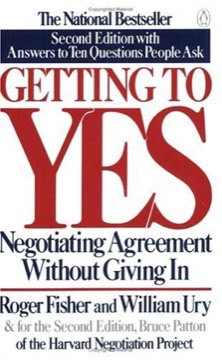
Voss's starting point is a rejection: he argues that the rational, interest-based model taught since Getting to Yes underestimates how much of a negotiation is emotional and how badly people report their own reasoning.
His alternative is tactical empathy — the deliberate practice of understanding and naming the other side's perspective and feelings, without necessarily agreeing with them, in order to lower the temperature and get at the information that actually determines the outcome.
Tactical empathy is not being nice. It is demonstrating that you understand, in order to be told more.
Devmark’s reading — not a quotation from the book
Why he rejects splitting the difference
The title is an argument. Voss's position is that a compromise both sides dislike is often worse than no deal, and that the instinct to meet in the middle usually reflects a wish to end the discomfort rather than a judgement about value.
The vivid version is a hostage negotiation, where partial outcomes are not available. The transferable version is quieter: the middle is a default, not a solution, and defaults deserve scrutiny.
Mirroring and labelling
Two techniques carry most of the practical load. Mirroring — repeating the last few words the other person said, as a question — reliably produces elaboration, and costs nothing.
Labelling names the emotion or dynamic you observe: "it seems like this deadline is the real problem." Voss's guidance is to phrase labels as observations rather than assertions about the other person, because the former invites correction and the latter invites defence.
Getting to 'that's right'
Voss distinguishes "you're right", which is what people say to end a conversation, from "that's right", which is what they say when they feel genuinely understood. The second is the signal he treats as the turning point.
The route to it is a summary — a combination of labels and paraphrase that restates the other side's position well enough that they recognise it. The demand this makes is real: you have to have listened.
'You're right' ends a conversation. 'That's right' begins the part where something can change.
Devmark’s reading — not a quotation from the book
No is the start, not the end
The book's most counter-intuitive claim is that seeking early agreement is a mistake, and that "no" is a better opening. A no makes people feel safe and in control, and what follows it is usually more honest than what follows a cornered yes.
The related warning is about the counterfeit yes — agreement given to end pressure, which is why a quickly won concession so often fails to survive contact with implementation.
Calibrated questions
Open questions beginning with "how" and "what" hand the other side the problem without handing them control. "How am I supposed to do that?" makes a constraint visible without an accusation.
Voss specifically warns against "why", which reads as an accusation in almost every language, and against questions that can be answered yes or no, which end the flow of information.
Accusation audit and the late-night voice
The accusation audit front-loads every negative thing the other side might be thinking, stated by you first. Saying the worst version out loud drains it, and it is the technique in the book most obviously useful in ordinary professional life.
The tonal advice — a calm, downward-inflecting voice as the default — is harder to evaluate from a page and easier to overdo. Voss presents it as practice, not trick.
Black swans
The closing concept is the unknown piece of information that reframes everything: the thing the other side knows and you do not, which changes what a good deal even looks like.
The practical instruction is to treat any negotiation as containing at least one, and to keep asking and listening past the point where you believe you have understood. Most of the book's techniques are, in the end, methods for surfacing it.
Where it should be read sceptically
The evidence is anecdotal and drawn overwhelmingly from the author's own career, retold by him. That is not disqualifying, but it is not research, and the book occasionally presents technique with more certainty than a single practitioner's experience supports.
There is also a real ethical edge. Several techniques are manipulative if used without good faith, and a reader should notice that the book is more interested in effectiveness than in where the line sits.
How it sits against Getting to Yes
The two books are usually presented as opponents, and are better read as complements. Fisher and Ury are stronger on structure: separating people from the problem, inventing options, and knowing your alternative to a negotiated agreement. Voss is stronger on what to actually say in the room.
The synthesis most practitioners end up with uses Fisher and Ury to prepare and Voss to conduct — which is roughly the division the two books' strengths suggest.
What to take away
- 01Label what you observeNaming the dynamic out loud lowers the temperature and invites correction rather than defence.
- 02Invite the noPeople feel safe refusing. What comes after a no is more honest than what comes after a cornered yes.
- 03Aim for 'that's right'It is the signal that the other side feels understood, which is when positions become movable.
- 04Ask how, not why'How am I supposed to do that?' makes a constraint visible without making an accusation.
- 05Say the worst thing firstAn accusation audit drains an objection by voicing it before the other side has to.