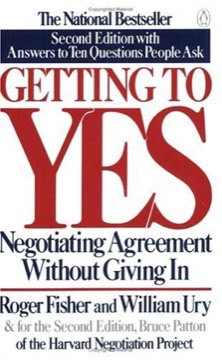
Getting to Yes
negotiating agreement without giving in
Roger Fisher and William Ury's method from the Harvard Negotiation Project, which replaces haggling over positions with a structured search for agreements that serve the interests underneath them.
- First published
- 1981
- Publisher
- Houghton Mifflin
- Pages
- 200
- Shelf
- Communication
- Level
- Core
- ISBN-13
- 9780091493714
Record checked against
Catalogue note
- Reads as
- FoundationThe standard first book on its subject.
- Level
- Core / BuildingAssumes general familiarity with the subject.
- Approach
- Balanced
- Written for
- Writers and speakers, Readers with some grounding
Saved in this browser only — no account, nothing sent anywhere. My library
Read this if
- You want to get to an agreement without treating the other side as an obstacle.
- You want the book people are sent to first on this subject.
- You know roughly how the subject works and want the fuller account.
The core idea
The book's foundational distinction is between a position — what someone says they want — and an interest — why they want it. Positional bargaining locks both sides into defending a stated number, which produces either a grudging split or no deal.
Principled negotiation asks what each side is actually trying to achieve, on the grounds that different interests can often both be satisfied where opposed positions cannot.
A position is what someone demands. An interest is what they need. Only one of the two has room in it.
Devmark’s reading — not a quotation from the book
Why positional bargaining fails
Fisher and Ury argue it is inefficient on its own terms. It produces unwise agreements because ego attaches to positions; it is slow, because concessions must be extracted in increments; and it damages relationships, because each side treats the other as an obstacle.
Their observation about being "nice" is sharp: a soft negotiator who concedes to preserve the relationship is not avoiding the game but losing it, and the answer is not to become hard but to change what is being played.
Separate the people from the problem
The first of four principles. Negotiators are people with emotions, egos and a need to feel respected, and substantive disagreement routinely gets entangled with relational friction.
Their prescription is to deal with both, separately: address perception, emotion and communication as their own work rather than as noise. The line they use — be soft on the people, hard on the problem — remains the clearest statement of the stance.
Focus on interests, not positions
The second principle, and the method's engine. Behind opposed positions lie multiple interests, some shared, some merely different rather than conflicting — and different interests are the raw material of a deal.
The practical instruction is to ask why, and to ask why not: what would stop them agreeing? Fisher and Ury are also clear that stating your own interests plainly is part of the method, since the other side cannot serve an interest they cannot see.
Invent options for mutual gain
The third principle addresses the tendency to treat a negotiation as fixed in size. The obstacles they name are premature judgement, searching for a single answer, assuming a fixed pie, and each side thinking the other's problem is theirs to solve.
The remedy is to separate inventing from deciding — generate options with the explicit rule that nothing is being committed to — then look for differences in interests, beliefs, risk tolerance and time horizons, since those differences are exactly what makes trade possible.
Insist on objective criteria
The fourth principle handles genuinely conflicting interests. Rather than a contest of will, agree in advance on an independent standard — market rate, precedent, professional standards, cost, an appraisal — and let the standard decide.
This reframes the discussion from what each side is willing to endure to what is defensible, and gives both parties a way to move without appearing to lose.
Agree on the standard before you argue about the number, and the number stops being a contest of will.
Devmark’s reading — not a quotation from the book
BATNA
The book's most widely adopted single contribution: your Best Alternative To a Negotiated Agreement. Your power in any negotiation comes from what you will do if there is no deal, not from what you say inside it.
Two consequences follow. Improving your BATNA before negotiating changes your position more than any tactic; and knowing it precisely prevents both accepting a bad deal and rejecting a good one. They warn specifically against the bottom line, which protects against bad outcomes by also blocking creative ones.
When they will not play
The later sections address asymmetry. Negotiation jujitsu redirects an attack on your position back to the problem underneath it. The one-text procedure uses a third party to build a single draft that both sides critique rather than exchanging proposals.
There is also a straightforward chapter on dirty tricks — deliberate deception, escalating demands, good cop/bad cop — whose remedy is to name the tactic explicitly, which almost always ends it.
Where it is criticised
The main criticism is that it can read as naive about power. Principled negotiation works best between parties with comparable alternatives; where one side can simply walk away and the other cannot, the method's leverage is limited and the book acknowledges this only partly.
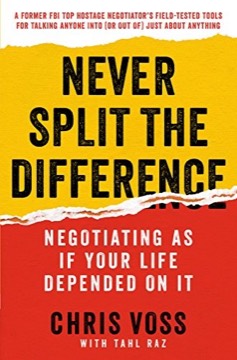
Chris Voss's *Never Split the Difference* argues the further objection that the model underestimates emotion and overestimates how well people report their own interests. The two are better treated as complements than as rivals.
How it has aged
Extremely well as a structure. BATNA, interests-versus-positions and objective criteria have become standard vocabulary in business, law and diplomacy, and are frequently used by people who have not read the book.
Its limitation is that it is stronger on preparation than on the room. Most experienced practitioners end up using this book to prepare and something more tactical to conduct — which is a fair division of the two traditions' strengths.
What to take away
- 01Ask why, not whatOpposed positions often conceal compatible interests; only one of the two leaves room for a deal.
- 02Soft on people, hard on the problemRelational friction and substantive disagreement are separate work and should be handled separately.
- 03Invent before you decideGenerating options under an explicit no-commitment rule is what stops premature judgement closing the space.
- 04Agree the standard firstAn independent criterion converts a contest of will into a question of what is defensible.
- 05Your power is your alternativeWhat you will do without a deal determines your position more than anything said inside the negotiation.