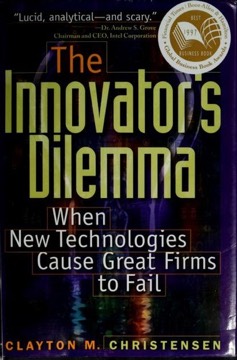
The Innovator's Dilemma
Clayton Christensen's study of why well-managed companies with attentive leadership and satisfied customers lose their markets — and his argument that they lose precisely because they do the things good management prescribes.
- First published
- 1997
- Publisher
- Harvard Business Review Press; 1st edition (May 1, 1997)
- Pages
- 286
- Shelf
- Business
- Level
- Core
- ISBN-13
- 9780066620695
Record checked against
Catalogue note
- Reads as
- FoundationThe standard first book on its subject.
- Level
- Core / BuildingAssumes general familiarity with the subject.
- Approach
- Balanced
- Written for
- Founders and operators, Readers with some grounding
Saved in this browser only — no account, nothing sent anywhere. My library
Read this if
- You are building something new and want to know why most new things fail.
- You have to choose what not to do, and want a way to think about it.
- You want the book people are sent to first on this subject.
- You know roughly how the subject works and want the fuller account.
The core idea
The dilemma in the title is genuine and uncomfortable: the practices that make an established company successful — listening to its best customers, investing where margins are highest, pursuing large markets — are the same practices that make it unable to respond to a disruptive entrant.
Christensen's contribution is that this is not a failure of intelligence or attention. It is a rational response to the incentives an incumbent faces, which is why exhortation to "be more innovative" does not fix it.
The incumbent does not fail by neglecting its customers. It fails by serving them exactly as well as it should.
Devmark’s reading — not a quotation from the book
Sustaining versus disruptive
The distinction is the book's load-bearing structure and the most misused part of it. A sustaining innovation improves a product along dimensions mainstream customers already value — and incumbents almost always win these, however radical the technology.
A disruptive innovation is initially *worse* on those dimensions but better on others — typically cheaper, simpler, smaller or more convenient. It takes root in a market segment the incumbent does not want, then improves until it is good enough for the mainstream.
Why the incumbent cannot respond
The mechanism is resource allocation. Disruptive products carry lower margins, serve smaller markets, and are wanted by customers the incumbent's best customers do not resemble. Every filter inside a well-run company correctly rejects them.
Christensen's point is that the decision is made not by executives but by the accumulated judgement of the organisation. Sales teams chase the commission, product managers chase the volume, finance chases the margin — and the disruptive project loses every internal competition on its merits.
The disk drive industry
The empirical core is a detailed study of disk drives, chosen because generations turned over fast enough to observe the pattern repeatedly. Successive waves of smaller form factors each entered through a new application and each displaced the incumbent leader.
The choice of industry is both the book's strength and a standing criticism: it is unusually clean, and how far a pattern established there generalises is exactly what later debate has been about.
Value networks
The concept that does the most explanatory work and gets the least attention. A firm is embedded in a network of suppliers, customers and channel partners with shared assumptions about what matters and what a product should cost.
Cost structures, and the definition of a good product, are set by the network rather than chosen by the firm — which is why an incumbent cannot simply decide to serve a low-margin market. It would have to become a different kind of company.
What to do about it
Christensen's prescription is organisational rather than strategic: place the disruptive effort in a separate unit small enough to be excited by a small market, with its own cost structure and its own customers.
He is also clear that markets for disruptive products cannot be researched in advance, because they do not yet exist. The recommendation is to treat early plans as learning rather than execution, and to fail cheaply — an argument that arrives at roughly the same place as lean startup thinking, from a different direction.
A small market cannot solve the growth needs of a large organisation. That is why the unit has to be small.
Devmark’s reading — not a quotation from the book
Where it gets misread
The most common error is calling every new or successful thing disruptive. Christensen's definition is specific and technical; a product that is simply better and more expensive is a sustaining innovation, however novel.
The second misreading treats disruption as inevitable or as a compliment. It is neither. Most disruptive entrants fail, and the theory describes a mechanism of displacement rather than a guarantee of it.
Where it is contested
This should be stated plainly. Jill Lepore's 2014 critique in *The New Yorker* argued that the case selection was favourable and that several companies presented as disrupted recovered or were never displaced. Subsequent scholarship has questioned the predictive power of the theory as opposed to its explanatory tidiness.
Christensen responded, and the argument has not been settled. A reader should hold it as an influential and partially contested theory rather than an established law.
How it has aged
The vocabulary escaped completely and was degraded in the process — "disruptive" is now marketing language largely disconnected from anything in the book.
What has aged best is the diagnosis of internal resource allocation. The observation that a company's strategy is the sum of thousands of small funding decisions, and that those decisions cannot approve a project that is worse on every metric the company tracks, remains one of the most useful things ever written about why organisations cannot change.
What to take from it
Two portable habits. First, when evaluating a threat, ask which dimension it competes on rather than whether it is currently good — a product that is worse on your axis and better on another is the dangerous case.
Second, when a promising project keeps losing internal funding, look at the filters rather than the project. Christensen's lasting insight is that an organisation's real strategy is visible in what it declines.
What to take away
- 01Good management is the mechanismIncumbents lose by correctly serving their best customers, not by ignoring them.
- 02Check which axis it competes onWorse on your dimension and better on another is the dangerous shape, not the harmless one.
- 03Resource allocation is the real strategyStrategy is the sum of thousands of funding decisions, and each one rejects the disruptive project on merit.
- 04Small markets need small unitsA large organisation cannot get excited about a market that cannot move its numbers.
- 05The theory is contestedInfluential and partially disputed. Use it as a lens, not as a law.