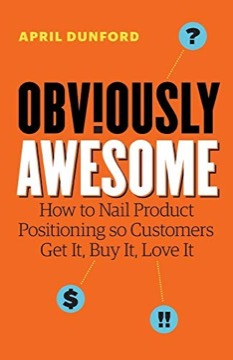
Obviously Awesome
April Dunford's practical method for positioning — deciding what a product should be understood as — built on the observation that most positioning is inherited by accident from whatever the founders first built, and never revisited.
- First published
- 2019
- Publisher
- Ambient Press
- Pages
- 202
- Shelf
- Business
- Level
- Entry
- ISBN-13
- 9781999023003
Record checked against
Only one source carried a publication date for this work, so the year is uncorroborated.
Catalogue note
- Reads as
- StrategicAbout choosing between options under uncertainty.
- Level
- Accessible / FoundationalNo prior reading assumed.
- Approach
- Applied
- Written for
- Founders and operators, Newcomers to the subject
Saved in this browser only — no account, nothing sent anywhere. My library
Read this if
- You have to choose what not to do, and want a way to think about it.
- You are starting or growing a company and want the unglamorous parts.
- You are building something new and want to know why most new things fail.
- You are weighing options and want a way to think about the trade-offs.
- You are starting from scratch here and want a way in that assumes no prior reading.
The problem she is solving
Dunford's diagnosis is that products fail commercially not because they are bad but because buyers cannot work out what they are. A customer who categorises your product wrongly will evaluate it against the wrong alternatives and find it lacking.
Her observation is that positioning is almost never chosen. It is inherited from what the company originally built, and it persists long after the product has become something else.
A buyer who puts you in the wrong category will compare you against the wrong things and find you worse.
Devmark’s reading — not a quotation from the book
Positioning is context, not messaging
Her central reframing. Positioning is the context you set for a product so that its strengths become obvious; messaging is what you then say. Most teams work on the second while the first is broken.
The consequence is that a messaging problem that resists rewriting is usually a positioning problem, and no amount of copy will fix a product the buyer has filed under the wrong heading.
The five components
Her framework: competitive alternatives (what a customer would do if you did not exist), unique attributes (what you have that they do not), value (what those attributes enable), the customers who care most about that value, and the market category that makes the value obvious.
The sequence matters. Each component is derived from the one before, and attempting to choose a category first — which is what most teams do — makes the rest arbitrary.
Competitive alternatives, properly understood
Her strongest practical insight. The alternative is not the named competitor a sales team lists; it is what the customer would actually do otherwise — often a spreadsheet, a manual process, an agency, or nothing.
Getting this wrong propagates through everything. A product positioned against a sophisticated competitor when the real alternative is a spreadsheet will emphasise the wrong attributes entirely.
Choosing a market category
The category is the frame that makes value obvious, and Dunford treats choosing it as the most consequential decision in the process.
She distinguishes three plays: winning an existing category, winning a subsegment of one, and creating a new one — with a clear warning that the third is far more expensive than teams assume, because it requires educating a market rather than redirecting it.
Creating a category means paying to teach the market it has a problem. Most companies cannot afford that bill.
Devmark’s reading — not a quotation from the book
The ten-step process
Unlike most positioning writing, the book supplies an actual procedure: assemble a cross-functional team, list alternatives, isolate unique attributes, map them to value, identify who cares, find the best category, and layer on a trend only if it is genuinely relevant.
The cross-functional insistence is not incidental. Sales, support and product each hold different parts of the picture, and positioning produced by marketing alone is usually wrong in a predictable direction.
The trend warning
Her most useful caution. Attaching a product to a fashionable trend appears free and is not: if the trend does not genuinely fit, it confuses the category and the buyer ends up further from understanding you.
She is explicit that this is the most common self-inflicted positioning wound, and the one most often introduced at the request of a board or an investor.
Where the method is limited
It is written for business-to-business technology, and the examples, buyers and sales motions all reflect that. Consumer positioning has different dynamics — brand, identity and emotion carry weight that this framework barely addresses.
The process also assumes a product that already has customers to learn from. For a pre-launch product, several steps require guessing, and Dunford does not offer much for that case.
Why it is unusually useful
Because almost everything else written about positioning is either a definition or an example, and this is a procedure that a team can run in a day and produce a decision from.
It is also short and unpadded, which in this genre is rare enough to be worth noting on its own.
What to take from it
The reframing — positioning is context, messaging is what you say — plus one exercise: write down what your customers would genuinely do if your product vanished tomorrow, and check whether your marketing is aimed at that alternative or at a competitor nobody is actually considering.
That single question resolves a surprising proportion of positioning confusion before the rest of the method is even reached.
What to take away
- 01Positioning is context, not copyA messaging problem that resists rewriting is almost always a positioning problem underneath.
- 02The alternative is usually a spreadsheetNot the named competitor. What the customer would actually do otherwise determines what you must emphasise.
- 03Derive the category lastChoosing a category first makes every other component arbitrary.
- 04Category creation is expensiveIt means paying to teach a market it has a problem, which most companies cannot afford.
- 05Do it cross-functionallySales, support and product each hold a different piece; marketing alone gets it wrong predictably.