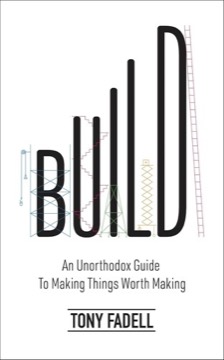
Build
Tony Fadell's advice book from a career that included the iPod, the iPhone and Nest, structured as short chapters on the problems he actually hit.
- First published
- 2022
- Publisher
- Transworld Publishers Limited
- Pages
- not established
- Shelf
- Business
- Level
- Core
- ISBN-13
- 9780063046061
Record checked against
Only one source carried a publication date for this work, so the year is uncorroborated. No page count is recorded, so no reading estimate is shown for the book itself.
Catalogue note
- Reads as
- PracticalWritten to be applied, not only understood.
- Level
- Core / BuildingAssumes general familiarity with the subject.
- Approach
- Practical
- Written for
- Founders and operators, Readers with some grounding
Saved in this browser only — no account, nothing sent anywhere. My library
Read this if
- You are building something new and want to know why most new things fail.
- You make things, and want to understand the work rather than wait for inspiration.
- You are starting or growing a company and want the unglamorous parts.
- You want something to apply, not only something to think about.
- You know roughly how the subject works and want the fuller account.
The structure
Six parts moving outward: building yourself, building a career, building a product, building a business, building a team, and being a CEO. The chapters are short and largely independent.
Fadell's framing is that this is the mentorship he received and would otherwise not pass on, which sets the register: specific, opinionated, and occasionally blunt about people he worked with.
It is written as mentorship rather than as theory, which is why it is specific rather than general.
Devmark’s reading — not a quotation from the book
The most useful material
The chapter on the first version of a product — that it will be bad, that shipping it is still correct, and that the second version is where the business is — is the one most worth having.
His account of storytelling as a product discipline, and of why the pitch should be written before the product, is the other. The Nest thermostat chapter shows it applied concretely.
Caveats
This is a survivor's account from inside two of the most successful hardware programmes in history, and the advice carries the assumptions of that context — capital, talent and a market that existed.
Fadell is also candid about being difficult to work for, which makes the management chapters more informative than the usual leadership advice but does not make them a template.
The context is exceptional; the advice is specific to it and does not say so often enough.
Devmark’s reading — not a quotation from the book
Written as a mentor, not a memoir
Fadell structures the book as a set of answers to questions he has actually been asked, organised by career stage — individual contributor, manager, leader, founder, chief executive — rather than as the story of his career. Readers can enter at their own stage, which is how he intends it to be used.
The first job
His advice for early career is to optimise for what you will learn and for who you will learn it from rather than for title or salary, and to choose a company whose product you would use. It is conventional advice made specific: he is clear about what a good manager looks like and what to do when you do not have one.
Making things people notice
The product chapters argue for solving a problem you personally have, for identifying the painkiller rather than the vitamin, and for the discipline of being able to state why anyone should care in a sentence. His account of the iPod and the Nest thermostat is used to show the reasoning rather than to celebrate the outcome.
If you cannot say in one sentence why anybody should care, there is nothing to build yet.
Devmark’s reading — not a quotation from the book
Storytelling as engineering
One of the better chapters treats the explanation of a product as part of the product: the analogy that makes it comprehensible, the reason a customer should switch, and the fact that a thing nobody can describe will not sell regardless of how well it works.
Disagreement and decisions
He is direct about the two kinds of decision — those made from data and those made from judgement when the data is absent — and about the failure mode of demanding evidence for the second kind. The chapters on hard conversations and on firing people are unusually concrete for the genre.
The Apple and Nest particulars
A good deal of the advice is drawn from hardware companies with enormous capital requirements and long development cycles, and Fadell's experience at Apple under a specific and unusual leadership culture. Readers in software, services or small businesses should expect to translate rather than apply.
Where it is a survivor's account
It is written after two conspicuous successes and a sale to Google, and it does not seriously examine the role of timing, capital access or luck. The chapter on Nest's later difficulties inside Google is the most candid section and the closest the book comes to accounting for something going wrong.
What to take away
- 01V1 will be badShip it anyway; the business lives in V2.
- 02Write the pitch firstStorytelling treated as a product discipline, not marketing.
- 03Mentorship registerSpecific and opinionated rather than general.
- 04Candid about himselfHe is open about being hard to work for, which helps the reader calibrate.
- 05Exceptional contextTwo of the great hardware programmes; the assumptions travel less well than the advice.