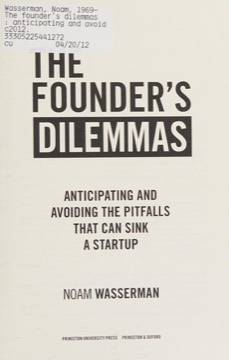
The Founder's Dilemmas
Noam Wasserman's research on the early decisions founders make — about co-founders, equity, roles and hiring — using data from nearly ten thousand founders rather than anecdote.
- First published
- 2012
- Publisher
- Princeton University Press
- Pages
- 488
- Shelf
- Business
- Level
- Deep
- ISBN-13
- 9780691149134
Record checked against
Only one source carried a publication date for this work, so the year is uncorroborated.
Catalogue note
- Reads as
- StrategicAbout choosing between options under uncertainty.
- Level
- Advanced / AdvancedAssumes you have read around the subject already.
- Approach
- Applied
- Written for
- Founders and operators, Specialists and serious readers
- Ideas
Saved in this browser only — no account, nothing sent anywhere. My library
Read this if
- You are starting or growing a company and want the unglamorous parts.
- You are weighing options and want a way to think about the trade-offs.
- You have read around this already and want a book that assumes it.
What makes it different
Almost all startup advice is drawn from survivors telling their own story. Wasserman, then at Harvard Business School, assembled a longitudinal dataset and examined which early choices correlate with which outcomes, including among companies that failed.
The result is less quotable than founder memoir and considerably more reliable.
Nearly every other book on this subject is a survivor describing what he happens to have done.
Devmark’s reading — not a quotation from the book
The central tension
His framing device is rich versus king: founders who optimise for control end up with smaller outcomes, and founders who optimise for value must accept dilution and the real possibility of being replaced.
Wasserman's finding is that most founders never make this trade deliberately, and that the damage comes from wanting both and deciding neither.
You can be rich or you can be king. The failure mode is refusing to choose.
Devmark’s reading — not a quotation from the book
The specific findings
Equity split early and equally is associated with worse outcomes than a negotiated split, because an even division usually signals a conversation that was avoided rather than a judgement that was made.
Founding with friends and family is more common and more fragile than founding with prior professional colleagues. And the founder-CEO is replaced far more often than founder mythology suggests.
Who should read it
Anyone about to sign a founding agreement, and specifically anyone who is about to split equity evenly because the conversation is uncomfortable.
It is academic in tone and contains real statistics. That is the point of it, and it is the reason it stays useful after the fashions in startup advice change.
Data, not anecdote
Wasserman's book rests on a longitudinal dataset of thousands of founders and start-ups, which is what separates it from the genre. The findings are stated as tendencies with effect sizes rather than as maxims, and several of them contradict the advice that circulates as common sense.
Rich or king
The central finding is a recurring trade-off: founders who retain the most control tend to end with less valuable companies, and those who build the most valuable companies tend to have surrendered control along the way. Very few achieve both, and Wasserman's argument is that founders should decide deliberately which they want.
You can usually be wealthy or you can usually be in charge. The data says rarely both.
Devmark’s reading — not a quotation from the book
Splitting the equity too early
One of the most consistent findings in the dataset is that founding teams who divide equity quickly, equally, and without a vesting schedule — typically in the first few weeks and without any difficult conversation about who will actually do what — suffer disproportionately later, once contributions inevitably diverge and the split can no longer be defended. The speed and ease of the original agreement is itself the warning sign.
Friends and family as co-founders
Teams formed out of prior friendships or family relationships are by some distance the most common arrangement and, according to Wasserman's data, among the least stable, precisely because the existing relationship makes the necessary conversations about roles, equity, authority and underperformance harder to have rather than easier. It is the book's most counter-intuitive finding and the one founders most reliably refuse to believe applies to them.
Hiring the people you started with
Wasserman documents the pattern in which early employees chosen for loyalty and availability become the constraint at scale, and the founder's reluctance to replace them is one of the more predictable causes of stalled growth. He treats this as a foreseeable event to plan for rather than a betrayal.
Where it is dated and narrow
The dataset is drawn largely from American technology and life-science start-ups in a particular period, and the funding environment it describes has changed. It is also a dense academic text rather than a readable one: it is written to be consulted at a decision point, not read straight through.
What to take away
- 01Rich or kingControl and value are a trade, and most founders never make it deliberately.
- 02Even splits signal avoidanceA fast equal division usually means the conversation did not happen.
- 03Friends are fragile co-foundersPrior professional relationships hold up better than personal ones.
- 04Founder-CEOs get replacedFar more often than the mythology admits.
- 05Data, not anecdoteNearly ten thousand founders, including the ones who failed.