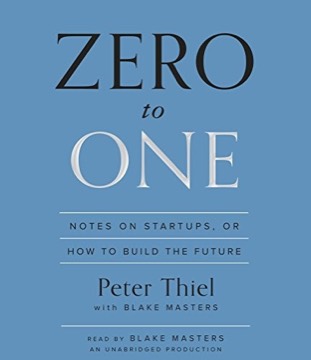
Zero to One
Notes on Startups, or How to Build the Future
Peter Thiel's argument, developed from lectures given at Stanford, is that genuinely new things come from vertical progress — going from nothing to something — and that competition, far from being the engine of good business, is usually a sign that a company has failed to build anything distinctive.
- First published
- 2014
- Publisher
- Crown Business
- Pages
- 253
- Shelf
- Business
- Level
- Entry
- ISBN-13
- 9780753555194
Record checked against
Two sources agreed on 2014; a third reported differently (openlibrary 2001, wikidata 2014, wikipedia 2014).
Catalogue note
- Reads as
- StrategicAbout choosing between options under uncertainty.
- Level
- Accessible / FoundationalNo prior reading assumed.
- Approach
- Applied
- Written for
- Founders and operators, Newcomers to the subject
Saved in this browser only — no account, nothing sent anywhere. My library
Read this if
- You are starting or growing a company and want the unglamorous parts.
- You have to choose what not to do, and want a way to think about it.
- You are weighing options and want a way to think about the trade-offs.
- You are starting from scratch here and want a way in that assumes no prior reading.
The core idea
Thiel separates two kinds of progress. Horizontal progress copies what works — one to n. Vertical progress makes something that did not exist — zero to one. Globalisation is the first; technology, in his usage, is the second.
The book's claim is that the second kind is both rarer and more valuable, and that most business advice quietly optimises for the first. Its provocations all descend from this distinction, including the ones that have drawn the most objection.
Copying what works takes the world from one to n. Making something new takes it from zero to one.
Devmark’s reading — not a quotation from the book
Competition is for losers
The most quoted line in the book is also the most misunderstood. Thiel is not arguing that competition is unpleasant; he is arguing it is value-destroying for the firms inside it. In perfect competition, economic profit is bid to zero, and the firm survives on thin margins with nothing left to invest in anything new.
His conclusion is that a company should aim to be so different that comparison is difficult — and that the ambition to "beat" an incumbent at its own game is usually a sign of having chosen the wrong game.
Monopoly, and how it is described
Thiel uses monopoly to mean a business with a durable, defensible position, not a regulated abuse of market power. He notes a telling asymmetry in how companies talk: monopolists describe their market as broadly as possible to appear competitive, while competitive firms describe theirs as narrowly as possible to appear dominant.
The diagnostic is useful independent of agreement with the thesis. When a company defines its market in a way that makes it sound unique, the definition is worth interrogating.
The four characteristics of durability
Thiel names four traits that tend to make a position hold: proprietary technology that is markedly better rather than marginally so; network effects, where each user makes the product more valuable; economies of scale, where marginal cost falls as volume rises; and branding, which he treats as real but warns is the easiest to fake.
The set is presented as a checklist rather than a theory, and the book is candid that branding without the other three is cosmetic.
Start small and monopolise
The recommended path is counter-intuitive: target a small market you can actually dominate, then expand outward from a secure base. A large addressable market is presented as a warning sign rather than a reassurance, because it usually means the market is poorly defined and already contested.
The canonical illustration is a company beginning with one narrow group, becoming the obvious choice for it, and only then widening — a sequence that looks unambitious at the start and is the opposite in the end.
A small market you own is a foundation. A large market you share is a fight you have already joined.
Devmark’s reading — not a quotation from the book
The power law
Venture returns are not normally distributed. A small number of investments account for most of the return, and the distribution is steep enough that the best investment in a fund often outperforms the rest combined.
Thiel's point is that this shapes decisions beyond investing. If outcomes follow a power law, then diversification as a strategy for your own career or company is weaker than it feels, and the question "is this the single most important thing I could work on?" becomes the right one.
Definite optimism
The book sorts attitudes to the future on two axes: optimistic or pessimistic, definite or indefinite. Thiel's argument is that the modern West has drifted to indefinite optimism — a belief that things will improve without any specific account of how — and that this produces finance, process and optionality in place of plans.
Definite optimism, by contrast, has a concrete picture of a better future and builds toward it. This is the book's deepest and most contestable claim, and it is cultural rather than commercial.
Foundations and people
Thiel argues that the early decisions of a company are unusually irreversible: equity split, founder relationships, and the first employees set a structure that later effort rarely undoes. He is direct about alignment — that cash compensation rewards the present while equity rewards the future — and about the awkwardness of founder disputes.
The related sections on sales are among the book's most practical. His observation is that technical founders systematically underrate distribution because good selling is designed not to look like selling.
Where it is contested
The book is an argument, not a survey, and it should be read that way. Critics note that its examples are selected after the fact, which makes the thesis difficult to falsify: a durable company can always be described as having been differentiated from the start.
The wider objection is political. Treating monopoly as a goal reads differently from inside a firm than from outside it, and the book largely declines to engage with consumer or labour-side consequences. Readers should take it as one person's position, forcefully made.
What it is good for
Read as strategy advice rather than economics, the useful residue is sharp: ask what you believe that few others do; prefer problems where success would be decisive rather than incremental; be suspicious of large addressable markets; and take distribution as seriously as the product.
Its most durable contribution may simply be the habit of asking whether a plan describes something genuinely new or a better-executed copy — and being honest when the answer is the second.
What to take away
- 01Distinguish new from betterVertical progress makes something that did not exist. Horizontal progress spreads what does. They need different plans.
- 02Interrogate the market definitionHow a company draws its market boundary usually reveals what it is trying to hide.
- 03Own a small market firstA defensible niche is a base to expand from; a large contested market is a fight already in progress.
- 04Outcomes are not evenly distributedIf returns follow a power law, spreading effort thinly is worse than it feels.
- 05Distribution is half the productTechnical founders underrate sales precisely because effective selling does not look like selling.