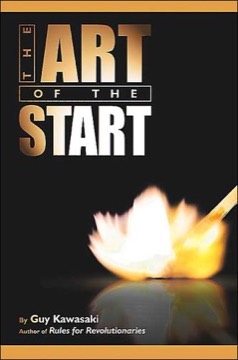
The Art of the Start
Guy Kawasaki's practical handbook for getting an organisation off the ground — written from his experience evangelising early Apple and later as a venture investor, and aimed squarely at the first eighteen months.
- First published
- 2004
- Publisher
- Penguin Group USA, Inc.
- Pages
- 226
- Shelf
- Business
- Level
- Entry
- ISBN-13
- 9781591841159
Record checked against
Catalogue note
- Reads as
- StrategicAbout choosing between options under uncertainty.
- Level
- Accessible / FoundationalNo prior reading assumed.
- Approach
- Applied
- Written for
- Founders and operators, Newcomers to the subject
- Ideas
Saved in this browser only — no account, nothing sent anywhere. My library
Read this if
- You are starting or growing a company and want the unglamorous parts.
- You are weighing options and want a way to think about the trade-offs.
- You are starting from scratch here and want a way in that assumes no prior reading.
Make meaning, not money
His opening position: organisations that endure are built to make meaning — to increase quality of life, right a wrong, or prevent something good from ending — and that money follows meaning more reliably than the reverse.
Kawasaki is a pragmatist rather than an idealist about this. His argument is instrumental: a meaning-driven goal survives the eighteen months of difficulty that a money-driven one does not.
The argument for meaning is instrumental, not moral. It is what survives the eighteen bad months.
Devmark’s reading — not a quotation from the book
The mantra, not the mission statement
His most-adopted idea. Replace the committee-written mission statement with a three-or-four-word mantra that tells employees what the organisation actually does.
The test is that a mantra must be usable by a person deciding something on a Tuesday. A mission statement that requires reading is not.
Get going
His bias toward starting: build a prototype, ship something, and let reality correct the plan rather than refining the plan to avoid reality.
He pairs this with practical advice on the first decisions that are hard to undo — equity split, co-founder selection, incorporation — and the observation that founders spend disproportionate time on decisions that are easily reversed and too little on the ones that are not.
Positioning and pitching
His pitching guidance is the book's most quoted practical content, including the 10/20/30 rule: ten slides, twenty minutes, thirty-point type.
The thirty-point constraint is the useful part and the reasoning is sharp — it forces a presenter to know the material rather than read it, and a slide that cannot fit at that size contains detail that belongs in conversation.
Bootstrapping
His financing chapter argues for deferring outside capital, shipping early, and choosing cash flow over conventional definitions of growth.
The specific instruction — forecast bottom-up from what you can actually sell rather than top-down from a market size — is the most durable, because top-down forecasts are the standard way a plausible plan gets built on nothing.
Forecast from what you can actually sell. Top-down from market size is how a plan gets built on nothing.
Devmark’s reading — not a quotation from the book
Recruiting and evangelism
Kawasaki's background as Apple's software evangelist shapes the middle of the book: recruit people who are infected by the meaning, hire for ability to do the job rather than for pedigree, and treat early users as evangelists rather than customers.
His hiring heuristic — hire people better than you at the thing they will do, and be suspicious of the instinct not to — is conventional and worth repeating.
Rainmaking and partnering
Practical chapters on early sales and partnerships. His partnership warning is the sharpest content: most partnerships are announced rather than executed, and a partnership without specific deliverables, owners and dates is a press release.
He recommends judging a proposed partnership by whether both sides would do it without the announcement.
Where it is dated
Published in 2004 and revised in 2015, and the context shows. The funding environment, the cost of building software, the channels available and the role of social platforms have all changed substantially.
Several chapters address problems — raising a traditional venture round, building a physical distribution partnership — in forms that have since shifted considerably.
Where it is thin
It is broad and shallow by design: a checklist book with short chapters and practical exercises rather than an argument. Nothing is examined deeply, and there is no evidence base beyond the author's experience.
It also reflects one temperament — energetic, promotional, bias-to-action — which suits some founders and misleads others, particularly in businesses where being early and loud is not an advantage.
What survives
The mantra exercise, the 10/20/30 rule, the bottom-up forecasting discipline and the partnership test are all still useful and all still uncommon.
Read it as a first book rather than a deep one: it is most valuable to someone who has not started anything before and needs a checklist of what the first year will actually demand.
What to take away
- 01Write a mantra, not a missionThree or four words a person can actually use when deciding something on a Tuesday.
- 02Guard the irreversible decisionsFounders over-deliberate the reversible ones and rush equity splits and co-founder choices.
- 03Thirty-point type forces knowing itA slide that cannot fit at that size contains detail that belongs in the conversation.
- 04Forecast bottom-upTop-down from market size is the standard way an entirely unfounded plan looks credible.
- 05A partnership without dates is a press releaseJudge it by whether both sides would still do it with no announcement.